Sunday, 17 April 2022

Successors on the thin side

 I have been smitten with the construction of ancient armies using the Wargames Atlantic skeletons and did some as Celtic Ancient Britons.  The WA sprues are obviously designed with a Hellenistic Greek flavour in mind containing pike arms which so far had not used. Pikes were used by the later Successor armies of Alexander fighting the incursions of Celts ( “Galatians” ) and even employing elephants.   Hmm, that’s kinda cool, and allows me to pick a third different army to play! I had a 3D print of a Woolly Mammoth printed which I then modified mainly by the tusks (I could not find a plastic skeleton model - at least to scale…) and begged wargaming friends for some spare ancient Greek type plastic parts who kindly provided enough to fill a 24 point Dragon Rampant force (thanks David and James!).  


The 3D print was extremely poor so needed to literally pore a bottles of liquid Super Glue over the model to prevent it from layering away as I stripped off the supports. Uggh!! Luckily avoided gluing my fingers together but certainly swore a lot in the process!  The purple cloth over the mid-section of the elephant seemed to be a common feature of the Hellenistic elephants - or at least to the modern illustrators and sculptors - and was needed more on the left side than the right side to cover the gap from missing ribs as the model was breaking apart in my hands! I needed to re-sculpt major portions.  

The model was a good in design however as the thin howdah could be removed and a more substantial one built on the flat surface with styrene sheets and corner pieces. The large Greek shields give more ‘identity’ to the model.  Finally, I added the thick ropes holding the fighting compartment onto its back with green stuff.  

The cavalry were constructed again with horses using melted down plastic sprues to represent the decomposing flesh.   Full torsos for the riders were used needing only to add skeleton arms, legs and, some helmeted heads.  Not really natural poses (They started as infantry and it is really tough to glue on stiff legs into place while also imbedding in a still curing green-stuff saddles!  But heck, these are the usual uncoordinated muscle-less skeleton dudes!)   Added the flowing capes from a medieval set and gave them a bit of color as being the elite Companions.  

Along with those figures for the collection, I made a temple out of styrofoam and wine corks while watching sports on the tube.  A thick layer of watered-down PVA glue (White Glue) gives a good hard coating and nice surface to paint.  

Roman Auxilia protecting the temple
Celtic chariots moving past the old 'white marble' temple
The Successors advancing on, rather a-historically, Imperial Romans in a recent game using a three-way fight scenario. The Galatians/Ancient Britons are facing more Romans on the other end of the table. The two would-be allies then fought against each other to a draw with the remnants of the Romans looking on....

I think I have now throughly quenched the ancients builds and currently have yet another British 1812 unit on the paint table.


Thursday, 31 March 2022

the original French Zouaves


The famous Zouave military unit of the French Army started as a tribal enemy to the French occupation of modern-day Algeria in 1832 but within only a couple of years they were recruited. Its original commander designed the distinctive uniform based upon the tribal dress which, interestingly, did not much alter for another 150 or so years.  The ethnic makeup of the unit soon became all French in nature, but the uniform remained quite standard.  I am showing the earlier dress which included the green turban for the 2nd battalion.  The 1st wore a red turban; while later years had the turban in the well-known white as this had less a Muslim connotation.  The leggings are portrayed differently by various illustrators, but I went with black as this is a bit different than the usual brown leather look.  I am using the Perry ACW plastic versions which are modelled after the famous American 5th New York Volunteers who, in turn, modelled their uniform very closely to the French version.  Thus I only needed to modify the round American canteen into the black leather water carrier of the French (albeit of a slightly later era to be honest) and remove all the oval Union Army buckle badges. A common trait of the French of the era was to cover the ammunition pouch with a linen which I mimicked to give them that much more not-the-American-version look! 

Here they are somewhere in North Africa with a French occupied village in the background.  


Thursday, 24 March 2022

A Canadian colonial clash

 The Battle of Batoche, 1885 

While the famous American conflicts against the native populations of the ‘West” were almost over by the time of this battle, Canadian expansion into the Prairies was continuing apace.  In the area of Saskatchewan, the indigenous Cree and Metis ( a mixed race and culture of farmers and hunters of French-Canadian and Native inhabitants ) were feeling the pressure on an ever increasing eastern homesteader possession; with Louis Riel the ‘spiritual’ leader of this very autonomous people. History has called this conflict ‘the Northwest Rebellion’.

While a few other major skirmishes had occurred, it was at the village of Batoche in modern-day Saskatchewan, Canada that the decisive battle to end their resistance to this pressure was backed by the military of the Canadian government which rested upon militia units from the eastern provinces.  These units made up of civilians were certainly enthusiastic enough but inexperienced.  The few Metis were often good shots and very experienced in ‘field craft’ but ill-supplied.  

Faced with the Canadian advance upon their ‘capital’ village, the Metis built small, effective and well disguised, three-man rifle-pits blocking the plodding Canadian advance by Frederick Middleton.   

The Metis rifle pits.  The figure within are Brigade Games Boers without any alteration.  Period photos show the Metis in similar attire.

What is interesting about this whole affair is the decisive battle was a prolonged four-day affair with only some 24 dead and 76 wounded total from both sides from the 1,166 engaged (Wikipedia). With my calculator at the ready, this is only just over 8% casualties over a lengthy 4 days. With an eight hour ‘work day’, this would have on average 1 casualty every 20 minutes or so.    No Somme, Cannae, Shiloh, or Little Big Horn here.  But with that, most rulesets have great clumps of miniatures removed from firing and combat.  Obviously this will not do.  However my new, go-to rule set of “The Men Who Would Be Kings” (a colonial set by Osprey Publishing) could be modified to accommodate the lack of casualties but still have units pinned, unable to effectively operate and have ‘morale’ issues to prevent much activity.  One other aspect of the battle was the ever decreasing ammuntion supply of the Metis.  They simply did not have the supplies needed.  Their fire had so decreased by the fourth day, along with the withdrawal of many who had given up the fight, that the Canadian soldiers frustrated by their commanders slow activity took it upon themselves to charge the Metis rifle-pits thus ending any further Metis resistance. 


The 'TMWWBK' rules are adequate but for two small changes.  First, any casualties would be limited to one per successful firing regardless of the actual number of hits. Pinning, not casualties, would be the important issue.  Secondly the Metis would set up in the rifle-pits designated as ‘hard cover’ and combined with their good-shooter ability and the Canadian militia poor firing, will have the unequal shooting which occurred.  However, the Metis ever decreasing ammunition supply would be handled by giving them a secret die roll (from the Canadian player) how many shots they would be allowed. I gave a 1d6 roll per rifle-pit;  but each day would see that amount decreased by one. Thus at best the Metis would have only 50% firing minus any further casualties or abandonments in the final phase of the game.   The Canadian player might see less fire power but would be unsure of the amount remaining thus continue with caution which was the trademark of the engagement.  

A “day” ( the historic battle lasting four days) would be 8 turns in length.  The Canadian player must have overcome all resistance to win.  If at the end of each ‘day’ (the 8 turns) and the terms of victory not met, the ‘day’ is over and the action pauses.  Immediately in the ‘morning’ the players can reposition their units with their morale afresh  (minus previous casualties of course ) in any new attack position along the start line for the Canadians or any available rifle-pit for the Metis.   

a Canadian Rifle unit in a staged photo.  During the game they did not reach this close to the Metis rifle  pits!

a red tunic clad Canadian militia unit. Indeed, some of the units sent by the Government, were still to wear their dress uniforms including the Home Service uniforms  

The TMWWBK rules are interesting as activation and morale are key aspects but can be very dice fickle.  The resultant lack of action and easily gained pinning effects are perfect for re-creating this battle. The photos are from my second solo play-test.  

The Canadian Militia, whose dress was very much influenced/copied that of the British home country, were in either contemporary rifle-green or red tunics.  As far as I know, the only source for miniatures are 1980s RAFM miniatures.  These are small “true 25mm” very stiff in posture and lacking multiple poses.  Thus I needed to create my own and used Perry Union ACW plastics. While not completely accurate, they do look the part and I needed to only to remove the oval badges and green-stuff the glengarry caps or, in some cases, add a Perry ‘Home Service’ helmet head.  (indeed some units wore these! )…. oh, and a different paint scheme, of course.  Much of the militia had no other uniform for campaign but their full dress version.  

The Canadian uniform of the era

The very dark green - almost black of the Rifle Regiments. I highlighted a dark green over a black base color on the miniatures.  

the model within the Park Site's pavilion 

I built my model rifle pits on this example.


Tuesday, 22 March 2022

War of 1812 mini quiz

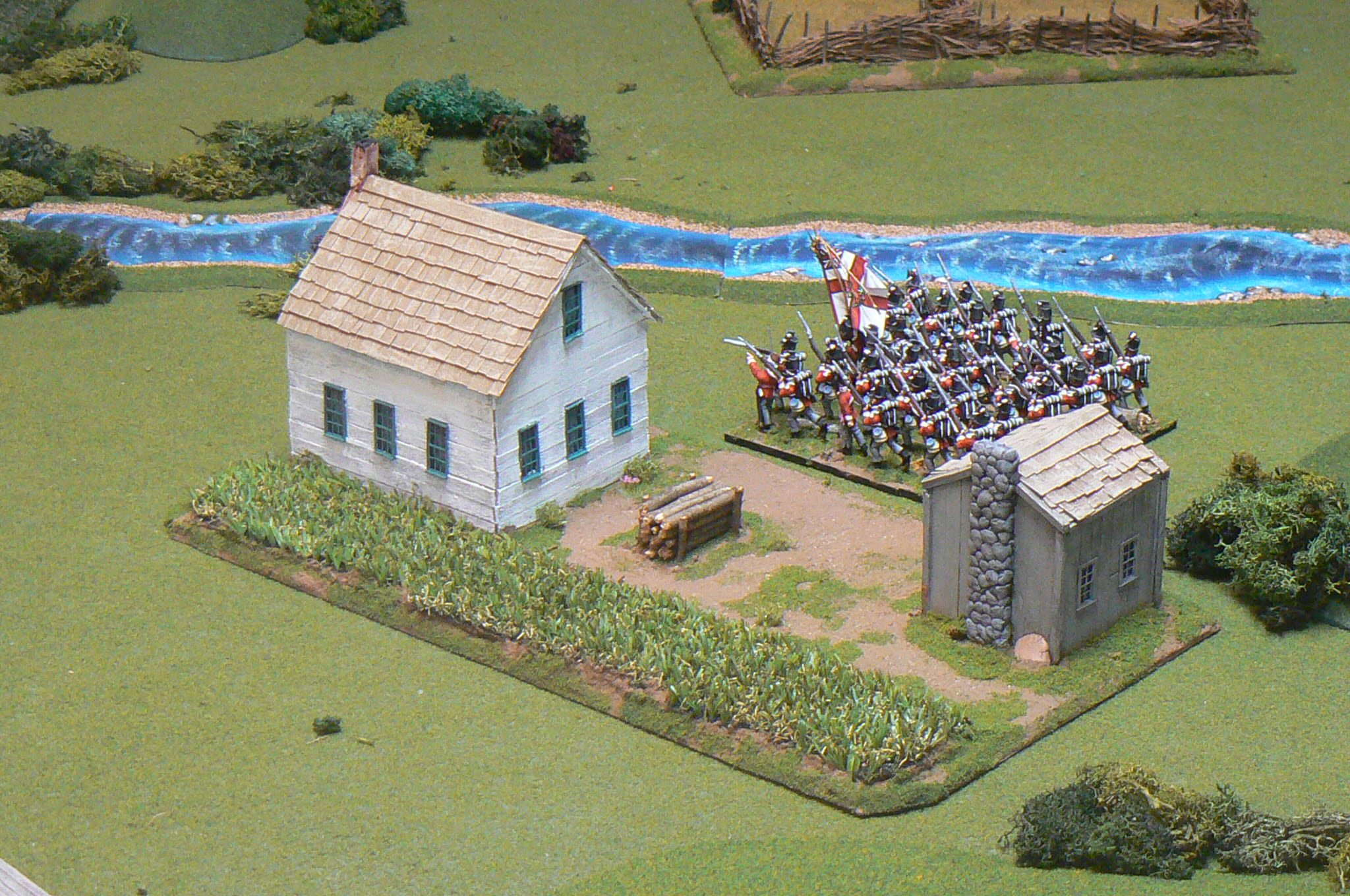
 Way back, I started this blog with posts on the War of 1812 as that was my current interest at the time. As followers of this blog know, I am interested in the military history and the modelling of MANY different periods and subjects.  Well, I finally sought to bring out the old War of 1812 units and randomly picked two from storage.

Old Glory British line in the foreground, Knuckleduster American Frontier Militia in the background
The flags are hand-painted, obviously, but do offer clue to the answer of the quiz.

Can you name the two British units with their unique flags?  You can place your guesses/confirmations in the comment sections.  Bonus points to disclose what these two units have in common within the British army of c.1814, the year of their involvements.


Saturday, 19 March 2022

Ancients down to the bone

 Historical Skellies!  

Not favouring any of the many potential fantasy versions of skeletons, previous posts demonstrate my historical versions of skeletons as Imperial Romans and Ancient Britons (so c. 43-70 CE) in their tabletop fights for control of Britannia.

The massed legions moving through (well, ok then...) WITH a ruined temple

The painting was simplified by the use of ‘bone’ coloured primer so only required a wash of Army Painter Soft Tone to give them definition. Muted colours and rust or patina on the metal bits provide the “been in the ground for a while” look. Note the two legionaries emerging in the foreground of the photo.

The Roman Auxilia unit.  Their former bases having been removed now have the honour of becoming their shields.

Roman auxilia archers

Hard plastics, in this case those from Wargames Atlantic, provide a great medium on which to glue the extra bits of helmets and shields which are offered as optional extras on the more fleshed out sprues of the historical models by the other plastic manufacturers. 
Ancient Briton massed Warriors

Chariots of the Ancient Britons 

The battle is on.


Tuesday, 15 March 2022

Sinai 1918

'Middle East' during WW1

This “campaign” started when Craig and PeterM played in my WW1 Middle East game using the soft plastic 1:72 scale figures I had painted a few years ago (almost an only one colour and a quick stain job).  Haven’t even done anything with the bases and only painted them a ‘desert’ colour.  The trenches are just self-hardening clay with a quick 'sand-bag' pattern scrawled into it. The terrain is very simple, usually only a piece of felt placed on the tan-coloured wool blanket.  Not very attractive to be honest     ( or at very most 'old-school' ) but the boys had so much fun that we have turned this into a regular meet playing out games using a selected roster of troops …this mostly determined upon how many and of what type I have had painted for each side! 

The final battle of the first campaign stage.  "Battle for Gaza". And yes, the Allies did have tanks (only eight, mind you) for the campaign for a brief period before being recalled to the Western Front.  Some were lost to Turkish fire including one of my models as can be seen.

Australian Mounted Rifles

After each game, we spend a delightful time (for us) analyzing the numbers and changing the rules for the next game.  The rules are the fantasy set “Dragon Rampant” for the stats of each unit employing the basic mechanics which satisfy our needs well. 


Sunday, 13 March 2022

Lord of the Rings 'urban' game

LotR game

It is simply from osmosis that I have any knowledge of the Tolkien worlds as I have never read any of the Hobbit or Lord of the Rings books.  Nor have I watched any of the movies except some random battle scenes so CGI’d and of such ridiculous tactical maneuvers that I could only go ‘pfft’.  This puts me much apart from one of the gaming groups I venture with.  They can happily ramble on about all the details.  When I dare to comment that they could use different colours to paint differently than what either GW or Peter Jackson have envisioned, I am met with such derision I might have said the British Army never wore red in the entirety of its existence! Such is their history of this fantasy world.

Yet I can play in LotR games. Don’t particularly like the rules, but an armoured guy with a spear is basically the same whether Orc, Gondorian or even a Medieval Yeoman for all that.

In this, once again with a “go and kill” scenario idea ….sigh ….I was one of the “good guys” against the bad guys.  It was ‘the army loses at 50%’ victory idea with both sides close to that at the end of evening.  However it was a nice looking and, for this fantasy world, a different urban environment set up by ChrisO.  

The figures and terrain are theirs (a collaborative effort). 


Thursday, 10 March 2022

Samurai!

 Samurai!

With the club once again opening up for participation, decided to take my Samurai with some basic terrain.  I laid out the terrain in a haphazard method, placed troops on the table only in their clan grouping without any respect to tactical positions, and said to the players your troops start in those positions and gave the terrain descriptions ( this and that are rough ground, etc. )  Quickly looking around the table, I then gave them the briefest of objectives ( which turned out to all converge upon the village centre as I soon discovered ) and had them to it.   So much for careful scenario design, eh? Still better than the 'kill the other guy' routine.

Pictures from the game:


Added a small contingent of Europeans to the collection.  Perhaps rather un-historical but adds to any scenario design as mercenaries if needed.

The 'sacred white stone' in the centre of the village. (Hey, I found this interesting very white stone in the gravel and so gave it its own sitting stool. Very Zen. And a scenario objective. )

a rare picture of the Peasants. They are usually slaughtered early in the game, usually within the turn of first combat!  Nice Perry figures nevertheless.

Wednesday, 23 February 2022

Snow play on a snow day….

The surprise snow we are receiving tonight has reminded me that I had not yet posted this game from many weeks ago my wife agreed to play a wargame with me (!!) - to be honest probably due to her boredom from being ‘trapped’ by all the snow our city had received the time! The simplest game I could develop was, ironically, my “Retreat from Moscow” - yes, the one with all the snow terrain! This game  is for the convention setting with all units each on large easy to move and measure circular bases, a very easy-to-digest rules (trimmed down Rampant style), and a straight-forward ‘get to the other end’ scenario. She and I played the parties of remnants of Napoleon's Grand Armee facing angry peasants, Cossacks and Russian regulars, with the occasional wild animal - all with a very random placement and action charts which does make for some interesting actions. Hopefully the use of clear or white dice and unobtrusive markers does not take away from the snowiness of it all.
overall table design.  A white table cloth forms the snow terrain
all the units are now on large circular bases which make moves and ranges very easy to calculate.  The game is very much designed for the convention setting.
Look out horsemen! The wolves are on your flank!

Tuesday, 22 February 2022

100 Years War grunge match

Prologue: Well, they are finally painted! I have had these very old Gamesworkshop 'Brettonian' knights ready to paint for many, many years. I have an old post of them still in black primer from 2016  (see: previous post ) I recently added embossed shields from Fireforge which emblems matched some of the headgear of these knights. These shields make painting of the knightly "logo" much easier.  The use of crested helmets did continue to some degree during this period, and the Osprey edition on Crecy and Poitiers illustration plates certainly show them, so I don't think they are too far off the historical track <wink>
Introduction:  After The Battle of Crecy in 1346, the French nobles felt the English with their ‘crooked sticks’ didn’t fight fair, so they want another go at it. 

 So in the blue corner weighing in at 24 points we have the contenders - the French - with three ‘Battles’ of knights on steeds with the help of "Genoese" crossbowmen.
And in the red corner also weighing in at 24 points, the defending champions - the English - with two groups of 'elite' longbow archers behind stakes and a group of men-at-arms together with a group of yeomen spear.
Unlike the first match at Crecy, we are giving "the Genoese" their protective pavises and not having any muddy ground to hamper French movement. These two factors are used to account for the historically overwhelming English victory. Round One: Deployment of the crossbow and archers was at maximum 18” for both. The English longbow shot first but the crossbow morale withstood both lights of arrows and they returned fire causing casualties but no discouragement from the English. Historically, the French knights grew impatient and charged through their crossbowmen. To account for this, I rolled for their movement. If successful, they would move through the crossbow into charge ranges, if not the crossbow would be allowed to shoot, softening up the English. But the impetuous French knights being who they are….. Round Two: Those "Genoese" who avoided getting trampled, moved into a tight group to avoid the advancing knights who, despite casualties from the archers, launched into the more respectable opponents of the English men-at-arms and spearmen; and while the spearmen were pushed back, the men-at-arms of foot held fast and the French mounted knights fell back to regroup. Unfortunately for them the archers, still untouched, launched volleys of arrows into them finally cracking their numbers and spirit. However their sacrifice allowed the reserve knights to move into charge range without casualties.
Final Round:
The French knights (or more the fact, their horses) avoided the stakes and attacked a more chivalrous target in the English knights on foot, and while pushing back the English, opened themselves to be a target of the archers who shredded them. Addendum: important rules which I forgot to employ were the stakes while offering extra armour for the archers cost 2 points which would not allow the archers deployed behind them to be ‘expert’ and shooting better; with the result the French knight gained more casualties than they should have skewing the battle result. Thus the need to rewind. So Grunge Match #2….. The historically numerous deployed Genoese would have spread across the who breadth of the French line but "Lion Rampant" rules prohibit such deployment. This tightening of frontage allows the French knights to avoid the crossbowmen rather than riding over them into a position to charge the English.
My dice rolling came into effect which did not allow the English bow to fire over two turns (!) allowing the French knights to charge without casualties. The Right ‘Battle’ of French knights avoided the stakes to crash into the English spear knocking them back. The crossbowmen, with clean sights, routed the longbow. The Left ‘Battle’ of knights charged directed at the longbow despite their protective stakes and pushed them from those obstacles. The English men-at-arms on foot, could and would advance into the milling French mounted knights getting the better of the fight. Emboldened, they would later charge at the crossbow knowing that should they await the French, the crossbow would merely shoot them down as they stood. However the crossbowmen do know their trade and punctured the English knights as they paced forward. The English, no doubt seeing the further array of the French knights behind the crossbow pavises lost heart.(*)
The English archers while heroically withstanding attacks of the French knights finally succumbed to these armoured warriors. The English army was no more. Crecy revenged!

 (*) a decisive victory made more impressive that a third of the French men-at-arms, the knights in reserve, failed every move roll (!!!), got nowhere near the fighting thus could have been fresh for any further contest.