Showing posts with label Waterloo Project. Show all posts

Friday, 17 July 2020

Napoleonic Baggage.


“Napoleonic baggage” is what he brought to his marriage to Marie Louise….
…or perhaps the necessary wagons on which an army must exist.

Needing models for both the grand game and the newer smaller focus of all-cavalry actions, I based both horse and wagon onto thin bases, but then created the thick bases of the grand game for attaching them temporarily.
These are my Dutch-Belgians of the ‘Waterloo Campaign’.  The horses are Essex, the riders plastic conversions, and the wagon is of MDF wood from Warbases.
The double team looks better for the smaller scale game while a single team - below- is more representative in the larger scale game 

Sunday, 11 August 2019

The big battle style....


The previous post had a 6mm big battle which each element was brigade strength.  My Napoleonic rules employ a similar ratio but using 28mm figures (but obviously fewer of them for the ‘footprint’!)
Here are some pictures of a Waterloo refight done a while back.  The area of this game would be but a square foot or two on Kevin’s table, but I assume (due to being a historical refight) all the fun maneuvering has already been done (all the corps been committed to one area of the countryside or the other like Grouchy and Gerard's) and the true tactical fighting is to begin……
Looking from the north-east 
the view Napoleon might have witnessed
and that of Wellington

Tuesday, 18 June 2019

Happy Waterloo Day

To everyone,
Happy Waterloo Day!!
the two hundred and third edition.....

a photo from the perhaps ninth game (!) of the Battle of Waterloo (1815) with deployments per the historical example on a element = brigade level. Very hard for Napoleon to win in any event.  In all those games (and most had excluded or reduced the Prussian involvement) only once did the Allies lose and only because the "Picton" player did a very foolish thing and charge over the ridge and into the grand battery AND again the Prussians did not arrive.  While a French victory it still could have gone either way; so hard one for the French to be victorious.
my 28mm Napoleonics - mostly Perry Miniatures

Anyway the 'Battle of La Belle Alliance' (as it SHOULD be known but Wellington was, of course, SO obnoxiously British....) is always a favourite to play.


Monday, 4 March 2019

Plunder, sir!

I love the movie "Waterloo" (1970) I was very young seeing it for the first time but already I was a confirmed military history buff.  I still think it a very good movie for the accuracy of the uniforms, history and even the acting portrayals of the characters. (Having read some of Napoleon's letters, his 'ranting' on screen is not far off the mark!) Alright, the terrain of the Ukraine is not correct for the battle site but can't have everything! The famous building important to the battle were good however.

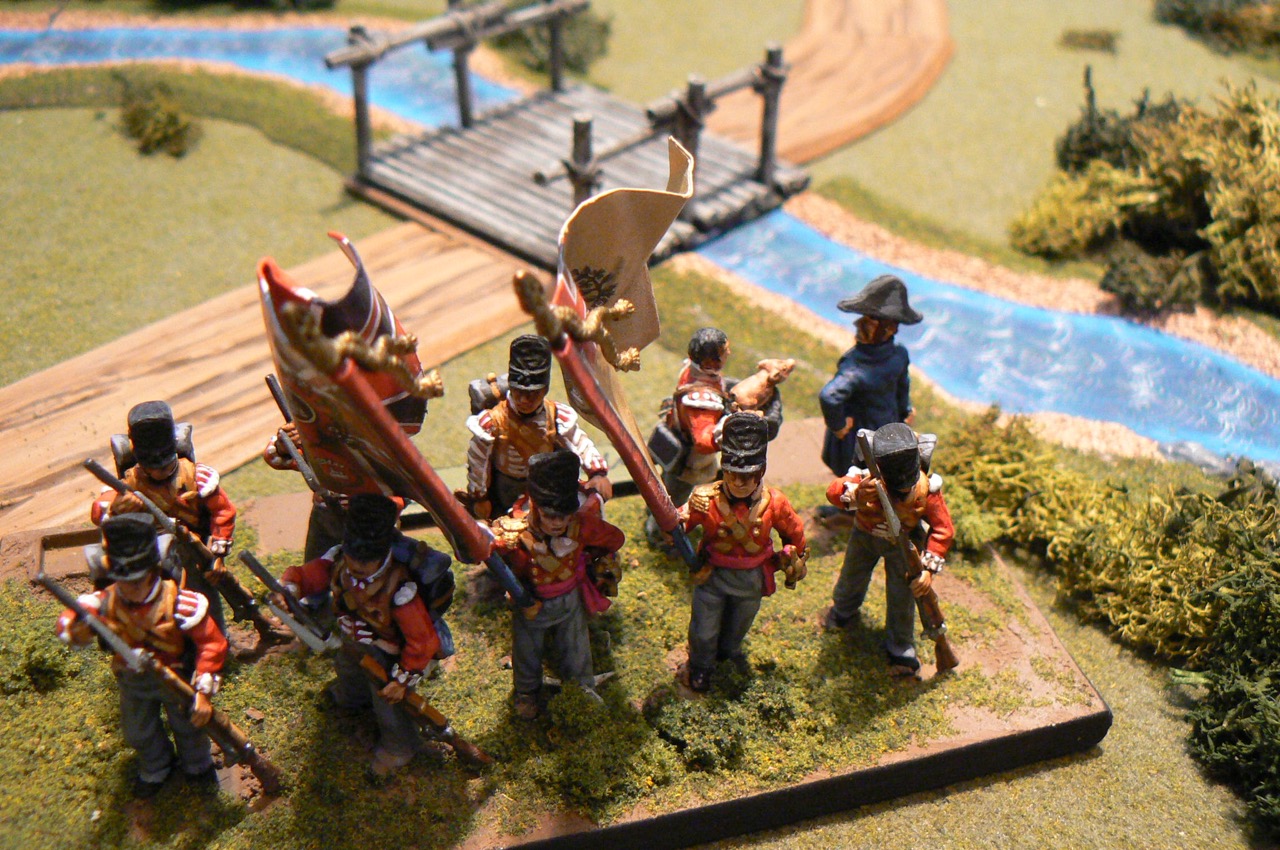
One of the humorous scenes is when Wellington questions a soldier of the Inniskilling Regiment about the contents of his pack. The soldier had just plundered a pig and sought to defend his hopeless position to the commander-in-chief.

Wargaming mate, WillB, won, as the club door prize, the Warlord figure done for the Historicon 2015 convention and was kind enough to present him to me.  I just HAD to do it up quickly!

I put it in behind my element of the Inniskilling which represents Lambert's Brigade.  'Wellington' is a Essex French officer of which I heavily carved the bicorne to more represent the distinctive curvature of the headdress.
"I knew something queer wa' scratching me back..."
The Inniskillings is my representative unit for Lambert's Brigade at Waterloo


here is the scene from the movie:
link to Youtube movie scene


Thursday, 2 August 2018

General Grouchy

I recall one of the players during a playtest of the Battle of Wavre awhile back humorously complaining that his wife must have had told me give him "Oscar's" forces upon looking at the command labels.  No, not grouchy like the Muppets' character ,  nor even a military person of a poor disposition, but the commander of the French Army's right wing during the 100 Days Campaign.

The most famous story of his career is one that he did not march to the sound of the guns of Waterloo but continued, as per the instructions he understood, to pursue the Prussians. The story goes that he was casually eating strawberries as Gerard, his corps commander, demanded that he march to Napoleon.

It is from this event, that I used two of the Perry Generals to image this exchange.
The muddy track of that day is apparent.  The square frame is to include a small die for game purposes. I think the raised fist and snarl of his face gives the right effect to Gerard's anger over Grouchy's decision.  
the other signpost reads "Waterloo" ...of course....


Monday, 18 June 2018

Happy Waterloo Day!

I almost missed this celebration, one of my biggies of the year....
How could I?!
British Life Guards clash with French Cuirassiers

This most famous of battles was my early interest in wargaming, probably after viewing the movie "Waterloo" (still a great movie for the Napoleonic crowd)  My first historical book, that of the battle, is still in my library some 47 years later.  I remember discovering it, with all the pretty pictures, at a used book store but not having the money to purchase it; waiting a full week until I could get back to the store; hoping beyond hope that it would still be there during all that time. It was, thankfully.

So Happy Waterloo Day and hope your Napoleonics painting or game will be that more fun for it.


Wednesday, 25 November 2015

Battle of Ligny play

The Battle of Ligny was a major battle of the 100 Days/Waterloo Campaign of 1815 between Napoleon's Armee d'Nord and Blucher's Prussians.  Fought at the same time as the better known Battle of Quatre Bras (trans: "four-arms" or crossroad) no doubt due to the British participation.

Having played the game five or six times now, these photos I found were archived from much earlier in the year.  I don't remember if they were 'published' yet, but I find the battle is fascinating and learned much from the re-creation on the tabletop.
The battle looking from the northwest.  The villages form the Prussian defensive line. Pirch's Prussian corps is on the left moving through the line of trees.  In the background, Milhaud's French cuirassiers are being moved up

Blucher needed to hold the left flank of the British-Allied army and understood, well, perhaps his Chief-of Staff understood.... that the crossroads would be a key to the French advance as so needed to hold at Ligny.  His dispositions reflected the defensive stance as the small but marshy Ligny stream afforded a nice line.  But that line was also convex and thus would allow the French artillery to converge fire upon the Prussian reserves.  In our games, much of the Prussian losses came from this fire.
Ziethen's Prussian Corps in the 'cauldron' formed by the Ligny stream and the line of Belgium hamlets along its length.

However the French still needed to take the towns along the stream as these afforded the only passage across.  The village of Ligny was the largest of these hamlets.
Gerard's French Corps ready to assault the village of Ligny

The eastern half of the battle, historically, had little fighting.  It became obvious during the previous playtests, that the 'Grouchy' player, commanding the French forces of mostly cavalry could not assault the eastern most villages and the Prussian player was not willing to abandon his nice defensive positions to move out to the open ground to be attacked by the French horse.  Stalemate.  In this game, I did not portray this side of the battle as it is but boring for those commanders.
Vandamme's French forces line up in support again the hamlet of S. Armand la Haye.  The artillery in our rules can fire through friendly troops.  The multiple batteries the model represents are to be considered spread among the individual units which the bases represent.  The wheel marker has it moving during this turn and so firing is compromised.  Not all the batteries are in position yet, it is assumed.

To be honest I can not remember which side won the game, but it is hard slog for both sides and, as in history, affairs can be influenced by the smallest of events. A few more good dice than the other side and enemy units collapse and victory achieved.

Wednesday, 17 June 2015

Battle of Ligny 200

Well of course I will have to host Ligny 200 being June 16th, 2015 and all!

Yes, the game could have been it's counterpart of Quatre Bras as I placed that battlefield on the other half of my 12 foot long table and if enough players we could have done both at the same time!  But alas, only four could attend; with BobS and his side kick Ian rolling (even vs odds...) to take the Prussians (Ziethen and Pirch respectively) and new players to the rules Peter and Morgan taking (Vandamme and the Guard; Gerard and Milhaud respectively).

The battle historically was vicious town fighting and lots of artillery fire and this game was no exception with the Prussian's defensive position a cauldron for French artillery fire.  It is a also a very tight battlefield of only 2 and a half miles (4 km) or so where the main fighting occurred.  This translated very well to the tabletop and while the Prussian players complained that there was no maneuver room, and I agreed showing them several maps of the deployment corresponding to the tabletop. Our brigade big bases always translate well proportionally to the deployment maps.
The Prussian "caldron" with Ziethen's corps deployed and Pirch's Corps aligned behind the row of trees. The troops in the upper right (north-east)  of the photo shows elements of Thielemann's corps which I did chose to represent as little was fought due to the terrain and deployments in this area of the battle 

 Ziethen in the fore and Pirch in reserve well behind him and Ian rolling rather poorly for his movement initiative, the French artillery started to do execution on Ziethen's corps.  Peter's slowly developing attack by Vandamme, and Morgan's assault by Gerard on the village of Ligny, whittled Ziethen down until an unfortunate '1' roll on the Corps had him break.  Luckily Blucher suddenly aroused from his slumber extorted Ziethen's men to greater dedication "No retreat, no surrender!!" and provided that commander enough morale to at least hold on.....  or in other words I stepped in as umpire I used nearby Blucher as the excuse to arbitrary give him a few more pips on the Corps Morale so to give him hold orders to continue the game!!
Ex-Berg troops still uniformed in white with officers and some of the troops in regulation Prussian uniforms.
Gerard's corps march upon Ligny

Ironically, BobS would continue on until the French now worn down from their attacks and effective counter-battery fire from both BobS and Ian's Pirch artillery which managed to more up, had them on the brink of loss. Morgan's Gerard's 4th Corps had taken Ligny but destroyed itself doing so and could not get any more infantry to open up the town for Milhaud's cuirassiers to pass.  The Young Guard took St Amand but were weakened in the effort.  Vandamme had some losses but many of remaining elements were dangerous low combat effectiveness.

 On the Prussian side, Ziethen will collapse soon (again...) and Pirch could not defend most of the towns and so allow the fresh French Imperial Guard to move at will.

Napoleon did not get his great victory as he wanted in 1815 and nor did he in this game of 2015 but the Prussians were pounded as well. Hard fought indeed.

Thanks for boys arriving and giving a good game.

  
Prussian artillery 'moving up' (the large wheel marker representing it's limbered state)  Nicely dramatic gun crew by Perry Miniatures.  


Friday, 29 May 2015

Battle of Waterloo - Enfilade 2015 - the player's deployment

Having completed the historical affair, we reset for the "what-Napoleon-could-have-done-with-his-deployment" game.

French Commanders:
Ron - Lobau,  Reille and Milhaud
Doug - D'Erlon with detached Guard guns
Bob - Druout and Kellerman

Allied Commanders
Stephen - Perponcher and Picton
James - Uxbridge and Prince of Orange
Seth - Clinton and Brunswick

Having a better grip on things, I recorded the players and their commands, and as was playing this time, had a bit better grasp upon the events.  But only a bit better mind you.
The view high above the Allies right flank from the west.  For those viewing from the upper bleachers, Hougomont is in the near middle with La Haye Sainte, and Papalotte in the middle and upper middle respectively.  Allies to the left, French on the right. 
Milhaud's Cuirassier Division deployed just to the east of La Belle Alliance 
For this battle, James took the Allied commands of Uxbridge and Prince of Orange while Steven, our newest "recruit" and fresh from deployment in Afghanistan and in his second game, took Perponcher and Picton, with Seth taking Clinton and Brunswick's forces.
The French were Bob with the Guard and Kellerman's heavy horse; Ron with Reille, Lobau and Milhaud and myself with D'Erlon and much of the French artillery.

The French planned to have the Guard swing around Hougomont to assault the Allied right flank rolling it up along the crest line while Lobau's corps will take on any reserves in the area and D'Erlon will  hold the attention on the Allies left with pinning attacks and heavy artillery bombardments.
The left wheel punch by the French but the Allies still holding the ridge ( represented by the road ) as it is difficult to coordinate combined arms attacks in the confined area this battlefield offers.  No doubt in the back of Wellington's mind.
Reille's forces under Ron's command.  Both he and I had very poor dice luck this game.
The French plan was perhaps good but our dice luck was extremely poor.  I rolled four 1's in consecutive turns for maneuver and thus could not bring up much of my numerous artillery to any thing like full effect ( I guess the ground was STILL muddy ! )  and even with hits, these were brushed away by equalling rolls by the Allied players.  Sigh.
The Allies withdraw from the crest to avoid the French random artillery fire - ineffective as it proved firing blind over the crest line and unable to maneuver to the crest.  The columns of French moving seemingly without much enthusiasm due to my pathetic dice.
On the French left, the Guard detached half of the Young Guard and a portion of the Old Guard to screen Hogoumount from their advance, with Kellerman's cuirassiers sweeping out around the French left. As they approached the ridge, the Guard cavalry took advantage of several mistakes on the part of Clinton and beat back the Foot Guards from the crest line, combining charges with barrages from the Guard horse artillery and bayonets from the Young Guard. Though they were pushed back quite a distance from the crest line, Clinton managed to re-organize and establish a new defensive position a short distance away. As Clinton was being pushed back from the ridge, Kellerman's cuirassiers found the Brunswick infantry exposed in open ground outside of Braine L'Alleud.   Brunswick attempted to stem the tide of cuirassiers around the allied right, and in the process made a powerful claim to assume the name "Die Hards" from the Battle of Albuera fame. Despite catastrophic losses, the Brunswickers refused to quit the field, merely falling back to a position where they could support and be supported in turn by Clinton's Foot Guards. At this point the French center and right had been pushed back from the ridgeline, and the assault was largely spent. The screening force around Hogoumont was still fresh, but likely too little to late, and the French acknowledged that the First Empire had likely well and truly run its course.
Lobau's Corps.  The green labels can be removed and replaced with other commander names for other scenarios. The black dice record combat effectiveness.  Paperless. Just the way I like it!
The French left earlier at the start of the battle before it went downhill :-))
The Allies kept commands tight, unlike in the historical affair.  One does wonder about Wellington's command structure, and it would suggest he allowed all his commanders only local control and was predicated on the idea that he would arrive in time to control in any disaster. It seemed to work however.  The hand is moving the Dutch 6th Hussars representing the Merlen's Brigade of light horse.
One of my infantry brigades in square - note the cube marker on the right - having bounced the Netherland horse (in the distance ) but now about to receive close fire from the Royal Horse Artillery supported by the Belgian heavy horse et al.
the action from Action 5 News 'copter!


Like the veterans of Napoleon some thirty further years into their lives as old men looking back at the good-old-days, we wargamers remember only the glory of the battle, won or lost, on the war-game table some days after the event.


Wednesday, 27 May 2015

Battle of Waterloo at Enfilade 2015 - historical deployment

With our small but dedicated band of our homegrown GdC rules devotees in place we started out Friday gaming with the historical deployments for both the Allies and French.

French Commanders
Dave – D’Erlon and Milhaud          
James – Guard (Druout) and Lobau      
Bob – Reille and Kellerman

Allied Commanders
Stephen – Clinton and Prince of Orange
Ron – Uxbridge and Perponcher
Rod – Picton and Brunswick

Seth and I were the "umpires" and helpers.

 Of course we did have the occasional person wander by to ask which battle it was.  Ah! was the reaction when they could view the deployments from the south; that is from the view as the French facing the upper part of the field in the same orientation which most maps portray the battle!

As I was still quite flustered from the drive down, the set up and various missed items and having to get all the guys up to speed on the new variations of the rules, along with all the early adjudication of play, I must admit I did not actually follow the narrative flow of the battle itself very well.

Here, Doug, I think you need something stronger than a soda....
On the French right wing the grand battery opened events up by shelling the two elements of Picton's command stuck on the wrong side of the ridge. Both of these elements took noticeable losses before withdrawing behind the relative safety of the crestline. The grand battery then continued their bombardment of the obscured allied infantry and cavalry, as D'Erlon and Lobau's infantry advanced in the center and Milhaud's cavalry moved to the east around D'Erlon. As the French under Lobau neared the ridgeline and La Haye Sainte, they passed west of the farm house. As they did so, the Highland regiments lost their discipline and charged over the crestline into the head of Lobau's column and the left wing of D'Erlon's infantry.  The highlanders assault turned into a general advance of Perponcher and Picton's commands, which did manage to force D'Erlon's corps to Fall Back after fierce fighting along the ridge line. However, the space vacated by D'Erlon was quickly filled with the raging gunfire of the Grand Battery. Weakened after their assault, both Perponcher and Picton voluntarily withdrew behind the ridge line in the face of the withering fire. Under cover of the renewed barrage, D'Erlon re-organized and along with Lobau pressed home the French assault along the ridgeline between La Haye Sainte and Papelotte. D'Erlon's easternmost forces screened Papelotte while Milhaud's cavalry charged home into the Allied cavalry just west of the village. In a vain effort to save the day, Uxbridge charged his heavy cavalry into Lobau's infantry in square. After being repulsed, the heavies too fell victim to the unrelenting fire of the Grand Battery. Between the artillery on their right and Milhaud's Cuirassier on their left, Uxbridge could no longer stand and quit the field. Shortly thereafter Picton also crumbled under the pressure from D'Erlon's infantry. As Picton and Uxbridge withdrew, the Prussians under Zeithen and Bulow arrived from the East, but they were too little too late and did little more than push in D'Erlon's screen around Papelotte.

The road represents the crest line and the defending Allies on the left have crossed one to assault the advancing French.  

The Allied heavy horse following up on the charging Highlanders.  [ the green dowel is our measuring stick as I prefer these to the eye sore and dangerous tape measures ]
The western part of the battlefield from the French perspective with Hougomont in the centre and Braine L'Alleud upper left.
Events on the West side of the field that at about the same time Picton and Uxbridge were withdrawing, Reille and Kellerman's heavies were making inroads agains the Allied right flank and the Imperial Guard were pressing their attack against Clinton and the Prince of Orange west of La Haye Sainte.    Reille was given the task of neutralizing Hougomont while his forces moved around the Allied right flank.  While the armchair generals proposed this move by Napoleon as the 'correct' strategy, the player quickly realizes that it takes much time and is restricted by Braine L'Alleud and indeed the ridge.  In the many plays of the battle the French players have found the restriction of area limits the opportunity for combined arms attacks - as the French commanders found during the actual affair!

The French Imperial Guard Infantry with the Young Guard in the fore.
D'Erlon's infantry supported by the Guard Horse Grenadier a Cheval and Red Lancers both in campaign dress representing the heavy and light horse contingents of the guard in the 100 Days Campaign.
 Together with the ill fortune of the Allied right flank, Wellington was losing his command quickly and near the end, it was thought the French would swing right to meet the Prussian onslaught in due time.

This was indeed my fifth play of Waterloo and I think the best part of the experience is the discovering the difficulties the French historically faced based on their deployment.  The small battlefield area and restrictions - the 'corridors' created by the farmhouses and the long ridge line - and the need for rapid attacks so no slow build up or wide maneuver well knowing the Prussians will eventually arrive making any hope of victory unattainable.  These tabletop reenactments make these points understandable now for us armchair generals.
So, with that in mind, and time left in the convention session, that while the French won this affair as the Allies did not, as Wellington had, glued themselves to the ridge, we reset the deployments for the "how-Napoleon-could-have-done-it" game as we shall see in the next blog post.


Wednesday, 1 April 2015

Waterloo game photos

Waterloo in the initial stages.  We are looking from the north-west with Hougomont the brick complex on the right and Plancenoit between the hands of DaveB in the purple sweater.  The road from far end to curve near the bottom (east-west) represents the crestline of the ridge. (for those who follow this historical battle!)  The table is 9 by 6 feet so we have plenty of maneuver room.  The scenario is designed for even a smaller space.

Using our measuring stick, "Napoleon" moves up the French Imperial Guard foot. 

d'Erlon's Corps behind the Guard Foot Artillery of the Grand Battery

Right out of the history:  the British Heavy Horse of Ponsonby's and Somerset's Brigades charge the French column of d'Erlon

Our rules allow artillery fire through friendlies.  No, the Hanoverians are not taking canister fire onto their backs!
The French advance in forlorn confidence 
Milhaud's Cavalry Corps.  The whole thing!
French advance around La Haye Sainte

French cuirassiers.  I just love the look of these guys!