Showing posts with label Prussians. Show all posts

Monday, 4 April 2016

Battle of Dennewitz game

As I had all the set up already prepared, I gave myself two concurrent sessions at the local
"Trumpeter Salute" Convention to replay the 1813 battle having the Prussians (and only Prussians for the most part) under Bulow (without much support from the Russians nor Swedes thanks to his commander Bernadotte) attacking the French and allies under Ney.  Bulow saw his opportunity as Bertrand's corps was isolated on the wrong side of the bridge at the village of Dennewitz.

Both JimF and PeterM were veterans of the first try and we were joined by Ken and interestingly by ChuckH who worked with Sam Mustafa play testing his rules Blucher. I wondered how he picked up on my rules so quickly, but apparently they are very similar to that which I and my friends have created at the same time.  The expression 'great minds think alike' comes to mind. I have listened to Sam's interviews and explanations of his rules and heck, yes, very close in concept.

Good then that I can use his campaign ideas!

Anyway,  the first go went much like the original game.  The French wisely set up all their artillery on the hills. The Prussians strength reduced by all this iron coming at them did not have the capacity to overwhelm the French line even with the artillery rules changed from the experience of the first game. To prevent "battery sniping" and, unless the player pays command points to order the concentration of fire upon but one target, the player is encouraged to 'spread the wealth' of fire upon multiple targets.  While the artillery did it's job,  the concept seemed to work and will, I think, be a benefit to the Borodino game with the huge amount of artillery available.
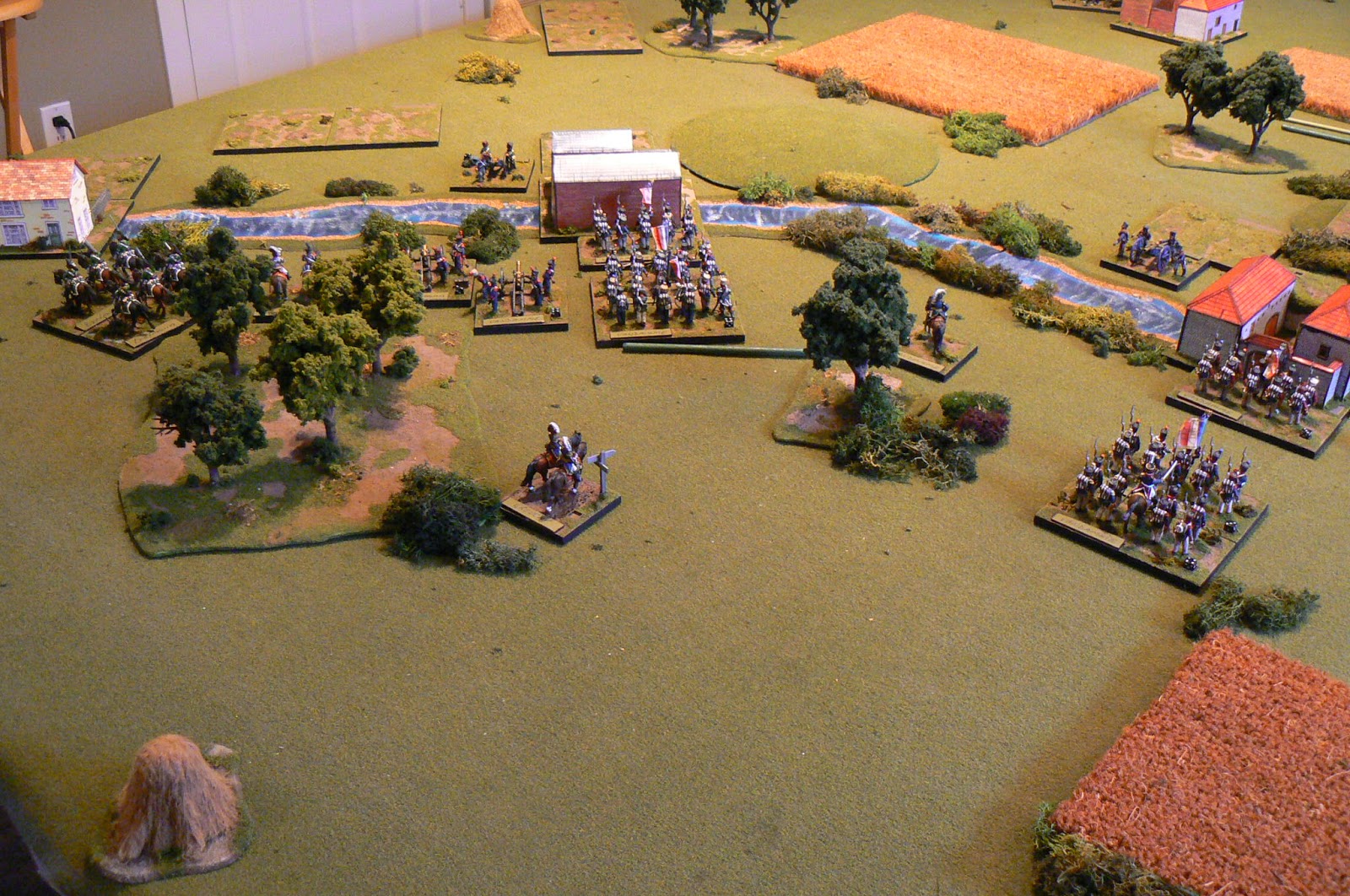
Looking south with the Prussians on the right and the French and their allies occupying the centre hills.  Oudinot's  corps is  in column at the far end of the table.

The game went well a just took the time available for the first session. The players moved on to the other games they signed up for so wargaming buddy ThomasM a very experienced Napoleonic player offered to take me on for the rest of the evening so I reset the scenario with him taking the Prussians and I in the role of Ney.  With the two games of failed Prussian assaults, I increased their endurance and had Oudinot's command come in later to see if that would create a more historical and even affair.  It did, along with Thomas's good generalmanship. The balance of the battle was close but being midnight (!) and having played for 10 hours (!!) we called it a night.
The French Cavalry Corps under Gen.Arrighi. Yes, the whole corps (albeit a small one) Each element is brigade/plus sized. 

still plenty of maneuver space.  we need to double the numbers then!


the Italians of Bertrand's Corps


Wednesday, 25 November 2015

Battle of Ligny play

The Battle of Ligny was a major battle of the 100 Days/Waterloo Campaign of 1815 between Napoleon's Armee d'Nord and Blucher's Prussians.  Fought at the same time as the better known Battle of Quatre Bras (trans: "four-arms" or crossroad) no doubt due to the British participation.

Having played the game five or six times now, these photos I found were archived from much earlier in the year.  I don't remember if they were 'published' yet, but I find the battle is fascinating and learned much from the re-creation on the tabletop.
The battle looking from the northwest.  The villages form the Prussian defensive line. Pirch's Prussian corps is on the left moving through the line of trees.  In the background, Milhaud's French cuirassiers are being moved up

Blucher needed to hold the left flank of the British-Allied army and understood, well, perhaps his Chief-of Staff understood.... that the crossroads would be a key to the French advance as so needed to hold at Ligny.  His dispositions reflected the defensive stance as the small but marshy Ligny stream afforded a nice line.  But that line was also convex and thus would allow the French artillery to converge fire upon the Prussian reserves.  In our games, much of the Prussian losses came from this fire.
Ziethen's Prussian Corps in the 'cauldron' formed by the Ligny stream and the line of Belgium hamlets along its length.

However the French still needed to take the towns along the stream as these afforded the only passage across.  The village of Ligny was the largest of these hamlets.
Gerard's French Corps ready to assault the village of Ligny

The eastern half of the battle, historically, had little fighting.  It became obvious during the previous playtests, that the 'Grouchy' player, commanding the French forces of mostly cavalry could not assault the eastern most villages and the Prussian player was not willing to abandon his nice defensive positions to move out to the open ground to be attacked by the French horse.  Stalemate.  In this game, I did not portray this side of the battle as it is but boring for those commanders.
Vandamme's French forces line up in support again the hamlet of S. Armand la Haye.  The artillery in our rules can fire through friendly troops.  The multiple batteries the model represents are to be considered spread among the individual units which the bases represent.  The wheel marker has it moving during this turn and so firing is compromised.  Not all the batteries are in position yet, it is assumed.

To be honest I can not remember which side won the game, but it is hard slog for both sides and, as in history, affairs can be influenced by the smallest of events. A few more good dice than the other side and enemy units collapse and victory achieved.

Tuesday, 11 August 2015

Battle of Gross-Beeren 1813 - the game

Battle of Gross-Beeren 1813 - the game   (August 1813/2015)

Peter "the Mathematician" excepted my invite for a go at our rules 'GdC' to see his new charts in action ( well, I created the charts based on his calculations of the dice variables).
Reynier's Saxons and French engaged with the Prussians of Bulow's corps 
The historic Napoleonic Battle of Gross-Beeren during the autumn campaign of 1813, was the large battle which ended the French move by Oudinot to take Berlin.  Oudinot's various corps travelled in parallel routes in a very Napoleon inspired method but failed to have each support each other, and thus, Reynier's corps of Saxons and French move toward the town of Gross-Beeren was not supported by either Oudinot himself from the west, nor Bertrand who was moving to Blankenfeltle, some 5 km ( 4 miles) to the east who emerging from forest was content to occupy the Prussians there rather than help Reynier's 'middle column'.

Bulow's corps is the three blue blocks on the upper centre of the map.  Gross-Beeren "Gr-Beeren" and the small windmill symbol forms the centre of the battle, while Dohschule's Division of Tautentzien holds Blankenfeltle aka Blankenfeld and which forms the game table

As Bertrand did little that day and the few Prussians facing him were content with that situation with all of the Prussian Bulow's large corps now able to face Reynier without interference, most scenarios often ignore that area and concentrate around Gross-Beeren itself.  However, that would mean too few elements for the afternoon, so I gave Peter and myself a bit more to play with!
The town is Gross-Beeren with the Windmill Hill off to the left off camera.  Blankenfeld is off to the right.  We see the Saxon division Sahr (left) and Durette's French division (right) initially engaging the lead Prussian elements.  
The short synopsis of the game is that it surprisingly went much like the historical battle.  While the Prussians overall had some numeric advantage - 24 elements to the French 20 - Bulow with his 17 could take on Reynier's 10 while Bertrand and his 10 element strong corps made no headway against the smaller Prussian all Landwehr force holding Blankenfeld.

I took the French side while I gave Peter the opportunity to use the larger Prussian force.  Like Bertrand, I was met with effective cannon fire ( rolling well, Peter took out my leading light horse which prompted a corps morale rolled which, I my usual style, I rolled very poorly for and forced me to halt my advance, in file, within the woods.  Again like Bertrand had facing concentrated Pussian artillery fire that day in 1813.  I furthered this poor situation by totally not realizing, until Peter suggested late in the battle as the idea then struck him, to expand into the woods to work around staggered lead brigades!  The elements in the woods would be disordered and more trouble to order about so not ideal but could in time give combat to the Prussian and earlier moves might have changed things perhaps.  However, I could now see Bertrand's issues that day in 1813.
Wurttemburger's of Bertrand's corps.  These are Perry plastics with modified Austrian shakos - they had gone to this shako from the helmet in 1813. I scraped off all the Austrian cockades and such and added a small lozenge badge.  With the distinctive Austrian roll cut off the pack and removal of the Austrian canteen, together with a couple of the bottom buttons scraped off the tunic to allow the Wurttemberg half-lapel.... the Perry plastics make great models of these German troops. 
one of Fontanelli's Italian brigades disordered in the woods
My Reynier in the meantime faced against Peter's Bulow, who was allowed to deploy very close to the town. Historically heavy rain masked his advance made easy by Reynier's thought that the day was done and allowed his Saxons and French troops to start to bivouac!
heavy action at 'Windmill Hill' located just west of Gross-Beeren
As a rules note, the new command allowance give more pips for larger commands than we have used previously, and while players will enjoy more allowed play with all their elements, sometimes a lot of 1s on the dice, can really be troublesome if they have a big command!  However, like Bulow, Peter managed his large but not overly powerful force with a lot of finesse as it had many very fragile Landwehr (militia) units.
new markers include small green flags (same construction as the white ones) which, by adding or removing, allow for a more gradual step-down of the important Command Morale modifier die with each loss of a command's elements. The small "4 d" indicator provides players a reminder of the # of dice to roll for each command {important should a player have multiple commands to play).  The wheel indicates the artillery is limbered and thus can/has moved.
Prussian Landwehr cavalry.  Calpe Miniatures with "English shakos" in the rear.  I received these in a trade. They match well with the Perrys. 
However, battles go to those with the bigger battalions as the saying goes, and the Prussian numbers came into play.  Interestingly Peter, like Bulow in this battle, thought the open left flank of Reynier was key, which Reynier - and I - had no reserves to match; and like the Saxon division holding that area, my Saxon elements were obliged -- well, OK, forced by my adverse Command Morale losses -- to fall back.  Again, like the actual battle.  Love the confirmation of the historic outcome.

The French in retreat.  Rather more organized than in reality......


Thursday, 4 June 2015

Napoleonic Prussian Cuirassiers

I know how many of my collections grow.  And I can't help myself.  When faced with a sale of figures which you might need, and which are being sold at an extremely good price, what's a wargamer to do?  Buy them, of course!

During the last local convention the bring and buy had me rooting around packages like a starving weasel.  Luckily a fellow wargamer I know was just labelling his sale bags when I interrupted to examine the figures.  For a very good low price I now had 12 Prussian Connoisseur riders on Front Rank horses.  For our rules ratios, that is well more the entire Prussian cuirassier contingent for 1813-15 !

Oh sure they are but in one pose and the horses many in the same pose also, but the similarities make them easier to paint and look quite imposing all with a straight backs and swords at the ready!
While I could not use them for the Waterloo campaign but thinking perhaps as Russians for Borodino.  Similar helmet and all.  But after purchasing  --- and putting on my reading glasses! -- these had the dark blue litwa coat worn by the Prussians, and not the white dress tunic as like the Russians ( the Germans being much more practical about these matters... )

However I still can use them for the 1813 and 1814 campaigns where they show up in the large battles once and a while.

Sunday, 30 November 2014

Battle of Wavre 1815 refought

As Dave B. is an excellent sounding board ideas for developing the ongoing Napoleonic rules, a foisted upon him another Napoleonic game.

The Battle of Wavre was fought at the same time as Waterloo so gets little of the same treatment as it was considered a side show to Waterloo's main event.  Even the Prussians themselves knew this to be true and so left General Thielemann with less than his full corps to delay Marshal Grouchy ('Grew-she') while the rest of the Prussian army left to beat up on the Wellington's forces.
My "Marshal Grouchy"stand.  He is eating his strawberries as Gerard berates him to march to Napoleon's aid.

The Prussian defensive line was the difficult to cross Dyle River, so once again we are dealing with Napoleonic town fighting across the bridges at those points.
Looking from the south-east toward the direction of Waterloo, this photo shows the Dyle River.  Dave's initial French forces of Vandamme's infantry are assaulting both Bierge(center) and Wavre on the right while Exelmann's Dragoons look toward Limale on the left. Only the Prussian artillery are showing themselves on the far bank of the river near the villages.
I took the Prussians as they were pretty well stationary giving Dave the more decision making French command.  Historically, Grouchy followed what he believed to be the proper course of action from Napoleon's rather cloudy directives.  After the Battle of Ligny Napoleon gave Crouchy who previously led only a corps of cavalry, command over the infantry corps of General Gerard and Vandamme both of whom were heavily engaged at Ligny, along with the cavalry of Exelmann and Pajol.  Napoleon seemed to want to have Grouchy keep his sword in the back of the retreating Prussians while Gerard pressed for him to march to Napoleon's aid once the cannon fire from the direction of Waterloo was heard.  These two different actions formed the options - by secret die roll - which the French under Dave B. could take unknown to me, as the Prussians.  Thus I could not commit my reserves accordingly.
Dave moving an element between Limale(right) and Bierge(center) .  Note the large blank bases which form my potential hidden reserves.  These bases I kept from their previous use as our artillery bases, which are now considerably smaller.


Now to be honest I did not have much choice in my reserves deployment, nor did Thielemann,  as he was seriously outnumbered and most of his forces were already committed to the defence of each of the towns forming the crossing points and so placed them historically.  Again, historically, the French had little idea of the forces ranged against them, so I felt justified in the scenario to have many potential hidden forces for the Prussians keeping their numbers unknown to the French.

As it was only a medium sized game, we ended up playing one and half-ish games rewinding the clock several times as we came to grip with different ways of handling the town fighting rules.  In the past we had town fighting a function of the normal open field element combat with an addition of overwhelming modifier for the defenders. Lucky dice aside, the only way to defeat any defender was to attrition them and so a "conga-line" would enviably form with a long line of attacking elements cycling through until the defender was worn down enough to evict. While simple, I felt it did not feel right nor was it satisfying play for the commanders.

So the scenario was kinda set aside as Dave B and I myself tried various options.  In the end, while it still needs to be tested, we came up with combat much in the same vein as cavalry combat with squares as in the defenders stay put until voluntarily removed or eliminated (not literally but as a cohesive body of troops).  Combat itself is simply a die roll-off without modifiers.  Elites only have more staying power.  A bit more to it of course but it follows the rules approach we continue to strive for in simple "convention game" procedures. The effect works however.
The French of Vandamme's Corps assault the town led by the 2nd Foreign Regiment ("the Swiss") representing Habert's brigade

With much of the game in intellectual discussion, the scenario was not played out to any extent. I was worried about reinforcement timing as for the rules now more streamlined, can cause historical timing of forces entering the table to be difficult to establish.  This proved again to be the case and is but another item to be looked at, but the new town fighting rules might work now. Hopefully.

Hmm, I think I will have to re-roll that one!

Monday, 20 October 2014

Refight of Battle of Montmirail 1814

With the plan for a game still in effect but with a necessary change in the number of players and their timing in arrival, I needed to have a smaller game with later arriving reserves and so the 1814 battle of Montmirail in the campaign for France seemed to fit the bill.  Well, OK, minor changes required with my Prussians replacing the Russians and the newly painted Hanoverians taking the Prussian's place!  The French were still the French fortunately as my original collection was designed specifically for this battle.

With everyone with coffee and cake in hand,  I had the "umpire chat" with Bob and Ian commanding the Prussians (Sacken's Russians)  With only Ricard's French Division on the table, I told them that they were ordered to take the village of Marchais to open up the road to further advance per the historical plans.   While I did indicate further French forces were moving up, I did not indicate that these were the French Imperial Guard in great numbers!  Sacken was equally surprised apparently.
I commanded the Prussians of Yorck - my Hanoverians - which guarded the LOC for the army.  I took these as Yorck historically seemed to do little which is ideal for me.  Involved with the rules for the others, I often forget to move my own troops!

The "chat" with Dave commanding the French has him wanting to destroy the Allies.  However he has negative victory points for losses of Old Guard elements. Nevertheless he was excited to command an attacking ( ! ) force with good troops for once.  He had the quality, the Allies had the numbers.
Interestingly this battle had few cannon as the mud of northern France during this rainy winter of 1814 made the movement of artillery extremely difficult and only a few batteries were available to Napoleon.  The flat terrain of the area and no significant historical influence meant a flat table.  At this level of combat, the problems of hedges, minor streams and the like, are of no concern of the corps commander/player.  Makes terrain deployment easier anyway!

The Prussians I had deploy first. As they ARE Prussians I left the original command labels on the bases and so Thielemann = Lieven and Bulow = Taillsin's corps.  Ian also commanded Vassilitchkov's cavalry labeled as "Jurgass".   Ian and Bob decided on corps deployment lines and with that, placed all their meagre artillery on the right and left of each respectively thereby creating a 'grand battery' of 17 points ( ! )

 With Ricard's Division holding Marchais, Dave moved the Old Guard infantry forward but was faced with the move by Bob holding a good position to his flank but the massed Prussian batteries to his front.  His moves by the very powerful French Guard horse were a bit less troublesome but he did have to pick his targets as not to get into an attrition contest with the more numerous Allies.  My historical holding back of the Prussians helped him somewhat but he still had to worry about this flank also.
You can read more from his blog at :  link  He writes an excellent report of our battles

The Allies numbers and good tactics were seeming to hold sway for the moment but I had planned for the later arrival of Barry after his early day shift.  I had him command the French Young Guard reserves.  Their arrival on the tabletop was predicated upon when he would show up!  His timing was good as it turns out.  

A few more turns later, the Prussian horse were beaten from the field by the powerful French guard horse and one of the Prussian corps had collapsed.
The Hanoverians with necessary action required with the arrival of the Young Guard, tried to hold Bailly and Fontenelle on the Allies left flank to protect the line of retreat. Widely spread, attacks of the powerful Young Guard and the 'Red' Lancers of the Guard broke the corps eventually.

We forgot to plot the number of turns completed but all agreed there were many and so concluded that on the short winter days of northern France, night was to fall and the fighting concluded.  While a  minor French victory, it cost Napoleon three wrecked Old Guard elements.

A scenario with powerful but fewer French elements in a central position with more numerous but poorer quality Allies holding front and the flanks made for an interesting game I thought.  

Much discussion again about the rules.  I suppose at this point the players all consider each game a play-test and so the rules are now always scrutinized!  Much of the discussion can be more about tactics than about the level we are trying to achieve with these rules, however all agreed they are coming around and are fun to play.  Most of the proposed changes are more procedural than any huge change.

I thank the boys for coming down and having a good game.  My motivation is revived.
early moves of the battle with the Old Guard marching up toward the massed Prussian guns of their center, the mass of Bulow's (nee Taillisin) corps behind the farm of Greneaux and the hand of Ian moving up Prussian dragoons trying to hold the mass of the French Imperial Guard horse

Close up of the Prussian infantry
The Old Guard seeing the massed Prussian guns in the distance and probably whispering "oh, merde!"
The initial cavalry clash
My newly painted and seemingly nervous Hanoverians. Rightly so under my rather dubious command.
My Hanoverians - historically the Prussians - thin on the ground with the Young Guard Division about to take the Village of Bailly [ top ] and part of the victory conditions and [bottom] the Guard Red Lancers threatening a brigade in square [noted by the cube marker on the base] in front of the village of Fontenelle.
 my Young Guard in the command of Barry during the battle 


Sunday, 17 August 2014

The big Summer Battle

The call out was made and Bob and James drove all the way from Oregon to play our Napoleonic rules!
I hosted my annual big Napoleonic game with a fictional battle between my Prussians and Seth's (also American by the way) Austrians/Bavarians.  Local boys Ian and Bob joined for the early morning start.

Once coffee was on, we got all the food and drink settled and all have arrived I present a very brief  outline that with the defeat of Napoleon at Waterloo, Prussia is back being irked that they did not get the whole of Saxony from the Congress of Vienna, and so they and the Austrians are at it again.

The leading Prussian brigades foot sore heard of a shoe factory at Wantizburg but thereby bumping into the lead elements of the Austrian Army.  Having designs on the territory, the Prussians did not want to destroy the town, as likewise did the Austrians and so each did not contest the town, for the benefit of the game play and this historical action.

I challenged the players to identify the tabletop.  I said it was well-known historic battle but not Napoleonic.  James got it straight away.  Gettysburg (what you Wantiz is not always what you Gettys..... yeah, silly but I got to call it something!)   Where forth we ended up calling it Gettysburg regardless of the troops and surprisingly, it turned out very close to the real thing!
The battle of "Gettysburg" looks to be about early "Day Two"

We had 7 smallish corps on the Austro-Bavarian side and 4 larger corps on the Prussian side. (some 55 elements in total for the Prussians alone)  Very similar in corps numbers to the historical action.
The Confederate masses of Johnson and Early's brigades... I mean Thielemann's Prussians commanded by James.
View from the NNW with Ewell's/Bulow's Corps under "American Bob" pushing back the Bavarians of Howard's Corps under local Bob's command (he later took Sickles' Corps also). 

It is still play-testing, so we tried out as new rules: the use of sub-commanders, we looked at the new artillery usage and quickly developed new corps morale [ Seth and I were exchanging emails the night before! ] and these were further refined during the game.  We did a lot of discussion during the 8 hours of play and even so, got a conclusion based on objectives if not corps morale breaks (as everyone kept rolling very well for these)

I had each corps come on the table in generally the same time and direction as historical; perhaps waiting or placing on the table as the situation dictated for the "storyline of Gettysburg" but it worked everyone seemed to think.
Seth's Austrians playing the part of Sickles Corps marching just in time to occupy the Round Top hills.  Old Glory figures on the left, Perry plastics on the right.
The battle was a close one and at the end, the Union Army (sorry, Austro-Bavarians) kept a hold on the flanking hills of Culp's and the Round Tops to eke out a victory.  The key combat was, and this so mimics history as to be almost scary,  a final desperate attack uphill by my two beaten up elements vs "Canadian Bob"'s isolated brigade.  The odds were even - I had numbers, he had the uphill position - and we were all at the minimum 1 MP. As our combat rule goes,  if I roll higher than he I win and take no hits and thus will take the absolute flanking hill of the A-B army.  If we tie, we both mutually destroy our combat effectiveness.But at least he is gone.    I roll a 2 but...he rolls a 3 (the best roll possible and only 16% chance of making!) and thus takes out both my units without loss to himself.  While this occurred not on Little Round Top but on the representation of Big Round Top, it was certainly the ultimate 20th Maine moment and assured the victory for the Union, aah, Austrians as it did in the real battle
Sorry for the fuzzy photo but I guess I was excited about the opportunity to take Big Round Top hill (at right) with my two brigades at the very left flank of the Austrian army and perhaps win the day for the Kaiser.  But as I describe in the text, Bob rolled high and he had a 20th Maine moment alas.  All game my corps move rolls were very poor and so I had many unsupported and disjointed attacks and Plum Creek along with Devil's Den - note the large rocks - disordered any moves I tried to make. Gneisenau was not impress by my performance this day
Had the Prussians had a heavy horse cuirassier division at this point we would have thrown it at Cemetery Ridge in a Pickett like gamble but alas I have not collected any as none were present in the 100 Days Campaign.  Hmm should I do them up regardless?? Oh lord, that Napoleonic black hole is gaining strength.....

Seth and I spent a bit more time after the other's departure going thru the action and the rules.
 We are getting there.

Thanks for James, the two Bobs, Ian and Seth for joining me in the big game and it proves that Napoleonics can look good, be a massive game but still play quick and fun and to conclusion.


Thursday, 17 July 2014

some artillery "reinforcements"

With the somewhat 'dramatic' change, not necessarily in the conduct of artillery fire within the rules but the number of firings/rolls allowed, the number of models required has bumped up slightly.  For the French I already had the models, for the Allies I required but two more, one for the Netherlanders and one more British horse artillery which we shall see shortly.  The Prussians needed four more, one of which I had already painted, one foot which I need to buy, and two horse artillery gun which, again, will be shown below.
The newly created artillery ratios are a result of integrating the number of rolls each gun model may conduct per turn with the actual historical number of guns within each formation for which the gun represents the artillery component. This is a great idea which a play test with David in our last game he suggested as an off the cuff remark but which I seized upon.  Simply, the MP (our little black dice) of each gun now represents 8 historical guns - a usual battery strength historically for many nations - per pip.  So a corps with 64 guns has 8 pips worth of fire and can roll the die up to 8 times to try to damage the enemy.  Obviously range and number of targets will influence the ultimate number but now we don't have the everything-in-range-can-be-fired-upon havoc we had in our convention games.  It was a little too much of a good thing.
So, back to the example, the corps has 8 pips of rolls but, our little black dice are but six-sided so 2 gun models are needed.  It is up to the player how to distribute the pips but the usual is probably have 4 MP/pips on each.  As "attrition" and enemy damage reduce this number, obviously the efficiency of the artillery will be reduced as it can fire/roll less times.

The one interesting aspect of this new approach is we do not have a need for close range fire rules as there is nothing to suggest a player cannot concentrate all his fire (roll all the dice) against only one target; that target either charging him or at near enough as to have all other target, if available not worthy of the effort.  Read: 'grand battery'

Previously with our Order of Battle we fudged much of the deployments as we struggled to keep the overall gun to foot to horse ratios intact. Now we can accurately establish the exact number of MPs needed and thus the number of gun models for each formation and indeed the type - foot or horse - which is the reason of my slight increase in artillery models.

Indeed, if a collector is so inclined, he could now represent that one battery attached to the lone cavalry brigade as a 1 MP gun model.  However, should he sustain but one hit, the model must be removed from the table as so that might be a somewhat 'expensive' endeavour.  However, even if chosen, the number of rolls does not change regardless of the number of models on the table and is based on historical allocation alone.  Very good that and eliminates the guess work for scenario design.

I have been fortunate that these new numbers are not many and so the costs have not been large especially as I have kinda cheated a bit.  With a trade with Mike B., and his generosity in giving me some loose figures he had lying about, I cobbled together some of the more unique models.

For the British I needed one more RHA.  Mike in our trading, provided 3 previously painted figures but no gun of course.  However I do have a love for the delightfully silly Congreve rockets and Winyates' RHA battery of Waterloo fame provided me the excuse to use him as an example for my new model.
I firmly believe that the gigantic 'ladder' models of Old Glory and Foundry for example were for the very heavy 24 or 32 pound shells for use in siege warfare and not on the battlefield.  The reference books all have the well-know illustration showing, in scale, the various rocket sizes down to the 6 pounder shell no doubt fired by Winyates at Waterloo, firing them as he did, on the ground.  Thus I portrayed the same.  Yes, yes, probably should be a trough but I decided to forego it.

The rocket part of each was a cast from unknown origins to which I glued a piece of wire. It really was that small.   I repainted the Foundry RHA figures but did no modifications as their poses work and the mere three don't look out of place with the other more populous artillery stands and were free  <grin>

The Prussian army of 1815 was an amalgam of the numerous previous states which were under French control or influence many as late as several months before the start of the 100 Days Campaign.  The Duchy of Berg merged into the Prussian army with many of their old French style uniforms still worn (the white tunics of the infantry) and the blue and red of the artillery.  I had some French style artillery gun models about so I went about heavily modifying some other crew figures I got from Mike B.

The result is the Prussian Horse Battery Nr.20 (ex-Berg) of 1815.
From the poses you might have deduced these were from Old Glory.  Actually British 1809 crew from which I chopped off their heads and replaced with British hussar heads [for the large cockade which is similar to those of the Prussian] reducing the plume and removing part of the shako flounders/cords.  The horse artillery, thinking themselves cavalry, I needed to add some Perry dismounted dragoon scabbards.  A change of tunic and pant colour - I left one in his old blue trousers and painted the new Prussian grey ones for the rest.  They look both Prussian-ish and their previous Frenchie-ness, which is the whole point.

The second Prussian horse battery [Nr 18] is also unique as it is the ex-Russo-German Legion artillery which integrated into the Prussian army in February of 1815 but continued to wear it's Russian/Prussian uniform.
For this unit, I used Old Glory Russian horse artillery figures (surprising that, really...) but need to remove the heads as the RGL used Kivers and not the combed helmets of the Russians.  So I used Warlord heads for these.  The weird OG poses were bent to show the crew hauling up the gun manually.  It works well I think.

Again, the cheap bugger that I am*, the figures were inexpensive (read: free) and the gun, while somewhat inappropriate should some rivet counter come along, is of the Napoleonic era, painted in Prussian blue and so close enough!

*edit:  Oh I can afford wargaming. It is, cost to time engaged, an extremely inexpensive hobby but I am trying for low expenditures merely to control my obsessiveness! See, my dear, it is in print....


Tuesday, 27 May 2014

the 3rd Battles - at Enfilade

Made the big effort at this year's Enfilade wargame convention held by NHMGS in Olympia, WA, USA, along with the many Canadians who attend, and co-hosted two large Napoleonic games using a ruleset in development by Seth and myself.  In short, their concept is for the convention game: keep it simple, effective, easy to use, and which gives a historic result. All this with 28mm figures on a small 8 by 5 foot table for 6 to 12 players.  And make it enjoyable.
It is a corps level game.  We don't care what the regimental captain does.  One cannot command skirmishers and be Napoleon.  We don't even want to try.

It is thus, that we tried the 3rd Battle of Ligny.  The first two games resulted in roughly historic results (see previous posts 1st Battle2nd Battle )  Now let us throw in all the  "what if" options ! The theme for the convention was "obscure" battles.  We all know of Waterloo, of this engagement, not so much......

View of the early deployments
Another view of the early deployments
the initial fighting for Ligny
French guns deployed between Ligny village and St. Armand. As historically done, these will cause havoc with the Prussian reserves.
a view of the Prussian left flank.  While good defensively against the French cavalry unable to assault the villages and unable to cross the stream, they would be foolish to attack the French horse of Grouchy's command placed alone on this wing.
Perponcher's Dutch-Belgian Division

Perponcher's Dutch-Belgian Division sent by Wellington to help the Prussians.  This is one of those "what-if" scenarios which I decided to add to this play of this historical battle.  As I played it historically accurately in the previous two attempts, both of which resulted in the mimic to the actual action,  this time I added all the possible contingents which 'could have' arrived to influence the outcome.   Thus Bulow 's corps did arrive, as did the French corps early under Lobau.   Perponcher was sent by Wellington as we must assume the Quatre Bras crossroad was not attacked early by Ney's French and thus this contingent could be provided.  Probably historically accurate as Wellington would be unlikely to send any native British units away from his command and would have likely sacrificed these 'foreign' troops saying they were still part of his army and thus in the agreement to assist Blucher if he was not attacked.

In our re-creation, they came at Marbais at the right corner of the Prussian deployment area and were moving down along the French bank of the stream.  They would have run into D'Erlons's corps at some point.


Close-up of the Belgian Line troops part of Perponcher's command.  I created these from Perry British torsos, Victrix British shakos (needed for without covers), French packs and their arms (for the cuff flaps! )

There is not much to tell of the game itself as the players were running it themselves by the fourth turn and so with time to chat about particulars of the rules which came up from time to time, I kinda lost track of the play in between.

Nevertheless the result had the French lose on points with the Prussians still holding three of the 'key positions'  despite losing large numbers.  However in the 'post mortem of the game' all ten players were still around the table with smiles on and happy with the game.  Fairly rare for most Napoleonic games I have known!
_______________________________________________________________________

The 3rd Battle of LaRotherie
held the next evening

To allow a comparison for results between the various developments of the rules, we have chosen to use the same historical scenario.  LaRotherie was the second major battle of the Campaign for France in 1814 and our third time running this game.

While we tried to be relatively accurate in the design, we must admit that Seth and I have not ..yet?... painted any Russians which under Blucher's aggressive leadership were foremost in the attack.  So we substituted part of Seth's growing Austrian for them as well as he supplied the Austrians, Wurttemburgers and Bavarians who rounded out the Allies contingents.

For my part, supplying the French side, I spent some time in the hotel room, re-labeling some of those French elements which fought on Friday to indicate the new commands.  If viewing the photos of our games, you might note that we leave a space at the rear of our stands to allow an attachment by temporary gummy tack a green piece of card with the historical General's name in order that the players can identify their command.  Not too glaring when viewed by the casual observer.
Early deployments of the Austrians (left) and French (right)
Looking from the Allies right wing of Bavarians and the weak French forces under Marmont which have fallen back to before the woods.  The mass of Ney's  Young Guard can be seen on the far side of the woods.
The following three photos shows close-ups of Seth's 'white tide' of Austrians.  The same basing technique unifies the look of the figures on the tabletop regardless of designer or painter.
The "wurst" of ideas?  A silly pun on the Austrian horse gun, well done by Seth and seen in 'yellow' on the right of the photo
The main thrust of the Allies against the town of LaR represented by my paper model
One might note the severe losses sustained by the Austrians in their main attack with most of the brigade elements down to 1 MP (the small black dice on each stand).  Because of the nature of this battle and the amount of guns, artillery fire was particularly over effective and something Seth and I are already working on for the future edition.
The range of the artillery as indicated by the range stick might be the most obvious change as these sticks were designed for earlier and very different approaches to the guns use.  Two steps forward, one step back seems to be the style of our rules development but we are enjoying this intellectual journey !
French Guard Horse on the loose in the Allies center attacking at will. 
The results had the French continue to hold the defensive line of villages for the victory.  The damage taken from artillery was too?? extensive which really hurt the Allies assault and which we will address.  Nevertheless for a late Saturday night with everyone fatigued and Seth and I somewhat out of voice, it when reasonably well.  
Of course talk of Leipzig (only the largest battle of the entire Napoleonic era !!) keeps popping up..... we very silly boys.....

While involved in our game, one of the players noted that the convention organizers may have deliberately placed all the horse and musket era games in our corner as around use were three other games of the type.  This Napoleonic  ( Black Powder rules? ) game had special made terrain.  Certainly a different look than ours but showcases the variety of approaches to the era.
Close up of my late war French Hussars (Perry plastics) and representing a light horse brigade