Showing posts with label Russians. Show all posts

Tuesday, 11 April 2023

new Napoleonic "reinforcements"

 While I would love to add these to my beleaguered Russian Napoleonic army as reinforcements in the current campaign I am engaged in, they will need to wait for later games,  but do form the basis of Baggovout's Corps at Borodino.  While the Russian infantry uniform had possibly only the shoulder strap color as the only major difference between regiments, the flag design is the main feature denote his formation's regiments (for those regiments of mine which are lucky enough to gain a flag if I have one available!).  Each of these stands represent a brigade and are represented by one of the regiments within that formation. 

The French of the Russian Campaign also gain reinforcements in the form of the red-coated Swiss of Oudinot's Corps, which, while it did not fight at Borodino, I did as I love the color red and they have been on the bucket list to paint.  The Perry pamphlet enclosed in their earlier war uniform plastics box is an excellent reference source.  Each of the Swiss regiments had a slight difference in dress, not only in the facing color but of the different plumes and distinctions of their voltigeurs and grenadiers to make painting interesting (and longer).  The pamphlet also has information on many of the other nations and French formations wearing the open lapel tunic including the Italians, white-coated French regiments, the Paris Guard in Spain among others as well as flags for many regiments. Even if you don't do plastics, ask for the sheets from a friend who does!


Monday, 12 October 2020

Petr and Vasili go hunting...

Petr: I am wolf!

Vasili: I am cold.

Petr: Cold hard hunter?

Vasili: Neyt. Frozen.

Petr: Too frozen to take out the Fascists. We have these molotovs for them!

Vasili: Rather use to light a fire.


A long period of silence fell between them as the noise of a lone German tank became louder.


Petr: And not be a brave comrade of the Motherland?

Vasili just grunted “Time to die” as he arose from the snow and ran toward the tank.

Petr mumbled: “Bugger”


Inside the tank, they were also cold.  Cold with fear.  The wind blowing snow, so blinding, had finally gone… but so had everything else; the others of his platoon, the infantry, the sky and all a grey bleer.   The commander was still hammering on the radio and yelling into the mike: “This is Reimer! Eins, Zwei, Zwei!  But no use; static only.  He hammered his fist on the useless radio for the final time.  “OK, Hans, turn aroun….Scheis! Russki!


The game of ‘What a Tanker’  using two Russian infantry with “Molotov Cocktails”  an incendiary weapon vs. a German PzIII.  With a couple of modifications, I am using anti-tank infantry much like one would play a tank in this game. 


Tank: The commander’s yell halted them all, the tank did not move.

Vasili: Ran quickly despite the snow to a position where he could take careful aim on the tank.

Petr: Did not move but perhaps just imaged his heroic actions (rolling 5 of 6 command ‘Shoot’ Dice but of course he could do little with those)


Tank: Better composed now, the driver quickly reversed the tank but the commander nor gunner could seem to acquire the Russian.

Vasili: was now chasing the tank to get into range.

Petr: Finally could see (acquire) the retreating tank through the swirling snow and covered the space between his foxhole very quickly (now having rolled 4 ‘Move’ dice!)


Tank: The crew now completely composed, rolling a perfect 1,2,2,3,4,5.  The tank backed up further, acquired Petr (needing the extra ‘acquire’ [2] Dice to do so as Petr is a small infantry target), aimed the main gun, fired, and reloaded successfully.  The shot, however, missed Petr. The hull machine gun could not fire.

Vasili: Not having the distance to throw his incendiary, moved to the side hoping the tank would lose sight of him.

Petr: Moving nearer the tank, he lit the wick and threw.  The ball of fire struck the armour but did little else.  He reached into the deep pockets of his great for another bottle (‘Reload Dice’) and as he looked up, he did not have the time to light the wick (no ‘Aim’) and his last words may have been “Bugger” 


Tank:  The crew did not have a shot at the Russian but the one ‘move’ did the trick and the Russian fell under the tracks.

Vasili: Now ran up to the tank and threw his first Molotov and was already getting his second when the explosion warmed his face. The second one also hit.


Tank:  The tank was on fire having lost 2/3rds of their “composure” (4 of the 6 command dice temporary lost)  but the driver managed to pivot in place to face the Russian.

Vasili: Not want to just stand in front of the tank and suffer Petr’s fate, could only follow the turning tank to keep to its side.

Tank:  Panic set in and it would do little.

Vasili: Lit the last bottle, threw it, and then ran.  The bottle fell short in the snow. But he had survived.  Yet so did the Germans.


Saturday, 13 July 2019

Postnaya Bridge 1941 WaT game


Having winter terrain (my Retreat from Moscow game) and Russian early war tanks models, I thought that I might be tempted to do the ‘frozen gates of Moscow’ Nov-Dec.,1941and do WaT with a winter style.

I invited a bunch of the guys over with tank models to have a go at these clear rules. After a quite a long discussion over sizing (who knew that the difference between 1:48 and 1:56 could be so much!) and it was determined that my KV-1A model was 1:48 scale and so we went with that.  Jim brought his Matilda II, in jungle dark green(!); ChrisP brought a Stuart (a lend-lease not offered until 1942 so we cheated a bit there and he was reluctant to apply a whitewash over a rather bright green color-scheme.  I used the big KV-1a along with the truck full of engineers and explosives for the scenario.

On the German side, Gord grabbed one of Bill’s numerous builds, the non-white-washed 38, while Bill used the other with an artistic whitewash motif.  Clayton used my T-34 with German markings as the third tank.  The points were even for each side with 3 tanks aside.
The Germans move into the town 

The Russians were trying to blow the critical bridge before the Germans foremost troop of armour could control it and the town.  Lots of manoeuvring and die rolling in this game but the Germans got to the town first and concealed themselves well, awaiting the Russian advance.  The Russians need the engineers to blow the bridge; but as we can see, it was not to be, so Jim and his Matilda had to destroy it with shot.  Chris’  Stuart tank, we nicknamed “Stewie” was unfortunately brewed near the end of the game, the only casualty.
Germans position themselves.  The t-34(r) is holding the right flank (top)

But the bridge’s destruction was after Bill, in a rather bold move - either silly or a brilliant tactical maneuver depending upon result - used a fist full of Drive Dice to move out of the town, over the bridge and move swiftly around to the flank of the slow turreted KV in order to destroy the truck from behind its KV protector.  Russian panic enthused with my dice rolling slowly spinning the KV around with slow turret movement while the truck [we gave it command dice for movement only - for those knowing the rules the Drive Dice and Wild Dice as usual and with the Acquire Dice convertible to a Drive Dice but only if on the road.  All other Command Dice were ignored] needed to go off road to get away from the rampaging German tank.  While with all this slow motion maneuvering (I was rolling low for movement inches) it managed to block the line of site of the KV to its attacker which did not help.  Bill was relieved to have survived the Russian beast and promptly blew up the truck and the engineers and all their explosives within.
Bill's small but fast 38 vs my lumbering KV1a.  The Lorry driver is attempting to move away off-road but the tires are obviously slipping in the mud;  at least that is what the very low dice rolls suggest!
..then the truck finally can move down the road next turn only to move slow enough to block the KV's line of sight!
...and pays the price.   The lorry is a MDF from Warbases and I bought just for fun.  I added a 'canvas' cover (a large bluejeans clothing label of all things!) and realized I could add it to the collection. It looks the part of a 1930's design Russian truck of the early war with a wargamer's squint.

The KV, without the need to protect the truck, and too slow to engage the fast 38, lumbered forward to engage its original target of Clayton’s T-34(r).  We extended the game another turn as the destruction of that tank would not allow the Germans to maintain their scenario conditions.  However, no further effects were made and both sides had achieved minor victories.  I hope the boys enjoyed the play on the white cloth of Russia....


Saturday, 1 December 2018

Retreat from Moscow - the game


Well after a vacation to warmer climes, what type of game would you think I would like to do?  Something with steamy jungles? Perhaps an amphibious landing on a nice tropical beach? No, I decide upon the frozen tundra of Russia….. and the famous Retreat from Moscow of the Grande Armee!

To be honest, the vacation had little to do with it.  It really all started with a large white tablecloth I have had for years, and a chance encounter with WillB at the club when he was selling (giving away, really) some of his Perry ‘Retreat’ figures.  I couldn't resist. When I heard that the Seattle convention of “Enfilade!” theme is to be ‘Winter’ , well…….heck.


With my interest, Will later traded with me some further of his Retreat collection…seeing my weakness :}

The Perrys do packs of six foot and three horse, so I choose to continue that organization of units as not to make the whole project overwhelming.  In any rules, you can have various means “stretch out” the elimination of figures/units and I did not see the need for masses on the table.  This game is to be a lonesome party of stragglers in small units seeking a different way home from the mass of the disintegrating French army.

Because of the small numbers, or perhaps because of them, I saw this as another of my “convention games” to be played in a noisy environment by a bunch of guys not necessarily up on any particular rules or even the period at hand.  Certainly I feel overly complicated and ‘accurate simulations’ don’t really work at big events so I opt to simple and easy to command rules.  This often means I will need to make them myself to fit the type of game and the numbers I have.
So, in this case, while the Russians (mainly peasants as that is what I ended up with) could be commanded indeed by other players, it proved interesting putting them on “auto-pilot” by using a chart and basing their ‘commands’ on proximity to the enemy and a die roll to see how they react.

The rules, brief as they were, with myself putting in about a half hour of thought were kinda based on the ideas of Lion Rampant (with low amount activation, differing hits equal casualty amounts and differing abilities).  **spoiler - they proved to work very well indeed.
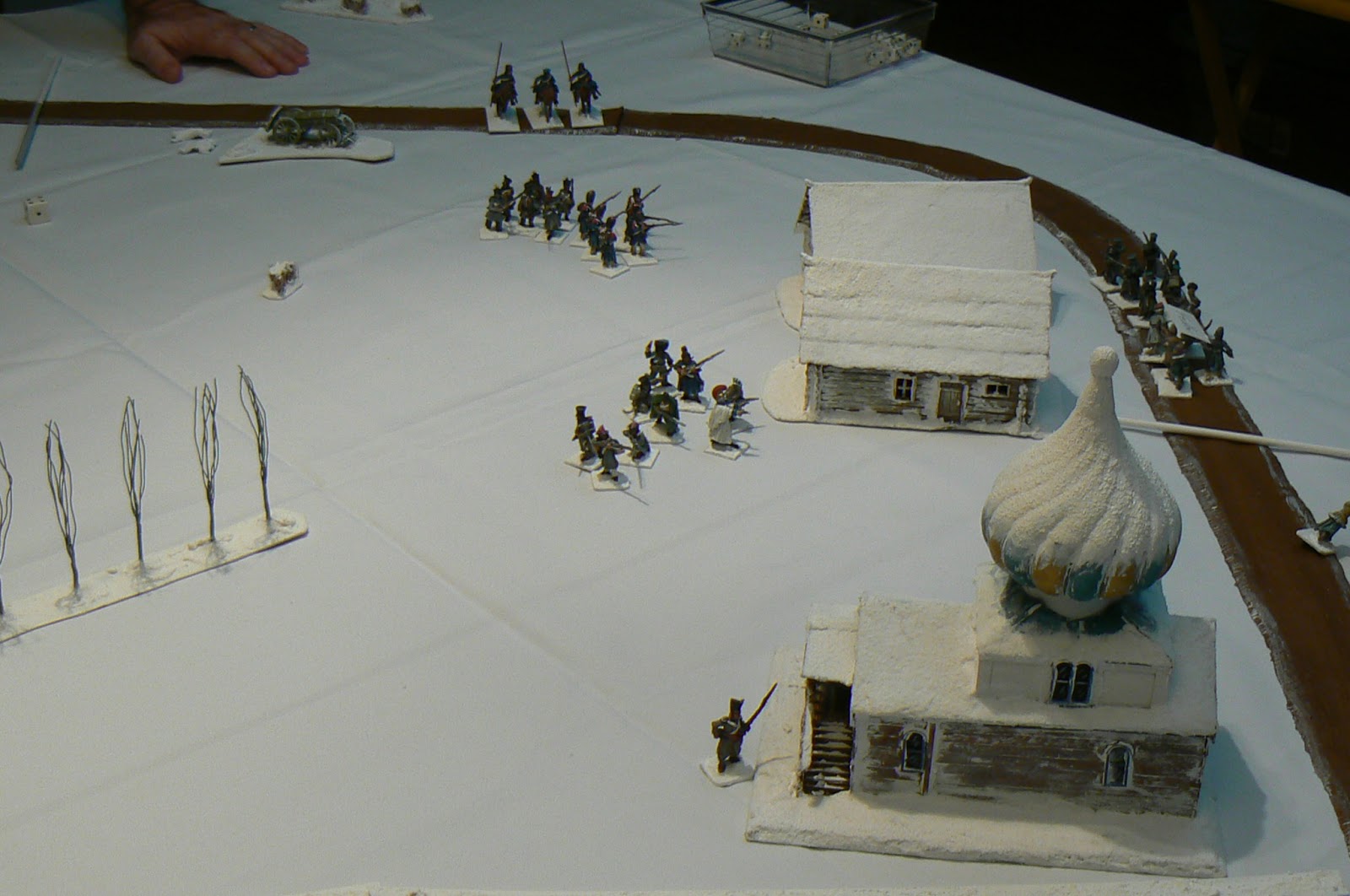
The individual groups of survivors make their way past a lonely Russian village through the snow of a Russian winter.....

Of course the other things to create the game are the painting and the terrain.  The painting was necessitated by Will’s units already done.  But this actually proved a blessing because while not my usual style, it gave me inspiration to keep it simple and basic.  Then, from examples of other painters of frozen conditions, dry-brush a light grey over all areas to give them a ‘cold’ look.  Thus unusually for me, I have another’s painting in my collection.
The 'Poles' leading groups of French dismounted cavalrymen and French infantry towards the lone bridge and survival
Russian Jagers behind the houses of the village.

As mentioned the ‘mat’ is a white tablecloth I had.  Not realistic, but practical.  The Russian houses were plastic ‘Pegasus’ types previously painted by me but not to my satisfaction so they were very much “re-purposed” covered in white paint and model snow.  The Russian church I had built a while back (see: my previous post on the church build)  also became “re-purposed” and covered like-wise. Undeveloped x-ray film provided by a doctor gaming-buddy of mine years and years ago (obviously as they are now have been digital for decades) provided the cold water stream.

OK, the game.
Firstly I told Will, Jim and Peter there are no morale rules.  Units can fight on until all the figures are eliminated.  The rational is thus:
“In these frozen winter depths of despair, if you surrender the enemy will certainly kill you.  If you run, it is into the white wilderness.  To give up is to die frozen.  The only option is to keep fighting until the bitter end or continue your trek home….”

Having no morale in the rules, certainly makes everything a whole lot simpler!

While not really ‘morale’ I put in a simple rule that units sustaining the most casualties in combat or any from shooting will retreat back a full move.  That simple rule, ended up to be used tactically by the players to ‘push’ the Russians out of the way in many cases thus shooting but so losing a turn of movement just to clear a better path.
My repurposed church and leafless plastic trees in the background
Movement and shooting distances are determined according to my painted wood dowels.  Surprisingly the only things NOT to chance within the game!  And, of course, painted as to 'blend in' to the terrain.  My OCD of wargaming.....

The winner is the player with the most figures off the far end of the table.  Jim, selected the mounted French contingent and the ‘Remnants’ (of the GrandeArmee) .  His cavalry raced literally directly through the countryside so having the terrain potentially causing harm.  But as I was rolling.... and sixes were needed, so he worried unnecessarily….( I think at one point I threw 48 consecutive dice and came up with only three individual 6s and so not enough to wound, let alone eliminate a single figure….)

Jim sat back to watch Peter and Will leap-frog each other, fighting off the peasants and the much tougher Russian Jager regulars.  Yes, the Cossacks were there (of course!) but insisted to but be merely be a presence and only coming into range once to be shot up by Will’s commanded ‘Old Guard’.  Surprisingly to all the players, after initial fears of being slaughtered, Will and Peter exited with the same numbers as Jim so all were considered survivors …until perhaps the next village is encountered!
The "Old Guard" appropriately providing the final rearguard.

Some good ideas for further betterment of the rules were offered and so I will go into the next game with Version B and knowledge it will probably work for a good game and entertainment of the players.


Tuesday, 17 July 2018

within the bigger battle....


….while the main infantry battle raged on the left flank, Napoleon sent a brigade of his cuirassiers together with some dragoons and hussars to capture the Russian redoubt of artillery playing havoc with his reserves….

So within the context of the main story, our playtest game of cavalry only Napoleonics using our version of Lion Rampant had French dragoons and hussars to take the redoubt while my cuirassiers were tasked to keep the masses of Russian horse from interfering.

I had the Russian divide up their larger number (but equal in point value to the French) between WillB, JimF and PeterM but roll for their starting positions.  This was to simulate, to a degree the Russians sending in troops from various spots of their reserves and some of the positions were made difficult to manoeuvre as a rules test.
WillB's Cossacks (Perry Miniatures)  Home built Russian village by me.  Wheat fields are a cut sisal foot mat.
WillB’s beloved Cossacks were first to move the attack rounding the village only to stop with numerous failed activations which he explained as the Cossacks suggesting they were not about to make any such charges having the enemy “having guns, sharp swords, and such!”
WillB's Cossacks, some still treading on winter ground!
Kevin with the dragoons and hussars surprised us by using carbine fire (!) to cause casualties upon the hapless asiatic horsemen.  The tactic worked well with him making most of the high activation rolls.  That could not be said of his dragoons who had a hard time getting around all the limbers and caissons (or so it would appear from his rather numerous failed attack activations!)  to attack the near defenceless Russian artillerymen who fought surprisingly well (we gave them a 6 on rolls to cause kills on the attackers)
French Dragoons slowly working their way through the Russian artillery
Meanwhile, Jim with all the Russian lancers charged and counter-charged with the French cuirassiers but found the additional stamina (armor) of the French horsemen hard to gain hits upon.  Of course much ‘discussion’ resulted from this   >)   In the end the talk turned to tactics and with the difference in movement, thus charge and counter-charge dynamics, the heavies were thought to be more vulnerable than it would first suggest.
The initial clash of my French cuirassiers (bottom) vs WillB's painted Russian lancers (top) commanded by JimF. Peter with his Russian cuirassiers can be seen in the top left.
Peter with only two units in the centre but those being the strong Russian cuirassiers, chose mostly not to use the ‘group move’ activation as that “put all into one basket’ but had each unit move independently to have “at least one available…on average” (he is our “Mathematician”).  He sat just out of the French heavies movement range content for the counter-charge if needed.  At that point the rules had the shot extend out to allow the standing Russians to put a shot into the French (this range would subsequently be reduced as all felt the range was ‘out of scale’ and tactically unfeasible). Well, I guess I could be continually be shot upon or charge, so as a good French cavalry commander, I charged…to rather mixed results.

Nevertheless the boys had fun and gave good discussion on the rules.

Thursday, 31 May 2018

Battle of Eylau 2018

Rather than snow …. or lots of baking powder all over the table….we decided to do this January 1807 battle in the summer.

Start of the game.  Eylau is represented by the yellow church in the middle
Showing James' fine work.  He did these French AND a Russian command!
Murat's huge heavy horse command.  Murat is the single horseman in the centre.  DaveB's nicely painted Imperial Guard is in the background.
Looking upon the Russian Right/French Left flanks
Showing Davout (commanded by myself) coming onto the battlefield near the village of Serpallen only to be stopped by a good defence by Ostermann (MarkS) and reinforcements coming in.  
Showing late in the battle with the Russians advancing with infantry and artillery.

I debated whether to add sandstorms (rather than snowstorms) add/or downgrade the Russian command and combat abilities, but in the end did not add any variations.  Probably should have.

One result is the Russians actually saw how few French were in front of them and immediately advanced.  By not lowering their maneuver pips and thus they moved at uncharacteristic speed for the Russians of this era.  Using group moves  (the now banned after game casual debate over lunch and beers), they managed to move troops to the beleaguered left flank to which Davout (myself) was attacking.  My attack along with all the other French commanders were stymied by the good Russian commanders.

Lestocq (and yes that is the spelling; and no, I have no idea how to pronounce;  we went with "la-stock") the lone Prussian finally entered at the historical time and immediately started marching toward the French.  However it was clear even at that point that the French were done and the Corps Morale rolls were starting to affect the outcome in any event (as they should)

It was a bad day for the French and our first a-historical result using the rules.  Should have gone with the original plan.  Must revisit this battle with such changes and see if the result will be different and, as interestingly, a historical one.
Nevertheless the game was a good one and as the players are now well familiar with the rules, the game chugged along at a good pace.  We had 95 elements on the table, with 9 players and concluded the affair in one time slot.

Thanks to all the players and to those who contributed the time and effort in painting and basing your figures for the game.

Saturday, 8 April 2017

Hosted games at Trumpeter Salute 2017


Chided into hosting 4 games during the convention, I decided on three completely different eras so that I may organize the transport into separate “shipments”  thus without much need to remember to move items from one pile into another each bleary-eyed morning…

With that in mind, I hosted a semi-skirmish Japanese samurai game on Friday, two distinct sessions of grand-tactical Napoleonic battle on Saturday, and a low key French and Indian War game on Sunday.  Surprisingly it all went well.

Trumpeter Salute Convention My games: Friday afternoon

Sengoku Era Japan - Samurai Game using “Katana Rampant” (Lion Rampant rules with addition for handguns)
Okudaira tempo ready to fire upon the walls 

The scenario has a surprise attack by the Takeda upon the Okudaira besiegers of their castle.  To keep it a surprise, I told all the players of the procedures to take the wall of the castle.  This included activation to climb the walls, and defensive fire from them.  While I kept the defensive fire rules for the game, the intent was not to have a siege game but a straight up fight with a surprise flank attack.  To that, I was successful.

 (besides…. the walls were built only to give a backdrop for photos!)

I gave the flank attack player the option of either using his normal troops to lead the attack but through the muddy fields (rough ground) or if he leads with the peasants they know a drier faster way.  But of course, then,  you are leading your attack with peasants who are not the exactly the best choice as a military unit to lead any attack!
The Takeda (with black back-flags) emerge in the muddy fields for their flank attack!

In any event, he lead with his samurai who while fighting well in the muck (‘ferocious’ rule) still are slow to get through it and impossible with his poor activation rolls! The (were) attacking the walls (now) defending from the flank attack players managed to recover from the surprise and a good game was the result.
the Okudaira reinforcements rush into the fight


 Game Two!

With a small game and fast action we had the time to have a second action. The scenario was a simple one with the Takeda having captured the personal standard of Okudaira Sadamasa who wants it back.


Trumpeter Salute Convention My games: Saturday afternoon

I would do two games of the historical Napoleonic Battle of Vyazma, each in a separate session.
a view from the east showing the French and Allies strung out along the road, with the town of Vyazma, represented by the church in the distance their goal to survival.  The villages of Gorontka (near centre) and Fedorskoie (near right) are represented with the French rearguard under Davout holding Fedorskoie.  The Russians of Ostermann-Tolstoy and Eugene of Wurttemburg (left) under Miloradovich are attacking from the south to cut off the retreat.

  This first one had six players participating with three French and three Russian players.
The Battle of Vyazma occurred during Napoleon’s retreat from Moscow and only days before the snows began.  Miloradovich, the Russian commander, pressed his attacks on the French rearguard of Davout’s corps centred around the villages of Fedorskoie and Gorontka, with Eugene’s (with some Italians), Poniatowski’s Poles , and Ney’s corps strung out along the road of retreat towards the town of Vyazma.
Wurttemburg's Russian Corp attacking the French and take Gorontka

For the French, their objective was to get as many units, including supply wagons, safely off the table and continue the retreat through Vyazma.  If they did so with more than those destroyed or captured (any left on the table should the Russians take that town), they win the game.  Thus, the French had the task of moving AND fighting to survive.
Davout must simultaneously transfer troops along the road and support the defence against the Russian attack. He does a good job

The Russian objective was simpler.  They were to destroy the French.  Casualties were not a concern.
The height of the Russian attack. The near marsh deemed impassible, as indeed it was historically, restricted direct Russian moves against Vyazma (off camera to the left) and served to constrict the Russian reserves.
We can see Platov's cossacks and Paskevich's small infantry division in the far distance trying to move against the French in a flanking move.

For this task, I placed the Russian commands in their historical locations allowing each player to deploy as they wished.  From east to west, Platov’s cossacks, combined with the small infantry division of Paskevich,  attacked from the end of the long table against Davout’s rearguard.  Wurttemburg’s corps with Korff’s cavalry came from the south, while Tolstoy’s corps with Siever’s cavalry moved toward Vyazma itself to potentially cut of the French/Allies retreat.
The Russians were historically estimated at 22,000 to 24,000 in strength.  The French total is unknown but would be at comparable numbers.
With a very large strength ratio and using 28mm figures, a village can only be represented by one building.   

The French players had the unenviable task of choosing when to run and when to fight all the while moving toward their goal of the exit point.  To be honest, seeing the deployments in full, I did not think the French had much of a chance, but to their credit, they managed to get more than 50% off the table successfully for the victory.  Notably on the French side was the decision by “Ney” who was closest to Vyazma, to quickly file his units off the table leaving only his artillery to hold off the Russians and keep the road open for the others;  and the unfortunate die roll by “Tolstoy” failing his corps morale roll and having to fall back thus losing the opportunity to close the door on the French.  It turned out to be a good scenario.

The Russian advance continues!

Trumpeter Salute Convention My games: Saturday evening

In this second game of the Battle of Vyazma, I reset the scenario to the original starting points.  I did move the road on which the French moved from the centre of the table slightly further away from the Russian southern attack which gave everyone a bit more maneuver space and the French a tad more time to have units retreat toward the town.
Deployment of the French (centre) along the road.  The Russians (left bottom) attacking from the south. 

In this game, we only had one player commanding each side.  It had the usual effect of having a much more ‘ordered’ game in action and in the even look of the elements on the table!
With only one player per side controlling all elements, the game tends to have a more "ordered" appearance!

Surprisingly the result again was a French “victory” with very slightly more elements having got off the table than were destroyed or captured.


Uvarov's Cuirassiers, historically sent into action very late in the day,  finally make an appearance. But as in the first battle, make little impact as they are late and too far in the rear to make an effect.  They are pretty however!


Trumpeter Salute Convention My games: Sunday

French and Indian Wars action - 'Manage-a-troi'

A good group of wargamers who are there to gleefully move around pieces on the table in good humour certainly make for delightfully entertaining game and none more so than the group who signed up for my French and Indian War game on Sunday.
Without knowledge of how many players I would have ( Sunday gaming is always less populous but numbers can be unpredictable) I needed to very much come up with a scenario on the fly.  In this case, the whiskey wagon (it would seem ALL my FIW games involve the whiskey wagon as everyone, natives included, would love to capture it!) .  The British were tasked to escorting it to the fort.  They could take the longer, but more open route, or the shorter but forest choked shorter route.  They chose the latter after the French and Native players had deployed.
The respective Native players (both the English and French having native allies) were given blanks but did not know if they were real or mere shadows in the darkness of the woods.  As the terrified Europeans could fire at perceived shadows and the chieftains having no control of the actions of their war bands, the unknown nature of the blanks to all players seemed to work to good effect.  Well, OK, a bit frustrating for the Native player to carefully move his blanks into an excellent firing position only to find not one but three of his elements were false but then again the European player halting only to find himself once again firing at shadows is an equally disappointing yet realistic event.  And it does add to the suspense.  I do assure the players that half of the blanks are real (even numbered are there, odds are not) so as more are revealed more is known of the remaining.  — although I might want to mess with that ratio in a future game! ;)

Again I will let the pictures tell the story but the game ended with most of the French elements eliminated and the wagon free to deliver the fire-water to the fort.
view of the action
the infamous 'Whiskey Wagon"
British regulars in campaign lead the British lights also in campaign dress. The British commander suggested to himself that he should have, in hindsight, reversed that deployment! ;)
Natives cross a stream.  I heavily 'terrain' my bases.  A very inexpensive by simply looking outside and nearby parks for the natural items. 
'the Fort' is designed to fit into a small corner of the table 

Tuesday, 31 May 2016

The Battle of Borodino - finally, the game!

The convention game finally played!


Finally the day arrived when we could finally place down all the miniatures on the table to do the game which many of us had done much effort to create.  I was worried (but had plans to compensate for) any of the boys not coming through with the figures they had promised to paint.   But they all came through.  Thanks guys.  Good job!
The battle deployment as seen from the southwest.

The French and allies


The Russian deployment.  Six painters contributed to create this army.
Mind you I still had one gentlemen who had me extremely concerned as, even on the morning of the game, he said he was going to apply the flocking and it should be dried in time if he left them in the car to bake in the sun!  He offered beer to calm my heart.  It helped.

After an extensive “training” session so that players would not make poor tactical decisions thereby granting their figures more time on the table, we got to it.

The deployments were based on the historical model but I allowed the players to rearrange within the area to their own whims.  The two what-ifs I allowed was the possibility of Napoleon releasing the French Imperial Guard but only if he thought the battle was won.  However the battle might only be won if the Guard was used. Nice Catch-22……

The other was the use of the Russian artillery reserve which was not used during the real battle. However if used too much the Russian army counts down in their morale (which did indeed happen)

Obviously those who painted up their corps commanded those and a few who are regulars to the rules had their pick of commands.  Seth and I were the umpires and later commanders; and we had a good number of the players with good knowledge of the rules to mentor the others, so we had very little of the usual rules confusion you encounter in many other types of games at conventions.

Russians:
DavidB with his Tuchov’s Corps and of Sieven’s cavalry
RonP  commanded my Borozdin Corps
StevenN commanded his painted horse of Korff
RodF with his Dokhtorov’s corps
JamesC commanded his Raevsky corps in the centre and his Karpov’s cossacks on the left
BobS commanded his Baggovout’s corps on the Russian right


The French and allies were all painted by me and were commanded by:
BobE with Murat and Ney (he went through all the tutorials and could handle both easily!)
Morand by Keith
Eugene on the left by Lance.
Junot’s Westphalians by Preston
Davout by ShawnMcElvoy
and Pontiatowski by Mark Serafin


The ratio of artillery to troops in this historic battle was the most of any major engagement and so the artillery in this game was truly a killer.  The players soon found that their forces were weakened well before any combat began.  For those who played the rules before, this was expected, but for the couple of “parachuted” players who signed up, this proved not the usual easy-go style of wargame for them and I was extremely annoyed that they had the audacity to whine and complain that “I can’t even do anything!” Or in otherwise, gleefully charge and win. What did they expect?!  For what I and the many other players, understood to be a realistic representation of the horrible blood-fest of the Napoleonic battle. Davout complained that “there is no way I am going to win”  Well, you are in the middle of the battle and facing lots of artillery and must take a heavily defended fortification!  No one said war is fair. Or we have Poniatowski faced with retreating cossacks and a defensive position on a hill, but certainly not admitting that his movement/command rolls were well under average, yelled at me (!) that “what can I do with all that against me!!”  Again, who said war is fair.  Either leave or try your best I respond.   Like I say, extremely annoying and a real buzz-kill to the enjoyment of the all the others who committed a lot of energy into this project.
(footnote: their side decisively won nevertheless….)

opening phase.  

my Polish (Murawski Miniatures)

The game itself turned out to be roughly to the historical form.  The vast amounts of Russian artillery weakened the attacking French, while the French “grand battery” of Davout’s ground down the Russian numbers.
James' Raevsky Corps defending the Redoubt.

Around the Redoubt there was heavy fighting and the French finally took the Fleches (two of the main victory points)
My Russians of Borozdin's Corps defending the Fleches

Murat's Cavalry Corps in full stride.  My version of Murat in the rear (see making of at: link)
Cavalry reserves managed to get into it after the infantry losses gave them the room to maneuver and the clash of Murat’s heavies vs Korff’s horsemen was one of the highlights.

French and Ally cavalry, with Westphalian infantry, advance against the Russian center

The clash of swords!

However, as is the case of many Napoleonic battles the reserves, or lack thereof, would determine the outcome.  It was thought the time had come that the French Guard could be committed and Napoleon released the Young Guard to secure the Fleches and the Guard Horse to support Murat.  Likewise, Lavrov’s cuirassiers were sent to support the middle.  However both failed to engage and it was the hard work of the centre commands of the French to force the victory.
Tolstoy's corps ensconced around the village of Gorki.  It did not move as ordered to the center to support the defence there.  Such is the tide of battle.  However strategically it remained intact to fight effectively another day.

Lavrov's Guard horse dispatched to help Korff in the centre but was not engaged.

With both elements at pip 1, it was a fight to the death for the control of the Fleches

Over on the Russian Right / French Left, the Kolocha River divided the battlefield. (which while not uncrossable, did disorder which has great effect on the troops) Both Platov’s horse (which historically went for a ride into the French Left) was also followed by Baggovout’s infantry corps;  moved over the river and seemingly had a mutually agreeable standoff with Eugene’s large corps.  Observing that “not much is happening over here.  Are you having fun?”  They both said yes at the same time.  So I left them to it.  Can’t complain if the boys are enjoying themselves!
The mutual standoff of the French Left Flank

The "casualties" grouped into their respective commands.  Some hard hit indeed.  Our elimination is combat effectiveness than straight kills.  All will come back to life in a campaign albeit slightly less effective.
Tolstoy’s command was originally assigned but that player unfortunately needed to leave (telling us in advance politely) and it was reassigned. Apparently while “orders’ were given that it move to the centre and while some movement was done, it was largely forgotten in its defensive roll to protect Gorki (another victory point).  Together with the inert Russian Guard of Lavrov and Baggovout’s corps, the Russian Right was intact and was deemed to be able to withdraw without difficulty.  The Russian centre was however destroyed and Tuchov’s corps was on its last legs and Karpov’s cossacks nearly eliminated.  While the French were in bad shape, the battle gave no doubt as to the victor.  The French gave a tired hurrah. A long battle.  As Seth suggested not only are the command morale flagging but that of the players as well.
The centre of the battlefield now very thinly held by both sides.  Hard fought and bloodied 

A quick presentation was given and a couple of artillery models were given to James who held up well defending the Redoubt against heavy attack with his well based figures and his good attitude.  The Tzar model was given to BobE for his help mentoring others and the hard slog in the middle, again without complaint.  He knew what to expect. It was The Battle of Borodino was it not!