Showing posts with label Colonials. Show all posts

Thursday, 24 March 2022

A Canadian colonial clash

 The Battle of Batoche, 1885 

While the famous American conflicts against the native populations of the ‘West” were almost over by the time of this battle, Canadian expansion into the Prairies was continuing apace.  In the area of Saskatchewan, the indigenous Cree and Metis ( a mixed race and culture of farmers and hunters of French-Canadian and Native inhabitants ) were feeling the pressure on an ever increasing eastern homesteader possession; with Louis Riel the ‘spiritual’ leader of this very autonomous people. History has called this conflict ‘the Northwest Rebellion’.

While a few other major skirmishes had occurred, it was at the village of Batoche in modern-day Saskatchewan, Canada that the decisive battle to end their resistance to this pressure was backed by the military of the Canadian government which rested upon militia units from the eastern provinces.  These units made up of civilians were certainly enthusiastic enough but inexperienced.  The few Metis were often good shots and very experienced in ‘field craft’ but ill-supplied.  

Faced with the Canadian advance upon their ‘capital’ village, the Metis built small, effective and well disguised, three-man rifle-pits blocking the plodding Canadian advance by Frederick Middleton.   

The Metis rifle pits.  The figure within are Brigade Games Boers without any alteration.  Period photos show the Metis in similar attire.

What is interesting about this whole affair is the decisive battle was a prolonged four-day affair with only some 24 dead and 76 wounded total from both sides from the 1,166 engaged (Wikipedia). With my calculator at the ready, this is only just over 8% casualties over a lengthy 4 days. With an eight hour ‘work day’, this would have on average 1 casualty every 20 minutes or so.    No Somme, Cannae, Shiloh, or Little Big Horn here.  But with that, most rulesets have great clumps of miniatures removed from firing and combat.  Obviously this will not do.  However my new, go-to rule set of “The Men Who Would Be Kings” (a colonial set by Osprey Publishing) could be modified to accommodate the lack of casualties but still have units pinned, unable to effectively operate and have ‘morale’ issues to prevent much activity.  One other aspect of the battle was the ever decreasing ammuntion supply of the Metis.  They simply did not have the supplies needed.  Their fire had so decreased by the fourth day, along with the withdrawal of many who had given up the fight, that the Canadian soldiers frustrated by their commanders slow activity took it upon themselves to charge the Metis rifle-pits thus ending any further Metis resistance. 
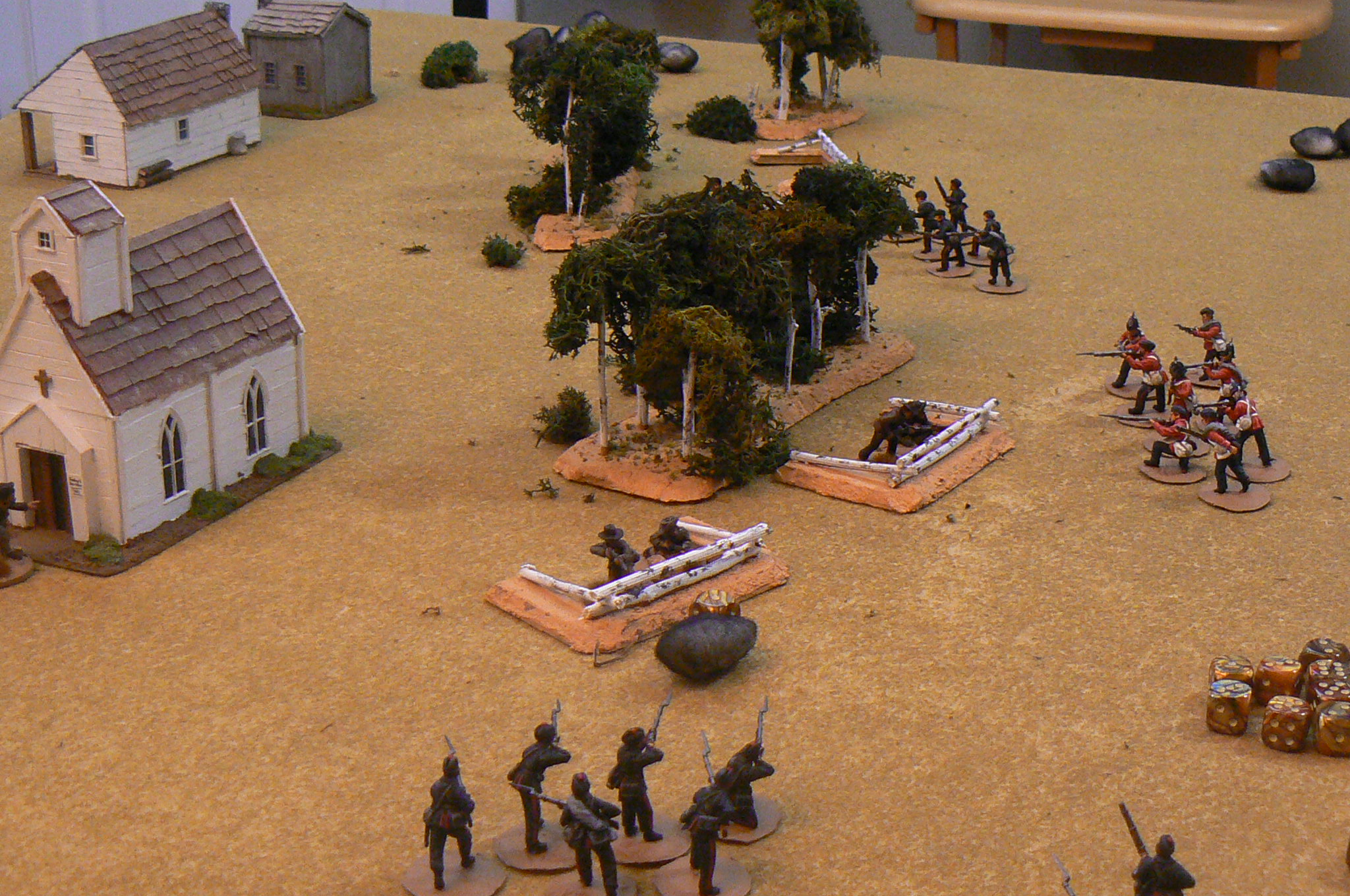


The 'TMWWBK' rules are adequate but for two small changes.  First, any casualties would be limited to one per successful firing regardless of the actual number of hits. Pinning, not casualties, would be the important issue.  Secondly the Metis would set up in the rifle-pits designated as ‘hard cover’ and combined with their good-shooter ability and the Canadian militia poor firing, will have the unequal shooting which occurred.  However, the Metis ever decreasing ammunition supply would be handled by giving them a secret die roll (from the Canadian player) how many shots they would be allowed. I gave a 1d6 roll per rifle-pit;  but each day would see that amount decreased by one. Thus at best the Metis would have only 50% firing minus any further casualties or abandonments in the final phase of the game.   The Canadian player might see less fire power but would be unsure of the amount remaining thus continue with caution which was the trademark of the engagement.  

A “day” ( the historic battle lasting four days) would be 8 turns in length.  The Canadian player must have overcome all resistance to win.  If at the end of each ‘day’ (the 8 turns) and the terms of victory not met, the ‘day’ is over and the action pauses.  Immediately in the ‘morning’ the players can reposition their units with their morale afresh  (minus previous casualties of course ) in any new attack position along the start line for the Canadians or any available rifle-pit for the Metis.   

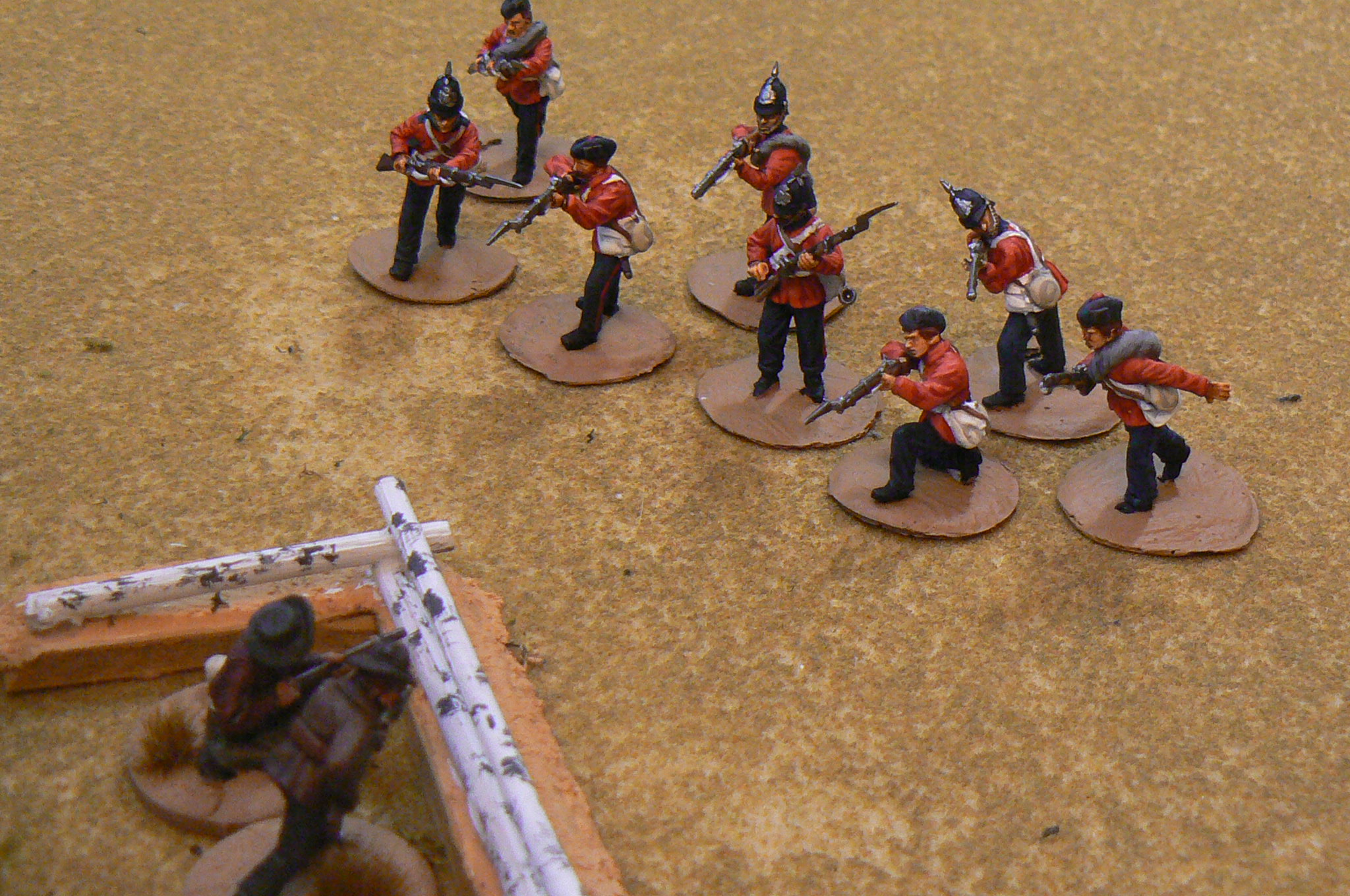
a Canadian Rifle unit in a staged photo.  During the game they did not reach this close to the Metis rifle  pits!

a red tunic clad Canadian militia unit. Indeed, some of the units sent by the Government, were still to wear their dress uniforms including the Home Service uniforms  

The TMWWBK rules are interesting as activation and morale are key aspects but can be very dice fickle.  The resultant lack of action and easily gained pinning effects are perfect for re-creating this battle. The photos are from my second solo play-test.  

The Canadian Militia, whose dress was very much influenced/copied that of the British home country, were in either contemporary rifle-green or red tunics.  As far as I know, the only source for miniatures are 1980s RAFM miniatures.  These are small “true 25mm” very stiff in posture and lacking multiple poses.  Thus I needed to create my own and used Perry Union ACW plastics. While not completely accurate, they do look the part and I needed to only to remove the oval badges and green-stuff the glengarry caps or, in some cases, add a Perry ‘Home Service’ helmet head.  (indeed some units wore these! )…. oh, and a different paint scheme, of course.  Much of the militia had no other uniform for campaign but their full dress version.  

The Canadian uniform of the era

The very dark green - almost black of the Rifle Regiments. I highlighted a dark green over a black base color on the miniatures.  

the model within the Park Site's pavilion 

I built my model rifle pits on this example.


Sunday, 13 February 2022

The French in Algeria c.1834

 French involvement in Algeria c.1834

I love the image on the right.  I added the red trousers from the more formal dress, as seen on the left hand figures. 

Ever since I looked at this image, I saw the potential in the Victrix plastic Napoleonic Guardsmen with their overcoats.  The red trousers are a great look.  But at the time, I dutifully employed those I did have, in the various napoleonic units I needed to create.  Then there was a sale at the local hobby store and the big old box of Victrix Guardsmen were still there, buried, and still at the old low price.  I could not resist!  


The rear of the 'African caps' used at this early date in Algeria. With muskets and looking very Napoleonic still. The start of use of the bulky packs worn in the campaigns of North Africa can be seen. 'Green Stuff' rolls were added. Some modifications to the equipment was done but the figures as is were quite appropriate for 1834.

The headdress is the “African cap” which would eventually be reduced in size and transformed into the famous kepi; but at this early date, the French were still experimenting on the military headdress to be worn as the traditional leather or felt shako was too hot and unsuitable to the environment of North Africa.  I created the 'African caps' from the Perry late Napoleonic French hussar shakos (the Rouleau) with the back leather flap the distinctive feature.  The pompons and cockades were removed and a button of the ‘African cap’ was added on the top. I must admit that I added the folds by paint only….

I picked this earlier era, as by 1840 the French in North Africa had taken to place ammunition pouches on a front waist, so these figures would not be appropriate.

Line Infantry in Algeria 1833. An 'interesting'  experiment in cap design by the regiment on the right.  These experiments were seen very early in the North African campaigns. The tincture of this plate over-lightens the intended grey too blue, but the pack was inspirational. 

Note the white/blue striped roll on the backpack. I found some plastic ones that look the part with paint

But alas, once again,  I have done a force without an opposition for them.  Perhaps I will obtain some Algerians of this earlier era of colonialism at some date, but first I will probably add the Zouaves to bulk up the French presence.


During this era the armaments of the French and locals were not all that dissimilar so battle would not be the usual one-sided colonial actions of the later part of the century.  Reading the military histories, the fights were quite intense.


Sunday, 14 June 2020

US "Pony Wars" Cavalry

Awhile back I found a small group of Dixon US dismounted cavalry of the mid 19th century and decided to quickly do them up.  No, I don't have any opposition for them but that is a minor detail...

More recently a friend decided to open up his imaginary 1920's "East Indian" campaign i.e. that of the sub-continent of Asia, to those locals interested in playing (eventually).  As humour, I offered the following "historical" explanation to how a bunch of American c1870 horsemen became involved in a war fifty years and half a world away:

From: General Waywronge , US Army Public Relations Department 
To: Military Allocation and Transport Department, Washington DC,
Date: 3 May, 1920 

Regarding:  Transportation of United States Army Historical Reenactment Troop,  Fort Cheyenne circa 1876. 
Destination:  Northwest Frontier Settlement Theme Park
Request:  Transportation of said troop plus horses, arms and ammunition, to mentioned location with all due haste for annual ‘Red Indian Days’ in June of this year.
———

“Sergeant, where is North West Frontier?” asked the two week old replacement;  he was confused upon reading the request.  The First Sergeant of the Military Allocation and Transport Department, already frustrated by the constant questioning by what he considered to be a halfwit - even by Army standards - did not even bother to look up from his reading of Gunga Din.  “Well it is in India, you idiot, in the North-West part, hence the name.”
 “Got it! North West India.” 
The sergeant, to his pleasure, heard a muttered muttering from the clerk,  “Oh yeah, that makes sense, ‘Indian Days’!

After many minutes of scribbling of orders the sergeant
engrossed in his Kipling book, had to respond to yet another question.
“ Sergeant that's a pretty big area on the map. Can you narrow it down for me?”
The sergeant replied,  “Try Jhamjar.”
“ ‘Jhamjar’, Sergent?”
“Jeez a’ ”, cursed the Sargent, “J…H…A……..”


It was thus that a small troop of US Army re-enactors in bluecoats and armed with old colt revolvers found themselves not pretend-fighting Red Indians in the plains of America but actually fighting Indians with machine guns several continents away

Sunday, 26 April 2020

The Army of Major Might

Will Bailie, a wargaming buddy of mine has his focus on the Indian/Afghan area for some time now and has created his own imagiNation world of a Indian Sub-continent land called Jhamjar (yes, like jam jar... so lots of "food you put on toast" puns possible among others).  He put out a call for local fellow gamers to add a contingent should they wish within the confines of era and geography.  (Link: Jhamjar explained )

 As I had some Boers laying about "without a home" , I decided to quickly base them for the task.
The following is my contingent's tongue-in-cheek backstory:

  
Major(recently retired)V.G.Might, late of the South African forces stationed in the Sinai at the end of the First World War, did not want to go back to Pretoria.  He felt many of his (former) command felt likewise.  Victor Might was dissolutioned fighting an ‘Imperial War”.  A dreamer and reader of grand adventures in the back and beyond of Asia and one morning, after a much gin-fuelled read of “The Chalice of Hunn-Nee”,  began his recruiting drive.  He found a large body of men armed and looking for adventure and offered them images of riches and exotic lands.

Courtesy of his ‘procurement officer’, a rather daring individual who boarded commercial ships as they transversed the Suez Canal, asked for their shipping manifests (often at gunpoint) and removed whatever would be useful.  One such vessel was transporting suits of men’s civilian clothing. “Can’t be wearing our old khakis can we?”  To the Major’s liking, as they were of somber tones; to these were added bandoliers and, of course rifles, by far the easiest to obtain. Razors were rare however, much to some of the men’s delight.

The army was given its employment the day when the Major’s second, Piet Rasponse “Rasp” Berry asked scratching at his growing beard, “So where do we find this chalice?”
   Might did not look up from his worn atlas of Asia, “Well, Rasp, the Huun Nee is thought to reside in the Bai Lie Temple somewhere in the Imagitush Mountains.”
   “And how, pray tell, do we get to this ‘Bai Lie’ place?” asked Rasp.
    Pointing a finger somewhere on the old page, Might responded, “Through this Jhamjar region it appears.”

…So there is my backstory to why a bunch of Second Boer War figures would be in a remote section of Asia. But how they are to be deployed, whose side are they on, and their quality is yet to be determined.

Photos of Might's 'Army' on the trail to Jhamjar


Saturday, 21 December 2019

The "Cattle" Expedition


Up to now I have always had plenty of time to engage in my favourite hobby, but with the recent employment at a 9-5 job, my wargaming time has significantly decreased.  As my dearth of posts recently can attest, it is certainly a time killer.  “Try to do any with that AND three kids!” was the retort from a couple of my wargamer friends!

Anyway, as a last, before Christmas game, I hosted a colonial British Afghan expedition to supply cattle to a far outpost.  Using my “veteran” (painted c.1987) Ral Partha ‘true 25s’,   I had all six of the players play on the same side, while I would control the natives via “auto-pilot” chart and hidden deployment.

In a rare cooperative method the gents allocated troops and deployment sharing an overall plan.  Sort of countering this, I also added my patented card sequence which uses a sequencing hierarchy to have the players move, should they choose, before others.  Some used this, others just flipped over the next card they had, but this together with the rules (The Men Who Would Be Kings - TMWWBK) ensured a lack of foreknowledge of who-moves-next.
The Imperial force marches
The terrain was largely unknown to the players - but of course they had the 2,000+ feet of elevation advantage standing around the table,  the normal “does this give me cover?” was necessarily indicated.
The logistical centre of the column advances
My collection is a bit on the small side, but with no way of adding to, I went with dividing all the units into six figures (8 for the natives) using the half-size option and increasing the speed and decreasing the shooting hits to offset.  So with that, and the usual poor shooting of the warriors under my diced control, the overall casualties were light (perhaps more realistic than the normal for most wargaming huge casualty numbers?)
The Gordon Highlanders having covered the left bank of the waterway, crosses to join the column

We still employed the rule’s activation which had the effect of the metal soldiers acting more prudently than their erst while commanders who might wish them to advance across open ground to “check out the unoccupied village” but the unit quite unwilling to move from their cover….

It came as no surprise to the colonials that as they neared their destination, the inviting British Regimental flag (they could not have seen the blood smears) was taken down and replaced by a horde of tribal warriors.  These were largely dealt with by rifle fire from the near by rocky knoll (and my usual very poor dice rolling for the apparently inept locals).  Throughout the affair I would regularly roll low - a string of four 1s at one point - so the tribal warriors seemed to have little heart in fighting and would rather withdraw than to engage, but much to the relief of the Colonial players.
The fort with one of the tribal units having charged outside the gates
The Highlanders, having gained the top of the knoll, exchange shots with the unit in the tower.
The mountain gun, at the right, sets up for the final shots of the battle.
 The mule-borne mountain gun was however finally set up and after fighting off three (!) separate attacks of the half-hearted natives (my dice rolling in full evidence here) to finally put in two blasts to knock down the gate.  With the fort retaken and the cattle still safe, the players rejoiced in their victory.
….then put on their coats and went out into the rain for home…..

Wednesday, 14 March 2018

Zulu using TMWWBK

The British camp defence. The British rifles in line provided huge firepower.  The NNC, with their red rags around the heads for identification,  provided additional firepower....well a bit anyway and luckily were not challenged in combat.  


Having just looked at my 15mm Zulu War collection the previous day when the call went out to host a game I thought of using them - they have been in the boxes much too long!  Hmm, using which rules?  Having played “The Men Who Would Be Kings” recently I figured I could guide everyone through and as JimF also joined, he could help.  Actually the first time using tribal forces by any of us (and it showed!) .

 I took the roll of the Zulu in my recreation of the famous Battle of Isandhlwana so I wanted the British players awed by the numbers facing them. They were not; despite having painted and based the remaining 96 I had yet to do, during the previous day. This ultimately gave the Zulu 6 impi/units with 48 figures each.  Actually not as impressive as it might sound as TMWWBK has the British infantry unit at 12 figures and a tribal at 16.  My 48 still represents the 16 strong tribal unit but in bases rather than individual figures; but the look on the table does somewhat display the historical strength disparity in this battle.
The 'historical attack' of the Zulu upon the British at the mountain of Isandhlwana.
While having appealing mass, still represents the 16 suggested by the rules.

I was discouraged almost immediately by my poor activation rolls for the Left Horn which did not get the order to advance apparently. Wrong side of the hill from the rest?  But the other impis were soon advancing at the double toward the British lines.

Francis commanding half the British which included the Natal Light Horse and he had them scout the plateau then do a sneaky move to go between two Impi,  which had left a gap, to move into the rear hoping to distract them (me) from advancing further.  I ignored that move and managed to move into contact of the left flank British company destroying half of that formation but excellent dice rolling by Jim (six of the twelve dice were 6s!) had my boys bounce off.  That was the closest the Zulu would get to any victory.  The overwhelming firepower by the British would not allow the Zulu to make contact despite their excellent discipline.
The excellent 'leadership' bonus of the elite modifier and my decent die rolling, had the Zulu arrive this far...they will however be shot up soon.....

The Left Horn finally came into range but by then the other units were spent.  In the post battle analysis, my advance without waiting for the Left Horn units was criticized as not timing the attack to arrive together. Probably correct. Using “Go To Ground” activation might have saved those units of ‘the Loin’ shot up, for later.  Also we started to talk of tactics (!) like using one unit in line to soak up hits as others come behind still fresh.  I set up my units as per the historical model and the usual Zulu way, but food for thought.  
only 5 of 16 left but my die rolls their bravery and discipline keep them in the battle.

While using 15mm figures, we made no changes to the rules including that of distances so using inches.  The Zulus with the extra d6 of movement and my unusually good activation die rolls for most of the game had them moving rapidly…into the rifle fire…. and defeat. History not repeated.


Friday, 5 January 2018

The new FFL

The Wargame Narrative

January 5, 1927

Dear Mere,
Happy New Year  
Sorry to not have written for sometime now but, really nothing to write about. We must still do our chores, clean the latrines, clean up, do the laundry.

But yes, some fun stuff too like get ready for our march into the desert to relieve a small fort near the mountains.  For us it will be a new experience.  Recently we veterans were grouped together in a new unit and given a fresh ‘regimental touch-up’ .

Of the trek I cannot say much. I am told it will be a boring travel over flat, featureless terrain and we will probably not see the natives should they dare to have at us.


We are commanded by officers we are not familiar with, so none know their quality - more on that later!  But we are of the Legion Etrangere Francaise so can probably overcome any deficiencies of any officer foisted upon us.


                                                                                                                        Page Deux


The march is well under way under the unrelenting sun.  Sous-lieutenant Premiermort turned to the sergeant and stated he “has a feeling the natives are close”  We look around but see nothing but flatness, a broken line of thin bush and heat waves.

Then the bullets start flying….

———

My preparations for the game:

I gained this collection of French Foreign Legion c. 1920s , as a fellow wargamer quietly brought a box of partially painted figures of mixed origin to the club.  A kinda aborted project he needed space and put a very low price on them.  Normally I do not buy painted figures but this was a good bargain and he gave me puppy dog eyes :)

 Originally I was going to re-primer but upon further viewing decided to just touch up and give them a wash.  With two coats of dullcoat I am pleased with the results. Not my usual style of painting but certainly do play the part well; the “regimental touch-up” as noted in the letter above. Also note that veterans means experienced by another - like pre-owned cars and 'experienced' golf balls....

The number of figures were pleasantly perfect to create a complete Field Force to which I added a few smaller sized donkeys I had waiting for some paint,  to include for any scenario design and simply because they look good together!

As the previous owner super glued the figures to the bases and had applied a couple of different methods of basing using sand,  I could not redo the basing - at least not with a heck of lot of effort! - and so did what I could to make myself happier with the bases. While not ideal, the GW round bases are not bad for the type of game.
A mixed collection of manufactures including I think (?) Old Glory and Tiger Miniatures
The basing is still a work in progress. Might dry brush additional sand colours and add a bit of dead grass to cover up the obvious figure's base lines.
The donkeys baggage train.  Many scenarios employ baggage for victory conditions.

Re-reading the above "Narrative" preamble, the reader will induce a number of issues which will influence the game.  Boring terrain for example as I have nothing for North Africa!  And of not seeing any natives?  It will certainly be the case as, again, I have none to play with and so the game will be the ultimate solo affair ; without another player, without terrain and without an enemy!  All will be up to my imagination and the dice.
The featureless terrain - as I have little for this period and region.  The scrub is brown lichen and the clumps of 'straw' are markers for the hidden Berbers.  They are obviously masters of the art of fieldcraft and are impossible to see.....as I have none! ;)

I am using “THE MEN WHO WOULD BE KINGS” rules by Dan Mercey for colonials.  Among its fun characteristics is that of rolling for the traits of the officers commanding each unit.  Well, as
suggested by our legionarire writer to his dear mother, my die rolling poor, as it often is, was to foist officers of 1-2, 1-3, and 6-5 onto the three units of my field force.  That is to say, one officer has “ a fine moustache” (which indeed the diced for figure actually does have!) but he is very poor commander ; as is #2 but he is “bullet-proof” so unlikely to die and bring in a better rated sergeant!   And for the machine gun, it’s officer is short-sighted so the machine gun cannot fire to advantage at long range targets…

And as I determined the officers not to be of the highest quality, they did not think to have scouts and so will be ambushed accordingly.

The terrain, what there is of it, has a small dry stream bed behind thin scrub to hide three groups of riflemen with modern arms together with a machine gun but poorly handled.  The fourth rifle unit was in hiding laying down behind an almost indiscernible rise of land.

The two Legion rifle units are in line of march with the machine gun and baggage mules between.

Each side has 24 points.

We start the game with the bullets flying….

TO BE CONTINUED

Thursday, 16 February 2017

Musings on numbers and bases

In the Lion Rampant rules, and while I have yet to exam, I must assume for TMWWBK rules also, hints are given by the author to increase or decrease the number of figures required for the game.

But really it comes down to the number of bases not the number of figures.  With that in mind, I mused about my 15mm Zulu collection and, having LOTS of Zulus but not all that many British, whether I could have 12 elements on each side but discount the actual number of figures that represents.  Let’s be honest, few of us would not envisage hundreds of natives descending upon the thin red line.  However with 12 figures for each opponent....well 12 vs 16 for the native but not that disparaging all the same.....it gives not that dramatic effect.

However if one looks upon each stand equivalent to a figure, then 12 stands is a unit.  For the colonial types these can be of a single figure; but for the natives one can place 3, 4 or many more on each.  These multiple figure stands still equate to but one “figure” for the sake of the rules, but now we are talking about 4X as many on the table and giving more illusion to the masses of natives opposing the few colonials.

Having my samurai at hand, I laid out all my multiple figure stands to oppose the singles.  Looks like a massive outnumbering but each unit has only 12 elements.

If I were to make the multiple stands a bit smaller, both units would have the same frontage/width and thus equal in the eyes of the rules.

Just musings at this point but something I will look into for the future.

Monday, 16 January 2017

"Great leader, is getting shot at the best course of action??"

Played a great game of "The Men Who Would Be Kings" Osprey rules (TMWWBK) hosted be WillB at the recent club night.  It was an interesting scenario, apparently straight out of the rule book, having, in this case, WillB's  c.1880 era Russians Colonial forces on one end of the table with the British and Imperial forces opposite and both needing to move to the other end to win respectively. The Afghans (under my dubious command) were in the middle, unfriendly to both.

The rules have the players roll up their leaders in a very role-playing fashion. This sometimes provides bonus and...sometimes not.  For instance, one of my Afghan sword-wielding units had a coward for a leader and so could not charge (!) and thus not the most potent of offensive units....

Another unit had a leader smoking hashish (it is assumed) for a separate roll of a d6 each turn determines the units leadership roll - good or poor -whether he was hyper or dulled by the influence!  [ for the record he was super-leader during the entire battle ]

Or the red-clad "regulars", who had an 'idiot' for a leader.  If the commanding player roles a 1 on a d6 should he wish to do anything with this unit, it is not he but the enemy player who commands them.  Obviously then, that player is most likely issue an order contrary to his best benefit!  Of course, should a roll of a 1 be detrimental, I will, more likely than not,  roll it.  And so it was in this game that, not once, but twice (!!), the unit was brought out from the safety of the rooftop into the open for the Russian player (PeterM) to shoot them down. (the quote of the post title is the ranker's response to this action I would add)
the Afghan regulars with an idiot for a leader ( note that the Afghan national flag during the era was simply a solid black banner with no markings)  Building and figures painted by and in the collection of WillB.

Neither Imperialist gained their game winning conditions so the victory went to the Afghans.  Another interesting and fun game with the TMWWBK rules.

Thursday, 29 September 2016

Perry loveliness

While watching one of those silly rom-coms, I asked my wife, "Do you believe in love at first sight?"
Not even taking her eyes off the screen, she replied: "Has the Perry's put out a new range?"

Well, since you did mention it.....

from the Perry new Cape Wars range