Showing posts with label AWI. Show all posts

Sunday, 31 May 2020

AWI in plastic

My collection of AWI is in its third incarnation. The first was old Minifig true 25s.  The next was, and still but only with my AWI French,  Front Rank.  And finally now Perry metals - for the most part.

 But I finally broke down to buy a box of Perry plastic Continentals while I await a Perry metal order  delayed due to Covid.  I thought they would be compatible.  Surprisingly for Perrys they sort of aren't; at least to my old eyes.  The plastics are much thinner and a bit taller.  Really nice, Beautiful. Would have liked shooting poses but as marching, nice.  Now of course seeing the transformation of the Perry sculpting to this much better human proportions, better proportioned weapons particularly in plastics compared to their early lines which included their AWI range, I probably should have been patient and await them*.   I nevertheless painted 6 for a small Loyalist unit 'King's Loyal Americans' which accompanied Burgoyne into the Albany Valley to Saratoga .  The remainder must stay in the box for now.  Should I later get excited about a Southern campaign I might be led to create a large unit of South Carolinian continentals - the spare hats included in the box have that distinctive cap worn by those colonialist. Or more probable, get traded or sold....the usual.

I picked up a base of the unit and took this quick pic. I hate the macro lens as it shows off all the minor issues of the painting when a more steady hand, better eye (or use of the mag lens ) and certainly more patience would be useful. They are not "El Mercenario" standard ( examples of his painting ) however for about 21 minutes per, OK for the table.... but I really need a longer arm!

edit*  Funnily enough the day after composing this post --they came in the mail!

Wednesday, 8 January 2020

Saratoga, here I come!


Finally had the time…and mental momentum….to finish my American contingent for my certain portion of the American Revolutionary War Saratoga campaign.  The battles to come will be a contrast in tactics.  I have certainly taken the mythical view so thusly the Americans will have good-shooting small skirmish militia units, some as veterans, with (for now) only a small Continental regiment and with artillery support verses very large but timid Brunswick Germans units.  The latter formed a large portion of the British army descending the Hudson River Valley in 1777.

I have taken the narrative of the historical campaign battles and thus will have fictional scenarios involving the Brunswickers attacking across open fields with the Americans firing into their ranks (an aggressive commander [Gen. B. Arnold?] leading);  the Germans attacking American defences well defended by artillery (allowing for American commander ‘Granny’ Gates’ “let ‘em come to us” plan if came to pass);  or reversing the latter scenario and having the Germans defend their built defenses against the American assault per the Breymann’s Redoubt engagement
'Benedict' encouraging the troops
In any case, the rules will be Osprey’s Rebels and Patriots [thus the mixed basing styles].  Speaking of which, the reader will have noted that the Germans (mostly Brunswick but there was attached a unit of Hessian infantry with accompanying artillery unit -  as those figures were slightly different posed and I had knowledge of that unit's flag!) have a ranked look while the Americans are on round bases either in group or larger singles.  This was deliberate as to convey the difference in fighting style (using the traditional view).
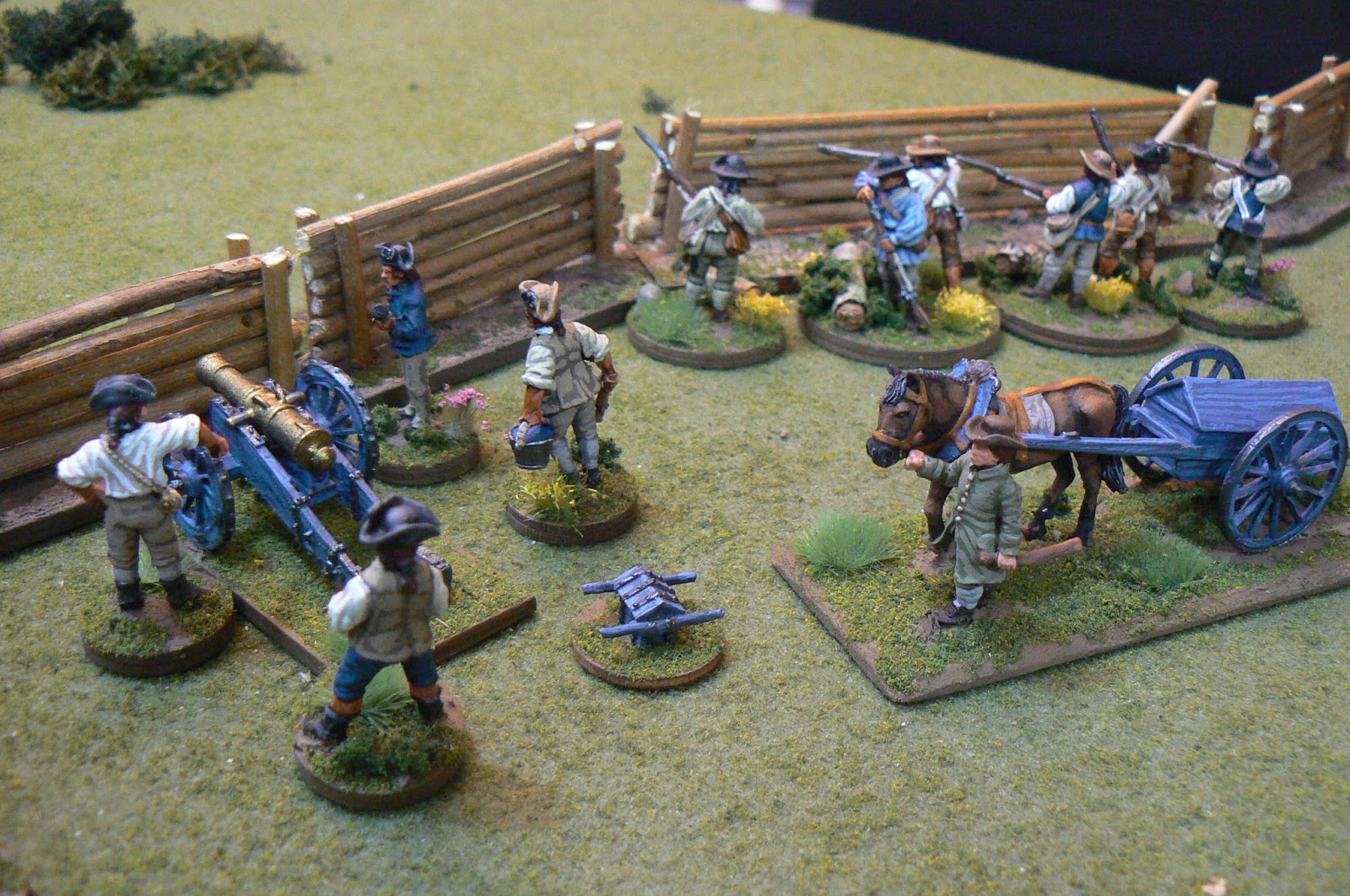
The militia form up behind the log emplacements 
One of the 'heavy' guns and another unit of militia skirmishers holding the right of the camp

The American figures are mostly Perry “Southern Militia” re-purposed [ obviously MY battles will be fought on exceptionally pleasant October days for the boys to be in shirts only! ] The Germans are old Foundry SYW Prussians (the 1777 German uniform continued to be virtually a copy or close enough….)  The Americans happen also to be artillery heavy but they did have a fair amount of guns in their encampments historically so.  Guns are points expensive in RaP so it might be fun to play out a scenario in which the American camp is defended primarily only by artillery and see if the firepower is enough to stop the German advance.
Part of the much more numerous German force

For once, I actually had a plan for the collection before ( ! ) painting/basing - not before having the  figures but 2 of 3 in the planning is good for me!  Other than perhaps another Continental unit to make it a bit more historical in composition, I have enough in size to conduct the battles I wish to run and the historical context to provide the scenario inspirations I will enjoy.

Wednesday, 18 September 2019

AWI action near Fort Anne


July 9th, 1777

 To his Excellency Lt. Gen Burgoyne

It is my pleasure to relate the clearing of the rebels near Fort Anne allowing Excellency's continued advance to Albany

Please indulge me to describe the actions of hie Excellency's Brunswick forces this day in service of the King.

The Grenadiers had the post of honour on the right of our front line with the Regiment of v.Sprecht to the left. The second line wascomposed of my regiment and that of Hesse-Hanau.  Due to the constriction of the field, the v.Rhetz formed column on the left while the Dragoons (dismounted) moved in the light woods to the right of the field. Our light cannon was in reserve.
My German force of primarily Brunswick units during the Saratoga Campaign of 1777.  Previously employed in the SYW, they have been recently "redeployed" and rebased.  
The American rebel militia at the far end of the field. 
a fence half-way along the field at appropriately musket shot to the rebels position within the forest had Specht’s regiment halt for a turn to cross [1] so that the column of v. Rhetz moving swifter took up the lead formation at while forming line of battle sustained fire from the hidden rebels but without pause continued their maneuvers [2].  The fire from the forest then ceased [3]
allowing the v Rhetz to move to the fence marking the end of the field. 
Von Rhetz's Regiment in column
now forming into line 
the Grenadiers (a combined unit from the grenadier companies of all the regiments) stand before the fence facing fire from the rebel "in the shadows" .
The Grenadiers meanwhile gainfully crossed the fence and advanced toward the tree-obscured rebel militia but halted before the final advance [4] which, with a huzza, cleared the final rebels from our path of advance [5] but at a heavy cost of 30% casualties and 6% of our total this day [6]. 

Your Obedient Servant,

Baron Riedesel 

Notes:
[1] I placed the fence at 20” from the militia position and for each inch the leading German unit came closer to the Americans, the harder for them to roll under d20 and thus ‘stay to their guns’ and continue the fight. I placed a disorder for failure which they needed to roll off (per the rules) before they were able to fire (their only activation action)
[2] I rather like the look of the formed line on which the figures are based rather than the proscribed ‘blob’ allowed of the rules, so I had this unit ‘go through the motions’. Most of the units are a healthy 18 figures strong. Rules ='large unit' which can take more casualties to get to the troublesome 50%.
[3] the Militia on the right failed their ‘morale test’ and retreated from the fence into the forest not allowing firing.
[4] they, of course, failed activation and stood there inches from the fence and the militia who passed their morale test and directed well placed shots into the Grenadiers.  Most of the Grenadier casualties occurred at his stage.
[5] the Grenadiers having passed their morale test (needing the +1 for elites to do so!) charged the fence line and the militia morale broke.  The Germans did not fire a shot during the engagement.
[6] The v.Rhetz regiment sustained one hit.  The rebel casualties are unknown but thought to be negligible.
celebrating the victory

Friday, 11 January 2019

a French unit of the AWI

Left over plastic bits and bobs can be useful, even for the ‘metal’ crowd.  I this case I had years ago built an American Revolution French force for the siege of Savannah in 1779.  I had moved away from that project but had one last unit primed and ready to paint.  But with sprue full of extra Zulu (read: negro) plastic heads available I was now able to create the rarely seen Chasseurs-Voluntaires de Saint-Domingue which played a role covering the French re-embarkment.

Clipping off the metal hats, then heads, of the Front Rank figures, I inserted the plastic heads. I wanted some variety from the identical heads so did not try to be too exact in the cuts.  In hindsight I probably should have done a more identical approach as the other Front Rank French have a straight ahead, ‘no-neck’ look to them.  I guess I have been influenced by the more recent ‘realistically proportioned’ renderings than the style of the decades old “thick and squat” sculpting style epitomized by old Front Rank poses.

As you can see, I took the photo shortly after gluing but before adding a black undercoat so the work can be better seen.  I will eventually get to them but no real rush as they have currently no opponent to battle with!

Monday, 24 October 2016

War of 1812 set up

While it is everyday that I do something wargame-ish, I do such diverse activities with all my different "projects" whether I want to, or not, few things ever get done to record.  Thus nothing new to report. Sigh.
However to fill the large table, if only for the fun of viewing, I set up a scenario version of the Battle of Long Island of the AWI.  I may not get to it, but fun to view the large number of regiments I have done --- and still more to do!!

Inside the American fortifications
The British flanking move
The 49th Foot in greatcoats they wore during the Battle of Crysler's Field in 1813.  I gave the Old Glory British infantry a "coating" of green-stuff.
The War of 1812 offers fun variations on the usual British regiment such as the West India Regiments (left) and the Swiss "deWattville" (right)

.....and the 13th Foot in white shakos from their stint in the West Indies. Did not indeed wear them long in Canada but that small detail doesn't make the 'cool!' factor.  Sister unit, the 64th in garrison at Halifax, Nova Scotia, did however, but they did not engage in combat.
Plus I have collected lots of the 'usual' line troops.  Canadian militia in the rear reinforce the advance.

Wednesday, 21 September 2016

Still got it

The annual date has arrived which leads me to the usual introspection.  Among the routines, I have a look at all my collections and see the years of painting.  The many, many hours of ....

Anyway, I used to paint eyes on certain figures whose sculpting is deserving of such detail.   These days, even with the very nice ones, washes or ignoring of such small items, is the normal with me.
However,  I rummaged into the boxes to look at my old French AWI collection of Front Rank miniatures and sought to give it a reorganization and complete it, having sat forlornly half-completed.  Most were painted many years ago and some only slightly more recently.  While close in style, I saw the difference and wanted some 'continuity' for this collection.  With this in mind, I needed to paint eyes once again to added to some of these units.

I must admit that I got the thrill of acknowledging that I have not quite lost the painting ability...and steady hand...needed.  Yeah, OK, not quite the standards of the best. Not even close.  But I am OK with the effort. Actually I am stoked that after a period of 23 years(!) I could still get that detail. A good birthday gift to myself.

The new ones are on the different bases (you can still see the white glue!).  I have yet to decide on a terrain scheme.  Probably the usual.....

French Martinique Colonial Regiment of c 1780
French 'Dillon' Regiment of the AWI period.


Tuesday, 25 August 2015

Historical Battle of Eutaw Springs

I stumbled across an old magazine article describing the the Battle of Eutaw Springs in the southern campaign of the American RevolutionaryWar and thought it suitable for use with my War of 1812 collection - same muskets, not much cavalry.
The large 3rd Foot.  Some 400 strong at the start of the battle so at 16 stands, 64 figures.  In the rear the sheep and stone walls are new additions to my terrain  
With my collection as it is, I settled on a 1 stand = 25 men ratio or about 1:6.  While this taxed the collection to match certain troop types ( I am low on horse as the War of 1812 had very few in any of those battles) I still had half my whole collection still sitting in boxes but this historical deployment still had 29 units on the table!  By far this was the largest battle I have conducted with these, and as I only have 25 disorder markers, I can't go any larger!
The centre deployments by both armies with the British defending their camp.  

The battle started much as the historical battle did with the artillery trading fire and taking out each other, and Lee's units attacking the British left flank.  While historically the American militia traded shots and then awaited the Continental regulars to continue the advance, the game had the militia disordered so the Continentals moved through them only to the also heavily shot up by the stationary British line.  Now it was the Continentals turn to fallback through the militia in the centre which had not reformed and thus collapsed rapidly.
One American unit re-deploying -read "routing" - though another.  In this case my militia in civilian dress and those of Kentucky frontiersmen.  

On the American left the small militia units did not make any impression on the British flank elites under Majorbank and permanently retreated and the other units on the American left felt it prudent to  not advance with an open flank and against the large 3rd Foot regiment facing them.

On the American right flank, Lee's troops were now disordered and falling back had the militia units of Marion and Malmedy's Carolinians wary of any advances and in some confusion. The 64th Foot gaining an easy victory led a general advance of the British units against the many heavily disordered American units milling about in confusion.  At this point I ended the affair as the Americans would not be able to do anything but run.  The battle thus did not match the historical result and was an easy victory for the red coats.
The Kentucky-men representing Lee's Legion meeting the British "64th" foot holding the British left flank.
The Loyalist held firm

Obviously with small battles numbers and certainly morale are the biggest influences in the result.  In this scenario, I took most of the units morale assessing militia characteristics by rote and had militia quality to militia units and regulars to regulars but as historically the British line collapsed fairly rapidly and the American militia seemed to preform well (as did the Loyalists) so it will be important to assess them carefully.
Greene's army, while having "militia" units, these were no doubt filled with ex-veterans and the British regulars were in low-ebb so need some downgrading to re-create the outcome of the historical engagement.

Nevertheless,  it was fun to see the boys on the table.


Monday, 30 June 2014

420 miles/ 672 km.... to play wargames

and then back home again....

Mike and I have known each other for many years, meeting a couple times a year for a wargame or two.  But the last time I was at his home, in the small town of some 5,600 souls in northern British Columbia, Canada, was 24 years ago!
So, with air flight ticket paid for with loyalty points.  And he a weekend off work, we had two and half days of fun pushing around some miniatures.

Mike in his own bit of heaven;  his wargame loft.


His [partial] army collection!  Needless to say we used only his figures.
The no chips (British translation: crisps) zone!


"the entrance to heaven"  His 'ladder' to the loft is a bit steep. He is so devoted to the hobby, he removed his roof to build this loft on top of his house!
After I snooped around the loft like a dog in a new house, going this way and that, poking my nose into every box and shelf, we got "down to business" and began the weekend with a Muskets and Tomahawks game.  I wanted to try this newish rule set as I need a good skirmish one for myself.   While it does have some gaps, and does involve a bit of dice rolling, the whole effect is fairly good.  We did not get into the role-playing as suggested in the rules but played it straight up with Mike commanding the British and I, the French.


It can be played on a small table.  The white round counters are my Indians blinds.


I have secured the village as Mike's British cross the bridges.


Mike had previously purchased my AWI collection and a few were used in this game. Good to see them again.


Ah, yes, my usual dice rolling.  Only three hits out of the 12 die thrown...


Entertaining game which seemed to ebb back and forth depending on how poorly we each rolled that turn.  Mike's dice were not hot either.
massed French vs Rangers behind a stone wall...oh, dear. It did not work out well for me.

We played and talked well into the wee hours.  We could say we were lulled by the continued sunlight as, at this high latitude, darkness does not really occur until 23:00 (11 pm), however, to be honest, we were enjoying the conversation and game.
Next day arose fairly early to watch the World Cup Football match.  After which, Mike's usual gaming buddies, Stede and Scott, arrived to play a Fire and Fury ACW scenario of the Battle of Spring Hill.  I took command of the Confederate cavalry which, for this scenario, did not have ammo so no use dismounting,eh. And they are directly across a stream from ready Union brigades but the terrain did not suggest a flanking move.  But once Mike, as GM, said moving across the stream was not disordering but a mere 3" move penalty I knew I would be a grey-clad 'Custer'; Reb's +1 for charging and all....

my Rebel cavalry has already pushed back the Union boys and occupy the town on the way to capture their supply train (upper right) the victory condition (other than eliminate the enemy)
a photo of one of my wild-ass but generally successful charges


The game was good as the friends agreed the scenario was interesting and no doubt they will have another go at it.  The Fire and Fury rules always give a good result. 

With the friends departure and after dinner, we had a go at a Russian (me) vs Prussian (Mike) Seven Years War affair with a home brew ruleset which I had started but failed to continue to playtest.  However previous games excited Mike enough for him to base this large collection to my style of basing!  So we spent another long evening ( 0330 hours in this case!) playing and revising.  Fun stuff. And no, not even close to being cohesive.

Mike's Russian infantry in the large stand basing style.


I massed the Russian artillery (yes, they were in red during the SYW)


My painted Bosniaks unit of the Prussian army now in Mike's collection.


Ability to move elements is based on the number of pips the player rolls.  We had large commands and only one d6 per so without group moves, you tend to fight with limited troops, so much of your army is not being committed.  In my case, my masses of Russian infantry were stationary on the flanks while the cavalry fought on the left flank and Mike's Prussians slowly crushed my center.  I managed to kinda plug the gap but I was already starting to call the retreat.

The 'Yellow Hussars' on my left flank stayed locked in combat for five turns! thereby thwarting the Prussian advance


The Prussian masses in the center.  The horse on the left is my Russian heavies to which I had to attach my CinC to move them which will see them turn left and break the Prussian green clad Freikorps in the caps and with really no option but to continue this 'death ride' around the Prussian army in its rear!  I lost his extra command pips which hurt my battle plans.


a 'gamer's view' of the SYW battle from the Prussian perspective
 On Sunday again breakfast watching the World Cup football and then upstairs to have a go at his home brew AWI rules which is an interest mix of parts of all the other rules he uses. 
The first game was a small scenario which a British regular force was attacked by a much larger but mostly militia army.  While the British did have reinforcements coming to the rescue, they were not needed as the poor militia had a tough time of it as they usual do with disorganization, routing, and poor fire.  Many times, Mike's poor rolls did not help :-)


a good example of the basing for both this AWI unit and of his (and mine) SYW formations


the game in action with the British confidently holding their positions


a couple of my former painted units shooting at each other

from the second game.  The cotton puffs indicate that the unit has not moved and cannot but has a +1 for "volley fire"

However all good things must end, and so on Monday morning I was at the airport for the hour and half flight home.  The day was nice and sunny all the way.  A good weekend.

From inside the Smither's terminal building looking at the mountains (no, not zoomed) The local skyhill is a bit to the left off camera.


The view of the coast of BC from 15,000 feet. 


Usually the mountains are obscured by rain clouds.  But are pretty on days like this

The Dash 8 in which I flew.