Showing posts with label HYW. Show all posts

Saturday, 10 December 2022

HYW 3-way(ish) scenario

French with mounted knights approach from the west, the Dunkirque contingent from the bottom, the English longbow on the hills near the village. The tower is just visible on the top of the photo.

Miniature wargaming is, well, a game.  Yes, it can represent a historical battle with surprise attacks, mismatched forces, and lop-sided results; however, in the usual games with friends at the end of a hard week at work, a frustrating "That was un-winnable!" scenario is probably the last thing desired.  Mine you personally I don't have a problem with those...and my dice rolling usually give me that result anyway!

The mismatch is all the more difficult to remove should there be only three players. Most (All?) battles are one side vs the other.  Therefore, how is the simple army vs army be done should the evening have three participants?  To give enough per side to get a game in and everyone have enough to command is a challenge.  Thought must be given to other considerations of terrain restrictions, defensive works, command abilities of the rules to provide a more even combat abilities for each side.

Decided to bring out the Hundred Years War (Crecy era) collection and provide the English (PeterM) with enough units to command in a central defensive position to fend off myself attacking with the Dunkerque contingent and a force of French under CraigM.  The French had a cannon on the far side, pounding the English tower with a cannon and defended by a small group of men-at-arms.
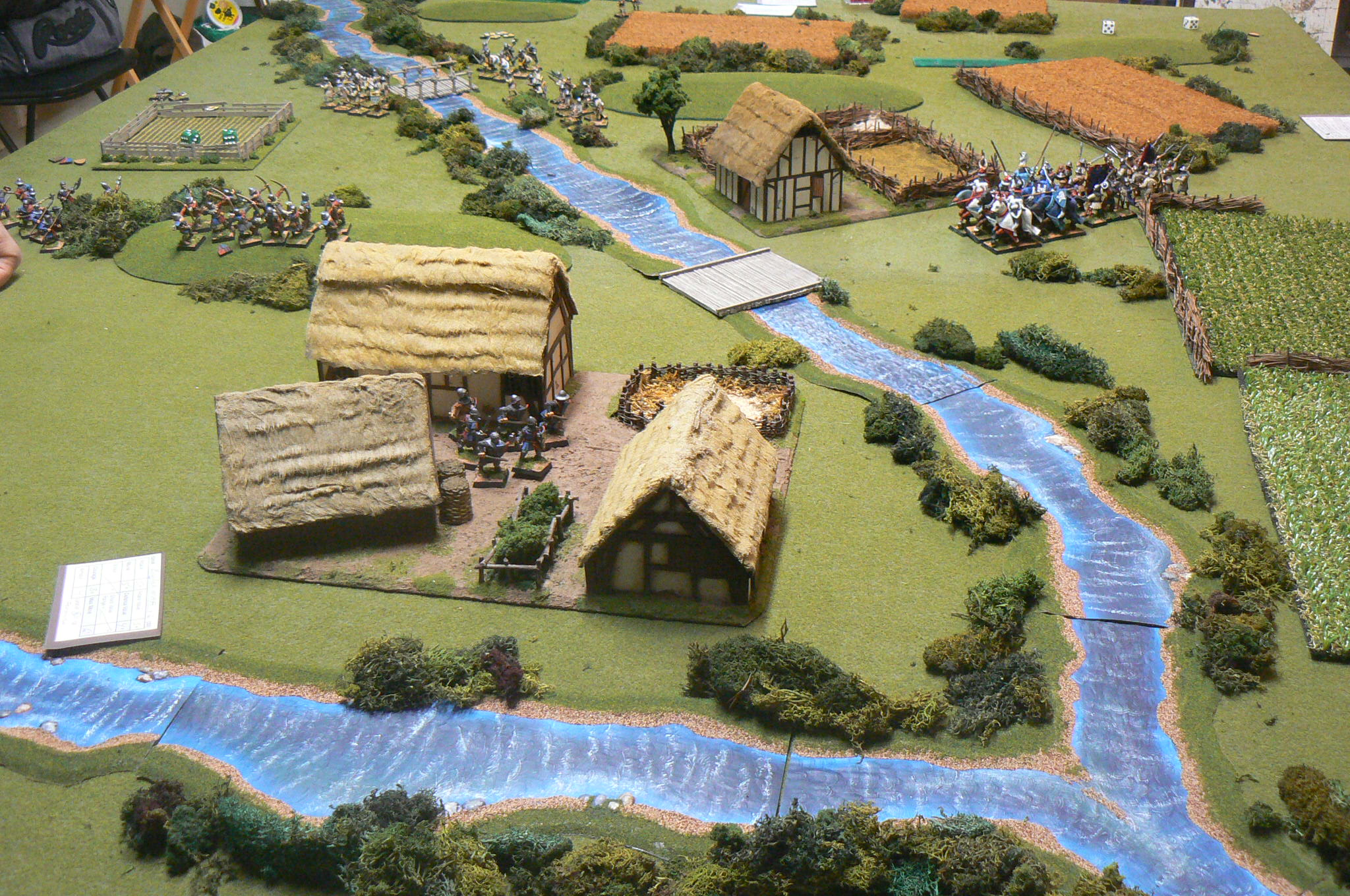
the village with the English defenders and the bridges across the stream.

Do you, the reader and sometimes gamesmaster,  get any pre-game discussions which start with, "what about the terrain?, what is light woods and which are heavy?, is the river crossable?, at which points?, are the fields open or rough ground?" sent to you in rapid fire questioning at the start of every game?  Obviously some need to be discussed but the question of fordability has always been one of those sore points with me. When a player asks about the, say, eight feet of river sections on the table stretching the entire table, would the army even know?  I would say "I don't know, find it yourself"; and getting, yes, the inevitable response of " Umm, how?" In this case I had the player disperse one of his units, the Bidower Woodmen, to sections he wanted to cross and roll for success. This unit would be lost to him due to this deployment.   He did the difficult rolls sucessfully to allow a portion of his army to cross rather than the bridge to his front.  As a GM, make it difficult, time consuming, and troop costly for the player to obtain such information, as just in real-life.  Lots of battles are a result of unknown terrain influencing affairs.  For example, American Civil War Corps commander Burnside kept feeding in troops to cross a well-defended bridge not knowing there was a crossing point of the Antietam Creek only a short distance away from which the defending force could be outflanked.  Tell that location in advance to the player whose army has never been to the location ahead of time certainly changes the subsequent action in the game.

Nevertheless in this game the French had a crossing point in addition to the obvious bridge.  The tower was improbably destroyed early with Craig's remarkably high dice rolling activations [ gunpowder cannon are not in the Lion Rampant rules,  so I would have the cannon activate on ever more difficult activation rolls theoretically limiting the number of shots during the game but his lucky dice allowed him to have successive firing rolls quickly gaining the pre-determined but unknown amount of hits to inflict upon the tower to bring it down. I allowed the number of dice this hidden amount would be based upon to be known, and Peter, ever the statistician, worked out exactly when to move out of the tower with a hidden(*) unit before this might occur. - note to self: keep unknown rolls unknown! 

 Interestingly we rolled to see how the tower would collapse: points of the compass with a d6 and if any 6 rolled per each figure would result in its demise.  Only one of Peter's troops was killed by a falling stone.  It was suggested that if I made the pip number a 1, he would have lost far more.  All game long, Peter and I were competing for the 'poorest dice roller' award.  We did agree however that he won that dubious honour.  

Mid-battle and the French knights are taking a scenic route to the tower, the knights are out of the tower minus one of their number (top of image), and the clash for the hill position has begun with my Dunkirque mixed weapon foot units (lower right)

(*) the tower (see previous post link) has a removable roof and I endeavoured to hide some knights within for Peter's use.  Craig, rather clumsily, knocked it over, revealing the hidden troops.  Well done reconnaissance or perfidious fortune?  Oh, that,  and the resultant "how YOU are to prevent it getting knocked over in the future" engineering discussion.....


Tuesday, 22 February 2022

100 Years War grunge match

Prologue: Well, they are finally painted! I have had these very old Gamesworkshop 'Brettonian' knights ready to paint for many, many years. I have an old post of them still in black primer from 2016  (see: previous post ) I recently added embossed shields from Fireforge which emblems matched some of the headgear of these knights. These shields make painting of the knightly "logo" much easier.  The use of crested helmets did continue to some degree during this period, and the Osprey edition on Crecy and Poitiers illustration plates certainly show them, so I don't think they are too far off the historical track <wink>
Introduction:  After The Battle of Crecy in 1346, the French nobles felt the English with their ‘crooked sticks’ didn’t fight fair, so they want another go at it. 

 So in the blue corner weighing in at 24 points we have the contenders - the French - with three ‘Battles’ of knights on steeds with the help of "Genoese" crossbowmen.
And in the red corner also weighing in at 24 points, the defending champions - the English - with two groups of 'elite' longbow archers behind stakes and a group of men-at-arms together with a group of yeomen spear.
Unlike the first match at Crecy, we are giving "the Genoese" their protective pavises and not having any muddy ground to hamper French movement. These two factors are used to account for the historically overwhelming English victory. Round One: Deployment of the crossbow and archers was at maximum 18” for both. The English longbow shot first but the crossbow morale withstood both lights of arrows and they returned fire causing casualties but no discouragement from the English. Historically, the French knights grew impatient and charged through their crossbowmen. To account for this, I rolled for their movement. If successful, they would move through the crossbow into charge ranges, if not the crossbow would be allowed to shoot, softening up the English. But the impetuous French knights being who they are….. Round Two: Those "Genoese" who avoided getting trampled, moved into a tight group to avoid the advancing knights who, despite casualties from the archers, launched into the more respectable opponents of the English men-at-arms and spearmen; and while the spearmen were pushed back, the men-at-arms of foot held fast and the French mounted knights fell back to regroup. Unfortunately for them the archers, still untouched, launched volleys of arrows into them finally cracking their numbers and spirit. However their sacrifice allowed the reserve knights to move into charge range without casualties.
Final Round:
The French knights (or more the fact, their horses) avoided the stakes and attacked a more chivalrous target in the English knights on foot, and while pushing back the English, opened themselves to be a target of the archers who shredded them. Addendum: important rules which I forgot to employ were the stakes while offering extra armour for the archers cost 2 points which would not allow the archers deployed behind them to be ‘expert’ and shooting better; with the result the French knight gained more casualties than they should have skewing the battle result. Thus the need to rewind. So Grunge Match #2….. The historically numerous deployed Genoese would have spread across the who breadth of the French line but "Lion Rampant" rules prohibit such deployment. This tightening of frontage allows the French knights to avoid the crossbowmen rather than riding over them into a position to charge the English.
My dice rolling came into effect which did not allow the English bow to fire over two turns (!) allowing the French knights to charge without casualties. The Right ‘Battle’ of French knights avoided the stakes to crash into the English spear knocking them back. The crossbowmen, with clean sights, routed the longbow. The Left ‘Battle’ of knights charged directed at the longbow despite their protective stakes and pushed them from those obstacles. The English men-at-arms on foot, could and would advance into the milling French mounted knights getting the better of the fight. Emboldened, they would later charge at the crossbow knowing that should they await the French, the crossbow would merely shoot them down as they stood. However the crossbowmen do know their trade and punctured the English knights as they paced forward. The English, no doubt seeing the further array of the French knights behind the crossbow pavises lost heart.(*)
The English archers while heroically withstanding attacks of the French knights finally succumbed to these armoured warriors. The English army was no more. Crecy revenged!

 (*) a decisive victory made more impressive that a third of the French men-at-arms, the knights in reserve, failed every move roll (!!!), got nowhere near the fighting thus could have been fresh for any further contest.

Saturday, 3 August 2019

Medieval ‘LR’ clash


With a slow rotation of games (telling me I have way too many armies/eras/‘projects’ already) we tend to forget the rules and spend quite a bit of the game asking ourselves “what happens now? The rule is?”

Trying to keep fresh on the Lion Rampant rules, I invited the guys over for a simple ‘refresher’ game.  Not knowing the numbers of fellows I placed down terrain, said “you English over there, we French over here”, gave out personal objects randomly (I was the only one who gave THAT any thought) and went at it.  No planning or battle strategy.  Very medieval that.

The only real innovation came with my introduction of a deck of playing cards for initiative.  As we had four players, each player was assigned a card suit from the deck.  With each card of that suit drawn the player then could try to activate any of his units.  If fail or activated, a marker is placed indicating that unit is done.  Eventually, all the players units would have been used. Once that happens, all the markers are removed and should his suit card be drawn he once again can nominate any of the un-activated units to be diced for.  Once the deck has been used up all players would have had an equal number of activations.  Not necessarily on a consistent basis, but eventually at the end.  We did have one player have five of his cards come up in a row (!) thus he was able to try to activate all his units one-after-another with one of the units doing this twice but with only 13 draws per player, it eventually evens out.
With this, rather than the I-go-you-go or heaven forbid the one fail you're out (per original rules), it creates more action and natural flow of the play.  Of course this can be for any game to get away from predictable player sequence.  Anyway it was agreed it did help with the play.

Pictures of the game.  All figures are mine and painted by moi.  (I was using my newly painted Dunkerque liveried types - in yellow and white with the bright blue dolphin and black on yellow shields)  Historically note: Dunkirk/Dunkerque was not actually French but Flemish during this time of c.1350 - the time of the Battle of Crecy and the armour styles portrayed on the figures. D’oh.  Didn't discover that tidbit until after painting them. Let’s over look that historical inaccuracy shall we…..
Dunkerque mixed yeomen militia (sheep optional)
massed English archers
Having achieved my 'personal objective' by burning the farmhouse, the yeomen will enter the battle.  The 'shield' 'marker indicating that unit has rolled for activation and cannot be chosen until after all the players units have done so.
Apparently this lad wanted to make sure the flames got it all.
my new straw fences using real pine fir needles! ....and lots of glue...
and yet more English archers behind stone fences.  The French really could not win this battle/game.

Saturday, 16 July 2016

Crecy ...LR style

**Warning**
The following blog post contains images of unpainted miniatures on the tabletop which sensitive wargamers may find offensive.  Viewer discretion is advised.

The historic Battle of Crecy with Lion Rampant

My current medieval collection is based on the English of the mid-14th Century.  Thusly I am thinking that I should do the French to oppose my rather large contingent of mostly longbow and to do so with a group of early version of GW “Bretonnian” mounted knights that I have at the ready.  But how would games play with only these MAA types - not withstanding the rule that only half your contingent can be of one troop type?   As one of the famous battles of the era , The Battle of Crecy in northern France comes to mind, as it is well documented as any of the period and is noted for its wild charges by masses of mounted knights.


I set up this battle for Lion Rampant, my current rules-de-jour.   I was going to bore myself with a turn by turn account to document the affair the effect of the rules to the historical account.  However in the herky-jerky motion that is Lion Rampant’s initiative play and my failure to make most of those due to my poor die rolling I decided just to give an overall of account. [ed note: I had 3 turns of both sides missing their initiative rolls which, in LR, means nothing happens. Lots of my 1s rolled. Yes, three turns of the boys just staring at each other... On the other hand the turns are quick to do -grin- ]

So if the short version is wanted:
The French mounted knights finally charged but were repelled and were slaughtered by the bowman. The famous Genoese crossbowmen gave poor account of themselves per history.  The new weapon of the cannon (apparently making its debut on the battlefield at this time)  fired twice (!) and the pits (anti-horse defence) was rather effective and the men-at-arms did their job. And yes, the arrow-storms were lethal.
In general the game account went quite well according to historical play with the French beaten off with over 3x the casualties sustained by the English.

While I still do not understand the strict gap requirement (and it certainly does not make for good photographic shots)  but in keeping with the rules the deployments for the English units were a minimum of 3 inches away from each other. The French will have two moves to meet the English line ( 20 inches ) and with the width equal to that of the English line could also have three units of mounted knight across and a reserve unit having the king one move to the rear.  This is unlike the actual battle which had three successive lines of knights however with the initiative rolls as they are in LR, this would allow at least some degree of charging and perhaps not allow the concentration of bow fire upon only one unit at a time.
The English 'line' of 2 archer units with the dismounted MAA in the centre.  Cannon holding right flank along the River Maye.  A mere 3 inches looks much larger when viewing a photo does it not? 

Oh, yeah, the Genoese crossbow were allocated a position in the front, per history, but I modified their stats to reflect their actions during that day in 1346:

Attack : ---      Attack Value : ---
Move : 6+ Defence Value: 5+
Shoot : 7+ Shoot Value/ Range : 4+ / 12”
Courage 6 Max move: 6”
Armour: 2 Special: no attacks allowed

The crossbowmen were without their shielding pavises (in the luggage) and already aware of the effect of the longbow from previous engagements during the campaign and with their
weapons affected by the rainstorms, they were reluctant to force the issue.  Thus the low courage, armour and shoot effects with no attacks allowed.
In keeping with the original rules and its mandates, I gave each side only 24 points (rather a small version of the battle!) but did allow the addition of two units of the crossbow and as they are certainly downgraded…and historically run over!….they were at 3 points apiece providing the historically more numerical French an additional 6 points.

Keeping with the historical affair, I had the English with two weird types of ‘units’.  The cannon which might have been first used in a major battle at Crecy; and the use of pits dug by the archers in front of their positions.  For rules the pits had an attack value of 6 (12 dice) with the hits added to any which the archers could add in combat.  This reflects the disruptive factor they effect.  One might just make it 6 dice for hits.  This minimizes the effect a bit more but continue to add any hits thus made onto the total from the archers in combat.
French knights fall prey to the pits in front of the archers and the arrows. In the background, the two remaining knights of the right group try to gain the courage for another charge at the English MAA. They will, unfortunately be shot down by arrows fired by the archers to their right. The banner bearer to indicate the unit is made of 'expert' archers to represent the skilled longbowmen.

The other interesting weapon was the cannon.  I copied other wargamer’s thoughts on the matter allowing an automatic fire of the cannon but requiring a 10+ to have loaded (and thus fire again).  Attack value is 6 and the range is limitless.  The special rule is “Boom” which has the target unit test for courage regardless of hits.
The effect of the cannon during the game was to take out one knight but it's unit passed the courage.  After all the English units had passed initiative during a turn later in the game, I could again roll for loading initiative ( no turn to ‘lose’ at it were) and indeed rolled a 10.  So it could fire again. (no effect this time)  However this rule does a wonderful job at simulating in fun way, the slow firing and perhaps little effect of this weapon.
The six figure crew of the cannon. The stand of spears I made so that it may be assumed by any opponent that they do have arms and may indeed for for the gun if charged! (I hope....)

Now, do I use these unhistorical Bretonnian leviathans?  Big horses, big men, big silly helmet crests.  And with the want to only have mounted knights in my retinue and now the knowledge that in a set piece battle they well might lose each time, do I paint them?  Hmm.

Nevertheless the Battle of Crecy was a successful try and went quick. Very much a ‘bathtubbing’ affair.
Dice to match my livery colours! Together with 'battered' markers


Tuesday, 27 January 2015

my forgotten HYW artillery

I find it funny that with any new rule set, wargamers will immediately set about creating variations for different eras than that intended.  "Lion Rampant" is no exception.  Already there is the setting about for rules for artillery, gunpowder weapons "handgonnes" and the like.

The author has created his own forum site ( forum link   http://duxrampant.yuku.com ) and has indicated that he dropped the artillery from the rules as not really in the scope of the action he envisioned.  However a suggestion for its addition was added.

Why I mention this is I had overlooked my one artillery small gun and crew of my HYW collection as I also did not really consider its addition.  Already thinking about the next game scenario, I could see it as a "target" for a besieged minor lord while it slowly fires balls to destroy his tower.  I was pleasantly surprised to find it has the required 6 crew members which for LR can be a full unit of dubious fighting ability in its defence should the opposing retinue get past my retainers.
I suppose a stand of spears might be required to suggest they could fight rather than merely run away.....

early artillery of the HYW 

Wednesday, 14 January 2015

Me Lord's Retinue for Lion Rampant

While usually playing only one game is not the stepping stone for a whole new direction,  Andrew's introduction of Lion Rampant [ LR ] did get me thinking about my dormant medieval 28mm collection.  While I do like the collection, thinking the painting fine and still interested in the period,  I could not make it 'work' for any of the common rule sets played around here.  The army lists of those rules either had me needing to buy - and paint - many more, or had me abandon large amounts.  I was willing to do neither, nor did the thought of rebasing excite me.....

Years ago, some club members came to the conclusion that nearly everyone had medieval figures of one type or another in 28mm individually mounted and wouldn't it be fun to have a huge game with everyone coming with whatever contingent they could create!   Well I was in as I had just traded for a large and now older GW plastic Bretonnian army - very historically Hundred Years Wars that.  Lots of archers of course and so completed the lot all in one livery.
The whole concept fell off the rails of course, as those things usually do, and so I have been left with this one-side-only collection too big and not finding the right opposition in terms of nice miniatures and or indeed willing to do the opposition.
There it lay in the box for years until this week.

After Andrew's game I searched the web and came up with the pointing system and set to task computing my retinue numbers and indeed can produce a three retinue army of 72 points !  And legally at that!  So all the various amounts of men-at-arms, archers, spearmen all are nicely grouped into proper units.  Wonderful!  With the 72 points I could field a 14 unit army if I so choose and all in the same livery.   These are all foot, Early HYW (c. Battle of Crecy)

I was struck by the simple fact that my collection fit almost perfectly with the army list values of LR
Nirvana!
With that
a) I will not have to purchase any more
b) It uses all my figures in total*
c) I will not need to rebase!
d) no other known rules set I can use my force without need to add to or subtract
e) I WILL NOT HAVE TO PAINT ANY MORE TO COMPLETE!

makes the choice fairly easy.  I do hope I will like the rules….

*with the exception of only 3 additonal Bidowers which I completed in short order as I had a few unpainted plastic spares. (see below)

The collection is the mentioned GW plastics, with a smaller amounts of Black Tree medievals, and perhaps ? Front Rank. They were long in the box and traded for or purchased in dribs and dabs so I can't rightly recall.

The livery is dark red/dark blue simply because I liked the colour combination.

One of the elite archer units of my retinue. Mostly plastics with a few metal ones for variation. 
The "Bidowers" 
Before and after slight modifications to give my Bidowers and bit of different look.  Originally GW plastics
the big bushy plastic bared head really alters the look of this figure. I added a small purse to the modified figure to enhance the change.  The bidowers would be mercenaries for hire I be thinking.
The final added figure to the bidower unit.  Again a new plastic head (from a donated Perry plastic left over sprue) provides the greatest difference between the original figure (in the back).  The added large bag again enhances the difference along with the clothing colors used. The other three figures of the unit are, were I believe called "scouts" or some such and are metal.

Now to play a game or two with this lot!

Sunday, 4 January 2015

a game of "Lion Rampant" rules

Andrew came over to introduce the newish rules of "Lion Rampant" by Osprey Publishing.

This is a skirmish-y level rules for the 'whack-and-slash' military periods.  Lacking any historical match ups between us, he brought over his Chinese with bows and pointy sticks to clash against my English early Hundred Years War force with bows and pointy sticks.  As the rules are very broad in nature, it really does not matter the type at all.
The rules are very general indeed with only real hint to their intended target era with the description of the unit type as "Foot Sergeants" "Men at Arms" etc.

Because of the game being a small affair and Andrew having to explain it all with but one game under his belt himself, I really should withhold comments until I have played it more to get more of the feel and subtleties of the system.  As a very visual learner, I saw, with the 'movement trays' Andrew suggested we use to speed play, each unit as a block without necessarily any skirmish feel.  With all units at 12 or 6 strong, that feeling of a block is maintained.  I saw no need for individual movement of figures or even that they be place individually on a stand for ease of movement.    At the end of the game I was already expressing that a 'unit' be only a stand in a vignette arrangement of, say 6 or 8 figures with all the Attacker 6+, Move 3+ etc etc information laid out on the stand itself with only perhaps a changeable marker showing the 'casualties'.

But like I said, I should reserve judgement.  However I would like to like these rules as they have seemed to attract a bit of attention from the local gamers and I have a huge army with 85 archers alone ( ! ) waiting to be used one day.....  (sigh)

It was good of Andrew to show me the rules and gives me a better idea of the interest in them.


Not a real good look to this game but it was kinda spur of the moment and quickly arranged.

my HYW boys all in livery

my pointy stick boys a bit worn down but still in the fight
Andrew's Chinese purchased painted from eBay

Overview of the small action with my archers to each flank of the spear and his horse at half strength from a couple failed charges at my centre. 

One of my "need a 5+" attempts!  OK to be honest the next six throws had much better results......