Tuesday, 2 December 2014

The Russian field fortifications at Borodino

I still remember two great influences of my wargaming interest as a kid.  A book on Waterloo which I still own and a relative's novel "War and Peace" with very moody painting of battle scenes which I still have in my memory.  No, I have not read the novel, well except those chapters about the battle itself, of course! But those illustrations still stay with me thus, I guess, my obsession to game this battle.

Of course one of the most important focal points was the main Redoubt the Russians built. The other, the Fleches, I think would make good victory points in recreating the battle.  Russians have them, the French need them for the points.  While historically the battle became pointless, for wargamers it is pride in that of the taking, just as it was in real life.

So without further ado, my Raevski's "Grand Redoubt" ......

Raevski's Redoubt .... 


Yeah, not all that grand, eh?
Well, in size, it really wasn't.  While I have seen very large renditions with 8 or more model cannons, those were for battalion scaled games and might well have been even overlarge for that.  Indeed the redoubt was only less than 200 meters (~200 yards) in length and having only 18 guns or 1.5 Russian batteries within.

I viewed several maps and have made the tabletop scale approximately 1 foot of table to 1 kilometer (0.62 miles). The table will be only 8 by 5 feet.    So at 200 meters the redoubt is about 1/5 of a foot which, if all my math is correct - never a sure bet - is about 2.5 inches or under 6 cm.   So my redoubt at 4 inches is oversized!!  Yes, the vertical and horizontal scale problem of wargaming rears annoyingly again.
Add caption
Obviously I did not plan all this out while starting the building.  I simply just took an available piece of hardboard for the base and started cutting hard insulation foam to shape.  With such a small footprint I decided on a more abstract creation knowing I could not possibly get all the correct details within. I did elevate it a bit as to give it more imposing character.  In the game,  as historically, it may well become an important focal point.
The French attack in masse.  The Pavlovski Grenadiers help defend.


The Fleches are similar in their small footprint.  Rather than have the proper three separate earthworks in the correct configuration - resulting in a model more suited to 6mm than our 28mm - I went for only one earthwork, not particularly tall,  to portray the rather inadequate protection it offered.  Due to its open nature, in the game it will offer no combat protection at all and only to forward fired cannon shot.
The Fleches

Again, as historically, it becomes a focal point, a marker almost, to be fought over.


The models have the necessary dice frame holder for the rules however the crew are detached to allow placement on other stands should they be required. The figures are Foundry and were acquired from MikeB who got them, poorly painted, in an ebay lot but he did not require.  So with a quick repaint, their small bases are ideal for these field fortification models.


Sunday, 30 November 2014

Battle of Wavre 1815 refought

As Dave B. is an excellent sounding board ideas for developing the ongoing Napoleonic rules, a foisted upon him another Napoleonic game.

The Battle of Wavre was fought at the same time as Waterloo so gets little of the same treatment as it was considered a side show to Waterloo's main event.  Even the Prussians themselves knew this to be true and so left General Thielemann with less than his full corps to delay Marshal Grouchy ('Grew-she') while the rest of the Prussian army left to beat up on the Wellington's forces.
My "Marshal Grouchy"stand.  He is eating his strawberries as Gerard berates him to march to Napoleon's aid.

The Prussian defensive line was the difficult to cross Dyle River, so once again we are dealing with Napoleonic town fighting across the bridges at those points.
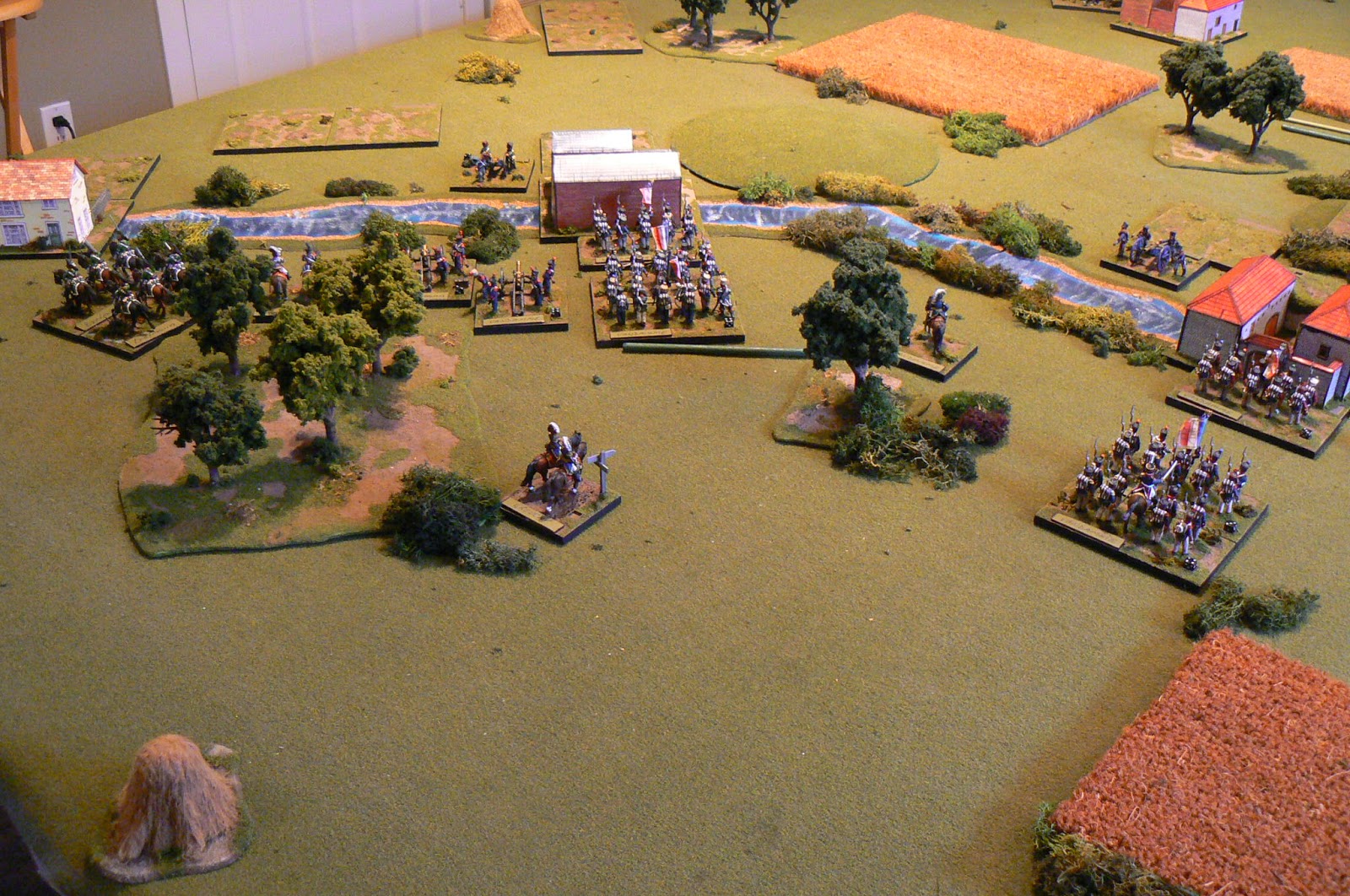
Looking from the south-east toward the direction of Waterloo, this photo shows the Dyle River.  Dave's initial French forces of Vandamme's infantry are assaulting both Bierge(center) and Wavre on the right while Exelmann's Dragoons look toward Limale on the left. Only the Prussian artillery are showing themselves on the far bank of the river near the villages.
I took the Prussians as they were pretty well stationary giving Dave the more decision making French command.  Historically, Grouchy followed what he believed to be the proper course of action from Napoleon's rather cloudy directives.  After the Battle of Ligny Napoleon gave Crouchy who previously led only a corps of cavalry, command over the infantry corps of General Gerard and Vandamme both of whom were heavily engaged at Ligny, along with the cavalry of Exelmann and Pajol.  Napoleon seemed to want to have Grouchy keep his sword in the back of the retreating Prussians while Gerard pressed for him to march to Napoleon's aid once the cannon fire from the direction of Waterloo was heard.  These two different actions formed the options - by secret die roll - which the French under Dave B. could take unknown to me, as the Prussians.  Thus I could not commit my reserves accordingly.
Dave moving an element between Limale(right) and Bierge(center) .  Note the large blank bases which form my potential hidden reserves.  These bases I kept from their previous use as our artillery bases, which are now considerably smaller.


Now to be honest I did not have much choice in my reserves deployment, nor did Thielemann,  as he was seriously outnumbered and most of his forces were already committed to the defence of each of the towns forming the crossing points and so placed them historically.  Again, historically, the French had little idea of the forces ranged against them, so I felt justified in the scenario to have many potential hidden forces for the Prussians keeping their numbers unknown to the French.

As it was only a medium sized game, we ended up playing one and half-ish games rewinding the clock several times as we came to grip with different ways of handling the town fighting rules.  In the past we had town fighting a function of the normal open field element combat with an addition of overwhelming modifier for the defenders. Lucky dice aside, the only way to defeat any defender was to attrition them and so a "conga-line" would enviably form with a long line of attacking elements cycling through until the defender was worn down enough to evict. While simple, I felt it did not feel right nor was it satisfying play for the commanders.

So the scenario was kinda set aside as Dave B and I myself tried various options.  In the end, while it still needs to be tested, we came up with combat much in the same vein as cavalry combat with squares as in the defenders stay put until voluntarily removed or eliminated (not literally but as a cohesive body of troops).  Combat itself is simply a die roll-off without modifiers.  Elites only have more staying power.  A bit more to it of course but it follows the rules approach we continue to strive for in simple "convention game" procedures. The effect works however.
The French of Vandamme's Corps assault the town led by the 2nd Foreign Regiment ("the Swiss") representing Habert's brigade

With much of the game in intellectual discussion, the scenario was not played out to any extent. I was worried about reinforcement timing as for the rules now more streamlined, can cause historical timing of forces entering the table to be difficult to establish.  This proved again to be the case and is but another item to be looked at, but the new town fighting rules might work now. Hopefully.

Hmm, I think I will have to re-roll that one!

Thursday, 20 November 2014

WW2 - "Battle of Smolensk"

Based on a real battle in Russia, this scenario designed by Brandon and played over two nights, had the Russians attacking a strong German defensive position including a town (always 'fun').  The two victory points being the town and the extreme German left flank of the table point.

The following is not really a narrative of the whole battle but merely observation from my point of view.

Gives a flutter to any Stalinist heart


Evening One:
The usual "what do you want to command?" allocation of forces with myself taking a Russian all-tank force as I don't often play their favourite "Battlefront" rules and so tried to keep it simple.
I was told to go attack 'over there' to the German left flank and so proceeded to move along the curvy roads gaining road bonus.  Now in the far, far distance the German Tiger tank fired and took out the tank on the crossroads so blocking that for all other use. THAT is the range?!  Oh dear.
My tank conga line.  The markers placed on the tanks are suppression and disorder markers.   And yes, for you tread heads out there, it is a German truck following.  Let's pretend it is Russian as Dave's growing Russian collection doesn't quite have enough Russian trucks yet.  (all Russian troops in the battle are his) 
Forced by terrain to limited attack avenues the Russians were forced "up the gut" and so I pushed my strung out tankers into immediate attack against the STuG and PaK 37 in the wood line.  Well they HAD been rolling poorly.....
A STuG and PaK in the woods support by SS infantry and a MkIV and Tiger in the background.  Yup, let's charge them!

.........with the usual results
With Kev's forces reaching the dragon's teeth, our casualties mount.
Of course at this point Comrade Dave who had initially stated " yeah, yeah, move everything that way.  I've got the town", now started to despair about his chances of taking the town faced with determined German resistance ( read: good dice rolls)
German infantry in the rubble.

At this point four hours and 6 turns gone by with the battle still in the balance.

Evening Two:
With the expected non-arrival of Sean, and the depletion of my force, I switched sides and took command of the German right flank holding the town.  I immediately went on the offensive to help what little infantry were left holding the corner of the town.  Ultimately while slowly losing hold on the town [ my first turn saw me roll three successive 9's to beat off a overwhelming infantry assault on my remaining town sector ], my panzers did some good shooting ( again, read: lucky dice )  to hold off any moves from within the town.
my situation as German commander.  The Russian trucks are disgorging lots of infantry as they are blocked by the burning Russian assault guns.  I have a couple of infantry stands in the pale house and good armour support.
Traffic jam in the town
a wider shot including Dave's T-34 in the upper right corner of the town at the precarious angle trying to get himself out of the rumble and failing for several turns his 'bog check' roll with the curses of " FOR THE LOVE OF...!!!!"
The overall battle was interesting as the Russian fire was so poor (rolling six successive 2's at one point of the game) that the German armour was seldom hit.  Brandon commanding the German left stated that his lone PzMkIV sustained 14 shots without harm. On the flip side, the Russian morale rolls were outstanding rolling 9 or 10 every turn!  The result was that the battle lasted much long than it have should as the Germans were still alive and the Russians tenuously holding on with meager resources.

After 8 turns and 8 hours of play the battle was declared a draw due to the location of forces at each victory point.

Highlight of the night:  Dave tends to be very demonstrative when rolling his dice.  Often he rolls the dice for firing with a loud "BANG!!" and with the usual result of a 1 or 2 ...rather than the expected 10.  Rather finding this silly, I suggested that he scares the dice with his loud scream and suggested he talk softly to them.  Sooo.. the very next roll he smooches them with kisses and soft purring of "I love you"  { yes he actually does these things. I lie not. }  And so rolls his one and I believe only 10 of the entire game.  Does he continue this sedate practice?  Heck, no.  Actually started using other, than the Soviet red dice, to make his rolls, to no greater effect.     Mind you, the group tends to blame you and you personally for any poor "shooting" i.e. random and unlucky low rolls, than the fates of the dice.  They like Armati and THAT is all dice so I should not expect less.  My bad....

Sunday, 16 November 2014

Napoleonic Saxon,Wurttemburg infantry completed

Ah, you say, there were no Saxon infantry in the Waterloo campaign buckaroo.  If you are trying [ed: wholly unsuccessfully]  to finish this one project before starting another,  why are you doing them?

Well, in a word: tartans.
I have but two more required elements to complete my Waterloo OOB. Yes, they are both Highland units.  Tartans are a pain in the... to do.  Rather have a tooth pulled.

So I am looking for diversions.  Being in grey overcoats and for the most part covered shakos, they proved fairly quick to do and, well, I will be needing them. Eventually.

I previously posted their construction
see: construction of the Saxon infantry

The painted result is thus:


The flags are cut out of an old edition of Wargamer Illustrated article on the topic.

I have also worked the 1813 version of Wurttemburg infantry with them having abandoned the crested helmet for a version of the twin-peaked Austrian style shako.  The figures are Perry Austrians having the correct belting.  The shako was modified by removing all the cockade and oakleaves adding a plastic piece cut for the badge and painting on the other details.
The roll on the pack was removed as it looked too Austrian [they folded the greatcoat/blanket over rather than rolling it].  In 15mm, maybe not an issue. In 28mm, noticeable. Also the distinctive Austrian canteen was removed. Oh and the tunic was modified by removing the top buttons from under the cross belts to allow for the half-lapel worn represented by again, painted-on details. Not  much work really.  yeah.....
Wurttemburg infantry.  Love the pink! With the lighter blue used, very charming lads!

With the massive losses of Russia, I will need only the two elements of Wurttemburg infantry for any of the 1813 campaign battles.

 OK, yes I should really finish the Highlanders, but with all the boys starting on their Russian corps, and to added to the Russian artillery I have done,  I thought I would do some of the Generals to get me going on this new emphasis. Terrain work to be done yet. [Old Glory riders on old Front Rank horses]


Tuesday, 28 October 2014

new units for Waterloo

Painting being steadily done to complete Wellington's army for Waterloo.
The Hanoverians made up a large contingent both with their Field and Militia contingents but also with the old veterans from Hanover who had formed the King's German Legion.
While the red caps are quintessential look of the Hanoverian infantry, there is debate about their use.  I tend to go with the look than the authentic.  If that was not the case, the uniforms would be much, much dirtier.  The yellow of the officer's sash and the white rolls has them identifiable on the table as, well, not British. 
The Hanoverian contingent in the field with the KGL line and lights in the fore forming the first of the "brigades"
The KGL artillery and Light Dragoons in the rear
the British 69th Regiment of Foot showing the effects of the combat at Quatre Bras with sliced shakos and bandaged heads from French cuirassier blades and only the one -the Regimental- flag; the King's Colour was captured in that battle.
The 2nd (North British) Dragoons or better known as the "Scots Greys"   I really do not like painting horses and especially light coloured , grey and white, horses as they are very hard to do realistically.  Reasonably pleased with how these appear. Equestrians please overlook! 
The Scots Greys off on the charge.
[ The blank area on the base is for attachment of their command label ]

Sunday, 26 October 2014

The British Foot Guards completed

Tried to quickly do up the two "brigades" of Foot Guards at Waterloo choosing the 1st and 2nd Foot Guard Regiments - sorry, Third, you will be left out.  It's the number ratio you see....

The First FG is representing Maitland's Brigade memorable in helping stop the Imperial Guard attack.
The famous "Now Maitland. Now's your time!"  (about 6:20 min. into it)

from the movie "Waterloo"

and my version
Now, Maitland, now's your time!"
do note that the Foot Guards 'reversed' their colours.  They go by other rules I guess....
Here they are from the rare rear view:

The blank area is for the attachment of the commanding General's name label.  The dice frame can be seen on the right.  I shifted the label area over a bit more to the left as to give room for the command figures in the rear.

The Second (Coldstream) Guards have often been illustrated with white rather than grey trousers at Waterloo.  Some contention whether this was true or not, but as the debate continues, I rather got tired of painting grey and, as with the straw welcome mat wheat field of the First Foot Guards, the white trousers distinguishes the Guards on the table.
I am not a fan of the highlight style with large areas and especially with lighter colours and so I opted for a wash on the light grey base colour I used.  Certainly quicker and perhaps a tad more "realistic" being darker than the white I first thought to use.  The officer's trousers less 'dirty' than the rankers.

The "rude" guardsman from the Westphalia Miniatures set can be noted second from the left.  He is defying the French to take Hougomont seen in the background.

Monday, 20 October 2014

Refight of Battle of Montmirail 1814

With the plan for a game still in effect but with a necessary change in the number of players and their timing in arrival, I needed to have a smaller game with later arriving reserves and so the 1814 battle of Montmirail in the campaign for France seemed to fit the bill.  Well, OK, minor changes required with my Prussians replacing the Russians and the newly painted Hanoverians taking the Prussian's place!  The French were still the French fortunately as my original collection was designed specifically for this battle.

With everyone with coffee and cake in hand,  I had the "umpire chat" with Bob and Ian commanding the Prussians (Sacken's Russians)  With only Ricard's French Division on the table, I told them that they were ordered to take the village of Marchais to open up the road to further advance per the historical plans.   While I did indicate further French forces were moving up, I did not indicate that these were the French Imperial Guard in great numbers!  Sacken was equally surprised apparently.
I commanded the Prussians of Yorck - my Hanoverians - which guarded the LOC for the army.  I took these as Yorck historically seemed to do little which is ideal for me.  Involved with the rules for the others, I often forget to move my own troops!

The "chat" with Dave commanding the French has him wanting to destroy the Allies.  However he has negative victory points for losses of Old Guard elements. Nevertheless he was excited to command an attacking ( ! ) force with good troops for once.  He had the quality, the Allies had the numbers.
Interestingly this battle had few cannon as the mud of northern France during this rainy winter of 1814 made the movement of artillery extremely difficult and only a few batteries were available to Napoleon.  The flat terrain of the area and no significant historical influence meant a flat table.  At this level of combat, the problems of hedges, minor streams and the like, are of no concern of the corps commander/player.  Makes terrain deployment easier anyway!

The Prussians I had deploy first. As they ARE Prussians I left the original command labels on the bases and so Thielemann = Lieven and Bulow = Taillsin's corps.  Ian also commanded Vassilitchkov's cavalry labeled as "Jurgass".   Ian and Bob decided on corps deployment lines and with that, placed all their meagre artillery on the right and left of each respectively thereby creating a 'grand battery' of 17 points ( ! )

 With Ricard's Division holding Marchais, Dave moved the Old Guard infantry forward but was faced with the move by Bob holding a good position to his flank but the massed Prussian batteries to his front.  His moves by the very powerful French Guard horse were a bit less troublesome but he did have to pick his targets as not to get into an attrition contest with the more numerous Allies.  My historical holding back of the Prussians helped him somewhat but he still had to worry about this flank also.
You can read more from his blog at :  link  He writes an excellent report of our battles

The Allies numbers and good tactics were seeming to hold sway for the moment but I had planned for the later arrival of Barry after his early day shift.  I had him command the French Young Guard reserves.  Their arrival on the tabletop was predicated upon when he would show up!  His timing was good as it turns out.  

A few more turns later, the Prussian horse were beaten from the field by the powerful French guard horse and one of the Prussian corps had collapsed.
The Hanoverians with necessary action required with the arrival of the Young Guard, tried to hold Bailly and Fontenelle on the Allies left flank to protect the line of retreat. Widely spread, attacks of the powerful Young Guard and the 'Red' Lancers of the Guard broke the corps eventually.

We forgot to plot the number of turns completed but all agreed there were many and so concluded that on the short winter days of northern France, night was to fall and the fighting concluded.  While a  minor French victory, it cost Napoleon three wrecked Old Guard elements.

A scenario with powerful but fewer French elements in a central position with more numerous but poorer quality Allies holding front and the flanks made for an interesting game I thought.  

Much discussion again about the rules.  I suppose at this point the players all consider each game a play-test and so the rules are now always scrutinized!  Much of the discussion can be more about tactics than about the level we are trying to achieve with these rules, however all agreed they are coming around and are fun to play.  Most of the proposed changes are more procedural than any huge change.

I thank the boys for coming down and having a good game.  My motivation is revived.
early moves of the battle with the Old Guard marching up toward the massed Prussian guns of their center, the mass of Bulow's (nee Taillisin) corps behind the farm of Greneaux and the hand of Ian moving up Prussian dragoons trying to hold the mass of the French Imperial Guard horse

Close up of the Prussian infantry
The Old Guard seeing the massed Prussian guns in the distance and probably whispering "oh, merde!"
The initial cavalry clash
My newly painted and seemingly nervous Hanoverians. Rightly so under my rather dubious command.
My Hanoverians - historically the Prussians - thin on the ground with the Young Guard Division about to take the Village of Bailly [ top ] and part of the victory conditions and [bottom] the Guard Red Lancers threatening a brigade in square [noted by the cube marker on the base] in front of the village of Fontenelle.
 my Young Guard in the command of Barry during the battle 


Tuesday, 7 October 2014

Russian Hussars ...in plastic

Currently ( sigh )  there are not plastic Russian hussars on the market and metals are not light horse.  In my ever present desire to have plastic troops for light weight transport, I would need to create my own.  I have the riders from the Perrys French Hussars box.  The hussar is basically the same in every army in this era with only the headdress as a national distinction.  So with the addition of the kiwer, a Russian hussar could be made.  Then I hit a bit of a snag.  They did not use the wolf-teeth sheepskin saddle cloth of the French but rather the pointed cloth version.  Darn.  Hmm, well, scrape off all of that from the French horses?  Lots of work that and ugly if experience will suggest.  But the local store had a box of FireForge plastic medieval Mounted Sergeants.  Having seen the news items I thought the horses could be modified.
So out came the blade and the 'Green Stuff'.  The medieval saddle horn was removed and the GS used to create saddle rolls - blankets, greatcoats - to give the saddle area some substance. Would not the practical Russians put all the valuable saddlecloths and plumes away on campaign and just carry the necessities of a greatcoat slung over the haunches?  Well, mine are anyway.   While the troopers legs fit surprisingly quite well, these rolls also served to cover up any gaps.

Here is a close up of the saddle rolls (oh dear, with the big lens you certainly can see my horse scrapings from removing a bit of the "medieval-ness" of the saddle... I have subsequently primed them already so I hope my thick paint work will deal with that!)
Perry French hussar rider with Russian head and FireForge medieval (!) horse
You can see the variety of the leg positions from the six horse halves on the sprue of the FireForge plastics.  I had a tough time fitting the separate horse necks onto the combined body halves, and thus hope my thick paint style will cover most of these ills.  They certainly look bad at plus 12 magnification!

 I have also show a shot of the Perry horse and the FireForge example (it is a medieval horse represented)
Perry horse to the left, FireForge (medieval) horse to the right
The Perry sprue comes with one torso without a right arm to allow for a trumpeter or flag bearer.  I used this to create a lance which was used by some in the units of the Russian hussars.  I clipped off the eagle from the top and created a tip.  A bit too thick perhaps but with a pennon, should look the part.  I gave one per unit.
Russian hussar holding a lance - a really thick lance !
Finally we have a pack mule.
Why the mule? Well, as usual, I overestimated the amount of GS I would need.   However I ran out of time to employ it and so balled it up and tossed it in the freezer in a sealed plastic bag. By this point the GS had lost all of its stickiness anyway.  I had learned from reading about GS that freezing slowed the curing chemical process.  Being in the freezer for almost two days however, I was surprised that a short time in my fingers had warmed the ball once again into a fairly malleable state.

Useable now I  looked for something else to do with it as not to waste.  In this case, a had a previously primed mule and thought to add the rather large remainder as tied down items. I used string as the securing cords with watered down glue to make the string paintable.  Further GS 'overstocks' will doubtless be made into other mule's baggage items.