


 |
| The food stuffs and pork on the hoof and escorted to the fort as the Fencibles march to reinforce the defences of Brewsterburg. |


435
At the ford, the next unit in the column, the US 30th, moved slowly over the ford and into close order formation. They were blasted by the Canadian 3rd SEM and militia causing 4 casualties at one time but the sergeants held them firm. (my usual wide swings in dice rolls, this time with two sixes, allowed them to stay for more punishment.) The advantage of large formations is demonstrated as another blast from the Canadian troops in the town has them now with 8 casualties but not yet at the dreaded half way point insuring them a permanent disorder marker.
 |
| The US 30th holding firm despite huge casualties. |
But unable to retreat as the following artillery is now slowly trying to cross, yet might not stand any further fire, the Americans in close order charged at the Sedentary militia, some of whom were literally protecting their homes. An exclaim of “Remember Your Homes! Remember Your Homes!” (and a really high dice roll of course!) had the militia hold thus forcing the Americans back. While their rolls were good, the SEM unit had an ignominious retreat with a poor action. However, the Fencibles travelling from the fort arrived to stabilize the defences.
 |
| The skittish 3rd SEM [on the left], the surprisingly edept Sedentary militia positioned in the sty, [top centre], and the arriving Fencibles, [right] |
The American CO seeing the Canadian retreat from the village but not the arrival of reinforcements believes the time has come for a final push and rushes back to the artillery struggling across the stream to move and set up to fire. “They are retreating! They are retreating!” but to no avail as more musket fire from the small militia unit proved again devastating and with 50% casualties the American artillerists run away. The second American gun while set up on the far side of the creek could not manage any effective fire and they too, retreated.
 |
| Soon the struggling American artillery in the creek ford will be receiving deadly musket fire |
The American commander reports that the Combined Lights have been eliminated as a combat unit, the US 30th also at 75% casualties. One battery was destroyed having lost all their equipment and half their numbers. The Kentucky Mounted Rifles had sustained almost 50% loss while the Canadian losses were very light and Brewsterburg saved from the ravages of the American raid.
Nate, my "campaign narrator" provided that Brewsterburg will be the focus of the next campaign action. The Native Abernaki were pleased with my visit and only if a roll a 1 will I lose some of their support (and yes, of course I roll the 1 and rolling again lost much of their support. Later that of activation rolls would convince me - and them - they were not willing to help…) Not asking the boss for more support and rolling a 1 means I will lose a unit to his greater command. ( and yes, once again I roll a bleeping 1!!) So I lost the services of the Voltigeurs. The final condition that rolling 2d6 and either boxcars or snake-eyes would have consequences for my troops morale ( and, well, this time I did not roll wrongly….)
The Americans are to capture Brewsterburg and were given two cannon, have “native” support of one unit of Kentucky Mounted Riflemen, but, due to the earlier Canadian raid destroying their ammunitions, the American units fire poorly and will need to make charges when possible.
The Canadians are “alert and ready”
To that end, the bee-hives were moved into the woods and out of harms way, the pigs and other food stuffs were shuffled off to the fort by half the Sedentary militia, and the Fencibles already moving at break of dawn while the fort garrison were at the walls and ready.
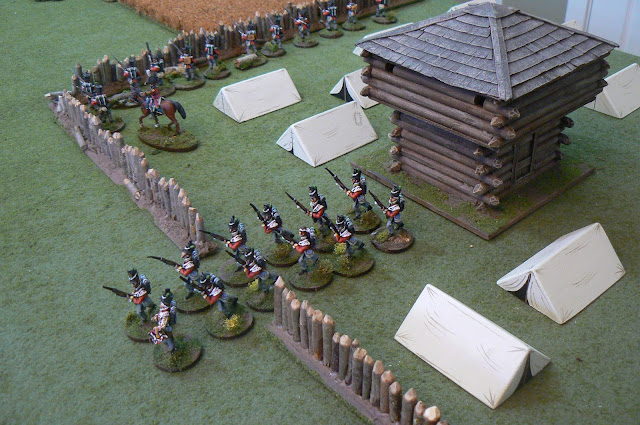 |
| Canadian Fencibles exiting "Fort Hammton" A unit of SEM mans the north perimeter. |
 |
| The local militia escort the food supplies from Brewsterville to the safety of the fort. |
 |
| In Brewsterville, the SEM (left) and part of the local Sedentary Militia prepare to defend the village. |
 |
| The long column of the Americans lead from Nateville to the objective of Brewsterville and its food supplies. |
 |
| The Kentucky Mounted Rifles are impatiently waiting their turn to file into the column. The wagons are ready and empty to receive the bounty of the excursion. |
Stay tuned to the second part of this exciting battle!
The first game of the year was a small medieval ‘Lion Rampant’ game with WillB and his young son going against each other defending or attacking the siege cannon firing against my newly painted Tower. (see my previous post link for its construction) Hey, I just painted it so OF COURSE it has to be part of the scenario!
 |
| I addition to the painting, I added a separate rocky base of insulation foam sheet |
Quickly inventing some quick rules for the guns damage firing at the tower, I thought I had cleverly hidden a small unit of foot knights under the roof but WillB, noticing the slight tilt in the roof ( he is a civil engineer and I never claim to be a precise builder!) adjusted the model only to discover my ruse. Luckily I made my several activations to have the knights climb down the ladder, over the rocks, and into action but only to have them fail their courage after only one combat and run off into the distance!
 |
| The enemy had already retreated away and then I careless rolled this for their courage! |
 |
| One of the medieval siege cannon firing on my new tower. This is a scratch-built affair made from a plastic tube, balsa wood, and brackets of strips of paper. The barrel, wheel-barrow and chest form the rest of the 6-man crew! |
 |
| Archers form the main component of my Battle of Crecy era collection |
 |
| The Dunkurque knights chop into one of the English archer units. A rather unequal affair. |
However, Arthur’s steady arrow barrages wore down the Dunkurque Militia of his father and the final cannon’s crew were slaughtered by Arthur’s men-at-arms before the tower could be felled by the cannon shot.

I don’t usually start the new year with the traditional pledges to one-self regarding the hobby. These promises often (never?) come true and, like so often seen in military history, generals, as we wargamers, are often fighting/collecting the last war/our last impulse, only to be met with unexpected new weapons/toys to fight/paint. Well, I have enough weapons/figures to keep me going without even thinking of what other wars/projects I might do!
So just trying to ‘clean-up’ those already in the to-do tray, including the many Napoleonic era Highlanders that friends have so kindly given me. Decided to paint up two large formations of them, the 93rd and 42nd and mount them on 20mm rounds going them an individualistic look for a large square formation. Finally finished the second lot (the 42nd) on the first day of this year. This 97 miniature strength formation will form an interesting eye-candy ‘terrain’ piece for any large Napoleonic Waterloo all-cavalry affair our group might come up with after this Covid thing subsides.


 |
| Victrix plastic Highlanders. To facilitate the easier painting of the kilts (ha!) I attached the arms with the interfering musket after doing the torso and the and painted them last. |

One more calcium-deficient unit...slingers. While the weapon distinguishes them as slingers, the lack of clothing or headwear can have them available for any ancients, or indeed a fantasy army, but they will constitute a skirmish unit for my Ancient British force.
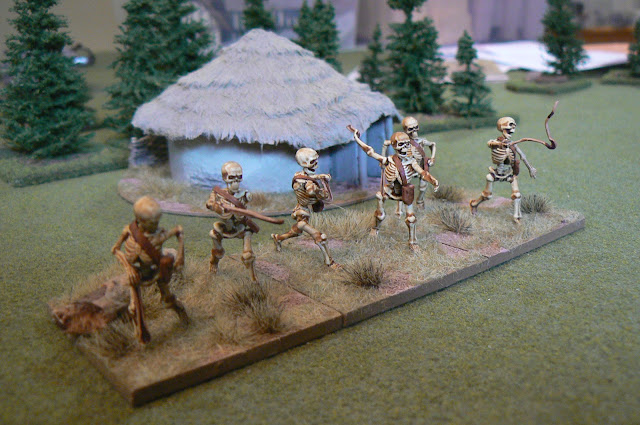
I added a styrene belt and attached bags adapted from plastic WW2 model pouches. Wire produces the corded slings.
For decorating the table, a Celtic house, as seen in the background, built from a packing tape roll, cone-shaped cereal card, some foam-core, and teddy-bear fur for the thatch.
Now to go out a dig out the walkway of snow.
Nothing says the Holidays as much as bones. Going ‘caveman’ and gnawing on the thigh bones of the turkey is a particular favourite treat for me, so not surprising, during these Holidays, I am painting up bones, many bones. Skeletons to put a fine point on it.

My Romans “were getting lonely” so I decided to make an opposition for them. The spur was a box of plastic Celtic Chariots (formerly made by Wargames Factory). I had sold the other part of that force to a wargamer friend who decided that the chariots were not compatible to the Victrix versions he had just picked up, so I was left with them. They sat for a while, but during the late summer, I had tried to make some plastic horses from melted sprues (*see note below) but as you can see from the photos they did not quite come out as I would have wanted…. However, they still had the shape of a horse and the rather ‘rough’ surface did look like decaying flesh. Skeletons in the making, as it were. The original ponies are now set aside and these de-fleshing horses will transport the chariots driven by Ancient British skeletons.
 |
| The reins are from the Victrix versions which were given as the wargaming buddy decided to do his in thread. They were the perfect length, fit into the yoke fittings perfectly and had the hands attached so could be given the boney arms with ease. |

I consider the whole collection less fantasy and very much a historical armed force…. well, OK, minus the flesh.

Firstly I have bulked up the Roman force by adding an Auxilia unit. I managed to find some faceless Roman helmets. Recent research suggests that Auxilia and Legionnaires were more closely equipped than once thought and it is offered that only the oval shield would be the major distinguishing feature. But I did not have any oval shields laying about. As I was pondering this, I noticed that I had not thrown away the bases cut away from the previous batch of skeletons used for the Romans placed on the flat ‘palace tiles’. As seen from the following photo these former bases are of a perfect shape and size. The newly repurposed pieces were quickly sanded down a bit flatter and received a new GS boss using a paint dropper bottle top as a mold. It was surprisingly easy to do. As these shields were, presumably lifted from the ground by their users and so would not be factory new, I did not worry overly about perfect copies.
 |
| note the similarity of the shields to the bases of the figures! |
 |
| The mold for the shield bosses |

The other Roman unit created are archers. These are helmet-less but do have a small shield which came in the box, along with the quivers (duly scraped smooth of any ‘fantasy decorations’!) and used strips of styrene for the belts to hang all the equipment upon.
 |
| note the two markers in the foreground for those units who have 'legged it' (these lower legs were not needed but I try to repurposed most plastic bits) |


(* The sprues - the frames on which the plastic parts hang and of the same material as the models themselves - are not recyclable. Rather that throw away, I thought to melt down with acetone and try doing a few different things with this mash. The horse molds did not really work but the bubbles and miscasting certainly have a zombie jive to them!)
My new wargaming pen-pal offered to create scenarios for me to play out for which I am using one of my War of 1812 collections. This is the solo-play of the first of the engagements. The set up can be seen at:link to my previous post of this campaign
While Canada was, at the time of 1812, very much British territory and all those (well most anyway) would say they were British citizens, this particular miniatures collection has only military units made up of people who were of North America and has no British Regulars. It is based on an all-Canadian, both French and English speaking inhabitants, who fought the Americans along the Chateauguay River in 1813. Thus, I will call them "Canadian" throughout the narrative.
The Canadian raid on the Town of Nateville had party of Abenaki Natives, the Canadian Fencibles (Regulars) and supporting Sedentary Militia downriver of the main force of Select Embodied Militia (SEM) (well-trained militia), and Voltigeurs (well-trained, experienced light infantry) to cross the main bridge to take out the American ammunition caisson to hamper the forming American invasion of Canada.
The engagement thus formed two distinct areas of operations which we shall call "the left flank" and "the centre" at the bridge or town.
The day started on the left with the Abenaki crossing the river together with the Fencibles. The American Combined Light Infantry (a unit of those companies of the various regiments who were considered to be light infantry trained. Some debate as to their training or even if they had distinct uniform differences) quickly formed up into close order to meet the oncoming Fencibles who would forego any shooting and use the bayonet charge. A bloody melee ensued causing casualties and disorder on both sides.
 |
| The Fencible charging the defending American Lights (in blue uniforms), the British officer on this flank directing the attack. During the entire battle the American commander did not emerge from his headquarters in the town. (I would have him on a separate activation as the raid was to catch the Americans by surprise) |
Meanwhile at the bridge the Voltigeurs were in mid-stream fording the river when they heard much screaming and stopped frozen in place - well, they failed to advance for whatever reason! - as the American Volunteers ran passed in front of them in rout away from the charge of the 3rd SEM. The American Pioneers simply put down their tools and surrendered.
 |
| The rout of the American Volunteers from the 3rd SEM (left) and watched by the grey-clad Voltigeurs (bottom) in the river. The artillery can be seen on the hill. |
The rout of the Volunteers did clear the field of fire for the American gun on the hill, but in the haste to load the cannon they inadvertently reversed the cartridge...or because I rolled a poor 4 on their activation dice?...
In Nateville, the bulk of the US infantry seemed obvious to all this fighting as they did nothing. At this time I had now rolled under 4 pips - on two d6 - for four successive activation rolls! Do note that for Rebels and Patriots rules activation for a unharmed unit is only 6+ on two dice. Perhaps the dice did have a bias this day as the Canadians favoured well than the American rolls.
The brave 3rd SEM kept up to task and quickly proceeded up the road to Nateville and a double-sixes activation roll brings into action the reserve of the 1st SEM unit.
 |
| The 30th US Infantry moving up (slowly....) to support the Combined Lights |
Back on the left, both the US Lights and the Canadian Fencibles reform after their combat but the Natives continued musket fire causes further disorder to the Americans. The fight would continue until the action in the town was resolved to signal the Fencibles to give up their fight with the American Light company who gave a surprisingly good account of themselves. Both units sustained 30%+ casualties.
But it was on the road to Nateville that the battle hinged. The 3rd SEM, not seeing anything of the Voltigeurs (yes, yet another failed activation from this unit. It was to have two more in turn and thus play no part in the engagement) saw the gun on the hill as a distinct threat and poured a devastating fire upon it causing half the crew to go down and breaking the morale of the artillerists.
 |
| The marker to the left indicates 50% casualties on the artillery unit. A grave morale situation indeed in the Rebel and Patriots rules. |

 |
| The officer with the 3rd SEM at the ammo wagon. |
The sounds of gunfire finally drifted to the town and eventually all three Infantry Regiments started to move in its defence.
 |
| The final moments of action as the wagon is alight and the Canadians (in red) about to depart. The American units could only fire off a single weak volley of fire. |
With the new reinforcing 1st SEM moving up to the bridge to secure the route of retreat and ignoring the plight of the artillery, the heroic 3rd SEM continued up the road to find the prized ammunition wagon just ahead of them with the teamsters desperately trying to move out of harms way. The SEM officer also could see the masses of the 10th and 31st US regiments emerging from the camps towards him. He decided to risk a further run up the road might get his unit up to the wagon to disable it or alight it and hope the following 1st SEM would help his inevitable hasty departure. And indeed fortune favoured the brave as a fortunate Attack Activation roll of 10(") and a quick thinking musketeer jamming his weapon into the spokes of the rear wheel had the wagon come to a stop. A lit cloth was deposited under the lid of the wagon and the unit made a hasty departure under rather poorly aimed gunfire by the oncoming American regulars to the sound of a mighty explosion. The American ammuntion supply was destroyed and the Canadians made their escape.
Casualty count:
Americans: Combined Lights 4 figures out of 12, Artillery 3 of 6, Volunteers 1 killed, 4 missing (rolled for), Regulars - all three units 0 of 18 each.
Canadians: 3rd SEM 2 of 12, Fencibles 5 of 12, Abenaki 0 of 6, Montreal Sedentary Militia, Voltigeurs, 1st SEM all 0 of 12.
As mentioned in the previous post, my Early War 1941 winter Eastern Front “What a Tanker” game that evening had four players (including myself) with a very simple “us v them” shootout.
 |
| My t-26 in the foreground running from the German looking to shoot 'up my butt' |
A PZIII and PZII against a T-34 and T-26. The night’s dice were fickle indeed as the one necessary die to complete the desired activity - usually shooting of course - failed to occur. Everyone was affected. But for me, the rather exasperating failure to do anything useful from a full set of dice only happened once, so that was good. And I got a kill, taking out the PZII with one shot. Rare indeed. It was early in the night, so I had the defeated player bring on a PZ35 (a rather better tank and game equivalent to a PZIII. I spend the rest of the game trying to avoid it! All the while looking to see if the other German had a shot at me!
 |
| "dog-sniffing" In the background the German is chasing my t-26, while in the foreground, the partially-whitewashed t-34 is ready to shoot at the rear of the heavily camouflaged PzIII. ED NOTE: This was only part-way through the battle; this would continue for quite some time. Weird game indeed. |
The game tended to resemble a “tail sniffing at a dog park” as one wit suggested, during which we circled around the snow-covered burnt-out buildings looking to shoot each other up the tail pipe (the weakest armour point) However throughout the night each of us would fail dramatically to get the relatively easily achievable 3+ on the dice, and roll lots of 1s and 2s instead. Ce la guerre!
If you are hosting a game is it very good to know ALL the rules so I wanted a practice game before hosting a “What a tanker” game that night. But I already packed up my usual winter terrain, so I put out a very plain table of a Russian village, a couple copses of trees and my latest t34/85. But what about an opposition? Well I do have a 1:56 R-35…. A bit mis-matched admittedly. Understatement no doubt as the Russian is a 8 Armour, 8 Strike beast vs the early-war two-crew 4 Armour and only 3 Strike.
 |
| obviously the R-35 to the left and the Russian t-34/85 behind |
Thus, I would have the R-35 (run by a Romanian crew being Eastern Front and all) only wanting to go back home, to cross the table and exit. The Russians were sleeping in a village house.
Perhaps rather foolishly the Romanian commander decided to take an open pot-shot at the “sleeping” Russian hoping for a lucky shot. He failed to hit. The Russians were slow to wake up and get active. The Romanian’ further move past an intervening house allowed him a second shot. This too failed, but the Russians were fully awake and on the move. They rounded the church but the dice failed them and the shot on the rear of the Romanians could not be taken.
 |
| Yikes! the Romanian is shitting bricks! |
The Romanian command dice then blessed them with a long move to - almost - off the table - and freedom. But not quite, so allowing the Russians to get one more shot off with their big gun. They took the shot but it failed to hit the rear of the small French-built tank! (8 dice needing 3+ but getting only two hits —-I am such a terrible dice roller when needed! ) the Romanians managed to get enough saving rolls to sigh a big relief as they exited the battlefield and continue their way home….
 |
| The R-35's turret is facing the Russian while the vehicle is making off the table.. |