Tuesday, 27 May 2014

the 3rd Battles - at Enfilade

Made the big effort at this year's Enfilade wargame convention held by NHMGS in Olympia, WA, USA, along with the many Canadians who attend, and co-hosted two large Napoleonic games using a ruleset in development by Seth and myself.  In short, their concept is for the convention game: keep it simple, effective, easy to use, and which gives a historic result. All this with 28mm figures on a small 8 by 5 foot table for 6 to 12 players.  And make it enjoyable.
It is a corps level game.  We don't care what the regimental captain does.  One cannot command skirmishers and be Napoleon.  We don't even want to try.

It is thus, that we tried the 3rd Battle of Ligny.  The first two games resulted in roughly historic results (see previous posts 1st Battle2nd Battle )  Now let us throw in all the  "what if" options ! The theme for the convention was "obscure" battles.  We all know of Waterloo, of this engagement, not so much......

View of the early deployments
Another view of the early deployments
the initial fighting for Ligny
French guns deployed between Ligny village and St. Armand. As historically done, these will cause havoc with the Prussian reserves.
a view of the Prussian left flank.  While good defensively against the French cavalry unable to assault the villages and unable to cross the stream, they would be foolish to attack the French horse of Grouchy's command placed alone on this wing.
Perponcher's Dutch-Belgian Division

Perponcher's Dutch-Belgian Division sent by Wellington to help the Prussians.  This is one of those "what-if" scenarios which I decided to add to this play of this historical battle.  As I played it historically accurately in the previous two attempts, both of which resulted in the mimic to the actual action,  this time I added all the possible contingents which 'could have' arrived to influence the outcome.   Thus Bulow 's corps did arrive, as did the French corps early under Lobau.   Perponcher was sent by Wellington as we must assume the Quatre Bras crossroad was not attacked early by Ney's French and thus this contingent could be provided.  Probably historically accurate as Wellington would be unlikely to send any native British units away from his command and would have likely sacrificed these 'foreign' troops saying they were still part of his army and thus in the agreement to assist Blucher if he was not attacked.

In our re-creation, they came at Marbais at the right corner of the Prussian deployment area and were moving down along the French bank of the stream.  They would have run into D'Erlons's corps at some point.


Close-up of the Belgian Line troops part of Perponcher's command.  I created these from Perry British torsos, Victrix British shakos (needed for without covers), French packs and their arms (for the cuff flaps! )

There is not much to tell of the game itself as the players were running it themselves by the fourth turn and so with time to chat about particulars of the rules which came up from time to time, I kinda lost track of the play in between.

Nevertheless the result had the French lose on points with the Prussians still holding three of the 'key positions'  despite losing large numbers.  However in the 'post mortem of the game' all ten players were still around the table with smiles on and happy with the game.  Fairly rare for most Napoleonic games I have known!
_______________________________________________________________________

The 3rd Battle of LaRotherie
held the next evening

To allow a comparison for results between the various developments of the rules, we have chosen to use the same historical scenario.  LaRotherie was the second major battle of the Campaign for France in 1814 and our third time running this game.

While we tried to be relatively accurate in the design, we must admit that Seth and I have not ..yet?... painted any Russians which under Blucher's aggressive leadership were foremost in the attack.  So we substituted part of Seth's growing Austrian for them as well as he supplied the Austrians, Wurttemburgers and Bavarians who rounded out the Allies contingents.

For my part, supplying the French side, I spent some time in the hotel room, re-labeling some of those French elements which fought on Friday to indicate the new commands.  If viewing the photos of our games, you might note that we leave a space at the rear of our stands to allow an attachment by temporary gummy tack a green piece of card with the historical General's name in order that the players can identify their command.  Not too glaring when viewed by the casual observer.
Early deployments of the Austrians (left) and French (right)
Looking from the Allies right wing of Bavarians and the weak French forces under Marmont which have fallen back to before the woods.  The mass of Ney's  Young Guard can be seen on the far side of the woods.
The following three photos shows close-ups of Seth's 'white tide' of Austrians.  The same basing technique unifies the look of the figures on the tabletop regardless of designer or painter.
The "wurst" of ideas?  A silly pun on the Austrian horse gun, well done by Seth and seen in 'yellow' on the right of the photo
The main thrust of the Allies against the town of LaR represented by my paper model
One might note the severe losses sustained by the Austrians in their main attack with most of the brigade elements down to 1 MP (the small black dice on each stand).  Because of the nature of this battle and the amount of guns, artillery fire was particularly over effective and something Seth and I are already working on for the future edition.
The range of the artillery as indicated by the range stick might be the most obvious change as these sticks were designed for earlier and very different approaches to the guns use.  Two steps forward, one step back seems to be the style of our rules development but we are enjoying this intellectual journey !
French Guard Horse on the loose in the Allies center attacking at will. 
The results had the French continue to hold the defensive line of villages for the victory.  The damage taken from artillery was too?? extensive which really hurt the Allies assault and which we will address.  Nevertheless for a late Saturday night with everyone fatigued and Seth and I somewhat out of voice, it when reasonably well.  
Of course talk of Leipzig (only the largest battle of the entire Napoleonic era !!) keeps popping up..... we very silly boys.....

While involved in our game, one of the players noted that the convention organizers may have deliberately placed all the horse and musket era games in our corner as around use were three other games of the type.  This Napoleonic  ( Black Powder rules? ) game had special made terrain.  Certainly a different look than ours but showcases the variety of approaches to the era.
Close up of my late war French Hussars (Perry plastics) and representing a light horse brigade

Monday, 26 May 2014

Back from Enfilade

Still trying to recover once again from attending this great Washington State convention.

Quote of the Weekend:
from around the Napoleonics table

"A couple of years ago we had to play Austerlitz using figures with shakos.  I really don't know how we got through it"

Thursday, 22 May 2014

Musee de l"Armee, Paris

Not to shorten the brief time my wife and I would have to explore London and Paris and not to bore the wife with endless staring at old clothing and armor, I dedicated only one military museum per city.  For Paris it had to be the Musee de l'Armee (the Army Museum) located in the Hotel des Invalides situated conveniently near-ish the numerous other tourist locales.

the Invalides


The entrance.  One of the beautiful buildings of Paris.  I am certainly old school and do not think the steel and glass structures of today compare.


the courtyard


Displays of full size mounted cavalry.  Note the length of the room!


One of the countless collection of interesting militaria.  These are Napoleonic shako badges


An actual British Napoleonic era "stovepipe" shako.  This particular piece of headgear seems to be most poorly represented by many figure designers. Now we have a better idea with an original.


I had to add this photo, as looking at these bearskin metal front plates, the wife asked "What's with the 'tiaras'?  With a smile, she quickly added, "Yeah, yeah, I know, bearskin plates" (the French only descriptions would not help her cheat in this regard!)  Then almost to herself, "How the 'bleep' do I know that?"  giving me a scornful look.


While we lingered at the early periods and the Napoleonic eras, the museum has extensive other sections.  While the layout of the museum is not particularly easy to discover and the museum signage is not well conceived (except to mark the way out!) other rooms had other nations and eras. 
Russian dress uniforms c.1900


British c.mid 19th Century

I am studying the extensive Medieval and Renaissance armor collections. In another hallway there is a window through which you can view masses of miscellaneous armor parts piled apparently haphazardly upon wooden shelves.  It would make any 14th century duke shake in envy!


The World Wars were particularly well displayed which we toured through and of more interest with the wife as it seems more 'current' than the "old shit" I like.  Both of us would have liked to spend more time but having closing near and having spent six hours already (!) we were near the last to leave.  I missed the gift shop as it closed early but it did not seem all that impressive; the usual poor souvenir items, behind the glass.
Nevertheless, a remarkable collection for the military buff;  now off the wargamer in me 'bucket list'.

Tuesday, 20 May 2014

Horse Guards Museum, London

 Horse Guards Museum, London
A small but interesting museum of the history and current activities of the Household Regiments. 
Guard on duty. 

The museum had an example of the heavy boots which one could touch (and indeed wear!).  They have much the same suppleness as very tall stiff ski boots! We saw him walk with these and indeed, if one has ever walked to the chalet in tight ski boots, you get the idea.  Together with cuirass armour  ( which one could also handle.  Heavy indeed! ) and helmet, standing at attention with sword in hand, is an ordeal.

museum entrance


The current parade dress of the Life Guards and Household (Blues) Regiments. 
My wife standing in the Parade Grounds.  In the very heart of the city,  this courtyard is expensive real estate.

Along with the Guard infantry, they make it known that they are still a modern fighting force and active in current actions along with the pomp, large horses and shiny helmets.  In this, they are unique.


Monday, 19 May 2014

back from London and Paris

This member of the 7th Polish Lancer Regiment was briefly distracted.
"Oui, suffering from jet lag but all is well from your trip. Tres Bien. Yes, I will tell your t'ree readers you will post shortly."

Monday, 28 April 2014

a 'pause' for the blog...

For all three of you who follow my blog, I will have a bit of a break for a month or so as vacation preparations, and events out of town have or will limit any blog entries.

I will note, however, my disappointment at the ill-timed closure of the National Army Museum in Chelsea, London, England as of the end of this month and exactly one week before arrival in London on my vacation! For a military buff as myself that is a major disappointment and much akin to the mournful despair of the devout Roman Catholic priest finding out St Peter's will be closed during his only possible visit to the Vatican!
My wife however is in quiet glee no doubt knowing it is one less boring museum she must endure.....

Anyway, I will hopefully return with a full report on the "Enfilade" convention in Washington State for the end of May.

DougH

Friday, 11 April 2014

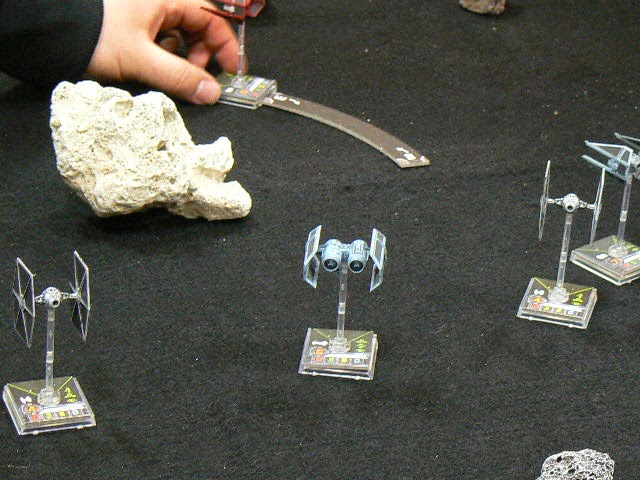
X-Wing game

I started by asking myself "Can you get shot down in space??"  I mean, well, in every air game I play in, I do indeed get shot down. However as this is space, can one get shot down if there is no down?  No was the conclusion but, as a fellow player suggested, I could well get shot up !

Yup, we of the Imperium believed the damnable Luke Skywalker might be piloting one of the Rebel craft in the  X-Wing game in which I participated  during the local 'Trumpeter Salute" convention held recently.  I commanded three ships, two Tie Fighters and a bomber for a total of 50 points.  I think Luke was near 50 points by himself!  While the four other players also were limited to 50 points  this still could result in a variety of ships and qualities.  Of course this included the Millinemium Falcon.  Big sucker that!  With a huge number of shields and hull !


The game was fun.  The rules relatively easy to pick up and the game masters were very patient and helpful explaining things.  I can see the appeal.  During the game the movie sound effects came from the GM's iPhone !

Oh, by the way, I lost two of the three ships with the other only one mere hit away from destruction. So my space piloting IS the same as my flying!  Thankfully I was not the only one with such damage and Luke was indeed blown into space.  Once the points were counted, we of the Darth Vader crowd won with the thinnest of margins by two points.

As an aside, I was amused by the reaction of a twenty-something player in the game when I said I saw the original Star Wars movie in the theater when it first showed in 1977.  In awe of the experience I had of that bit of history or simply of my age, I did not ask.......


Wednesday, 9 April 2014

Battle of Ligny. Game 2.

The second game of this battle at the "Trumpeter Salute" convention with new players with the exception of Steve A. who was now on the Prussian side as Pirch. I played the Prussian Ziethen with the tough task of defending the Ligne Stream.
As we had fewer players, I left the eastern side of the battle on the table, but we did not use Thielemann's or Grouchy's commands.  With the experience of the previous game, I understand why many wargame scenarios do not use this side of the battle.
Showing Vandamme's attacks on [l-r] Wagnele, Ste. Armand La Haye, Armand.  Gerard is slowly moving to Ligny [top]

Close up of Vandamme's French troops assaulting the village of Armand la Haye

The topography of the battlefield was very low, rolling farmland, virtually flat, so no hills were needed. Initially Napoleon was unaware of Pirch's Corps as a gentle rise of ground hid his force from the French.  To recreate this and to follow the maps of deployment, I allowed, as I did in the first game, these Prussians to be placed on the table behind a row of trees to mark the area after the French have done their first turn.  However in both cases the French did not appear to be overly surprised....
a view from 'south' and the French rear, showing the mass of Guard awaiting orders [lower center]  from Napoleon near the windmill [bottom]

Close up of the French attack lead by Habert's Division of Vandamme's Corps represented in part by the red-coated Swiss
In both games I tried to set up the forces as accurately as possible given that we are but dealing with miniatures and all.
This game differed only from the first by a more aggressive Vandamme but less aggressive Gerard who was charged with the task of taking the village of Ligny.  In this game the army reserves of the Old/Middle Guard and Milhaud's heavy horse moved back and forth not knowing with which attack to follow or support.  While the French used the Young Guard to help in the village assaults in both games, the players did not use the Old Guard as a hammer but as support, following interestingly, the historical precedence.

Vandamme cheering on the advance towards Pirch's massed corps
Again the historically imposed time limit cut the battle short. In this game, however, Ziethen managed to keep Ligny and Ste.Armand la Haye villages thereby holding open the flanks of Pirch's advancing corps to deal with the French who crossed over in the center.  How that fight would have ended is for speculation. If we wargamers were actually REAL commanders, the Prussians would have called it a day turns before we concluded after giving the French a bloody nose in order to have daylight to maneuver and retire while Pirch's Corps was whole and Ziethen's flanks were still intact. But it gives me a lesson, which I really should have already known with my years in the hobby, that precise victory conditions must be listed or players will just continue to push in more troops in order to roll dice yet one more time.


Tuesday, 8 April 2014

Battle of Ligny. Game 1


The local big convention of 'Trumpeter Salute' gave me the opportunity to playtest the revised rules with a new group of wargamers.  With Seth unfortunately unable to make it up due to workload, I decided to do not one but two tries at the historical battle of Ligny -  the OTHER big battle of the Waterloo campaign.

 The first try was Saturday night with six players.  I did my somewhat lengthy preamble using now a point form explanation of the concept and rules.  With an hour set up and about an hour to get the players together and familiar with rules we started.  I must say with six complete rookies, we had a fair conclusion with the self imposed seven turns representing the approximately seven hour battle until darkness ended it historically. We were finished the seven turns by 11 pm so the game was 3 hours real time in length.

In terms of historic action, the game was a bit behind in the timing but I thought the Prussians could have declared a retreat a turn or two previous so it is close to the real battle perhaps.  Good to know that the rules are that close to recreate the historic action. As a note, Game 2 was similar in timing!  However the rules are still in development an not even close to be written in any coherent way. So don't ask for them!

French view of initial set up from 'west' The hand with the stick is on Ste.Armand la Haye for those with any reference map!

Showing the Prussian left flank of Thielemann's Corps. Tonginne is in the foreground, Tonginelle to the upper right and Boignrr/Balatie to the left.
The game was a great way to discover the military difficulties the commander had in this battle as it is hard to imagine the reasons for some of the events.  For example --  why was so little action between Grouchy and Thielemann in the east.  But as the photo above shows, the Prussians were there in force and well placed behind difficult terrain of small villages and marshy stream and woods.  Not very good going for Grouchy's mostly cavalry force. They could not attack without disorder and the Prussians would be silly to come out and attack the French cavalry in the open ground. THAT is why there was so little action in this area of the battlefield. I did not tell the players about the battle and the historical actions ahead of time, but they acted in kind to the historical model nonetheless.  

the salient into which Ziethen's Prussian Corps was forced to hold the many village river crossings.
The above photo shows the western part of the battlefield which held the major action. As you can see the Prussians held a wedged shaped defensive position dictated by the shape of the largely uncrossable Ligne Stream but it created a salient into which the Prussians were confined and could be shelled from several directions as the tabletop action would prove.
Pirch's corps moves forward. Napoleon was initially unaware of this corps but welcomed it to move to form the reserve in the defensive salient. More for theFrench guns to destroy!
Showing Ziethen's defense of [l-r] Armand, ste.Armand la Haye, Wagnele. Only through the villages or open stream bits were elements allowed to cross the largely unfordable Ligne Stream and so these became focal points of the fighting.  Shows off my new paper buildings!

The eastern part of the battlefield from Blucher's perspective. For those with a reference map, you are looking east-south-east, with Tongrinne to the left, Tongrinelle village the light colored house in the middle of this photo and Boignee/Balatie in the upper left.
As with the real battle, the game seemed to focus on the large village of Ligny. I used my "Hougomont" complex to represent this village which could be  defended/attacked by two elements but which could not do any 'east-west' attacks; only 'north-south'.  This made it two wide in essence and made for continued fighting as the French need to clear both sides.  In the game, as in the real battle, it went back and forth for many turns/hours.
From the French side looking north and showing Gerard's attack upon Ligny with Milhaud's cuirassiers waiting for them to clear the village.

A great view from the 'east'. Steve A's hand of "Napoleon" pointing the way of the French attack upon Ligny.

The French cuirassiers emerge from Ligny [center]


The same scene from the French side. The Prussians have formed square [black square markers on the stands] [Center left of photo].Their reserves now tied up.


The battlefield looking from the 'south east'.

Prussian Landwehr element [ Warlord plastics with Old Glory metal mounted officer ]
The battle was concluded without any Prussian retreat.  It was more the wargamer "keep playing until all dead" than a campaign affair when a player will "try to keep something to fight another day".  Thus the Prussians stuck around too long and not follow the historic actions but I could see it would work well and have rules for it . 
The new artillery rules worked (!), and after the initial trials, they went extremely smoothly and seemed to have the right lethality.
All in all, the Battle of Ligny was well reenacted.