Tuesday, 5 January 2016

Austerlitz Victory Conditions?

Why is not Austerlitz not more often played?

Well, yes, it would take a shed load of miniatures but some of us do have enough.
And yes, to do it "properly" on the table will require a white mat and "snow" on the figures' bases, however that is not really necessary.
But it is hard to recreate the specific conditions of this famous victory by Napoleon as an accurate scenario. There are many difficult factors:
A)  The fog: hard to hide THAT many troops on the table without surprised players yelling "What the h**l!!".
B) The bad command: how to find that many incompetent Allied players... or to tell them "don't worry if you are going in the wrong direction".
And finally:
C) How to convince them that by doing so, will win them the game?

I had read one possible solution in having each village or hill as a point value, with some higher for one side than the other.  Thus, the one side will put more effort into capturing and holding those topographic features thus "pushing" the players in certain directions.

Thus we could have the points values as such:
                          French   Allies        
Telnitz                    2           4
Sokolonitz              2           6
Puntowitz               2           2
Schlapanitz             2           2
Santon Hill             2           2
Blastowitz              4           2
Pratzen Heights      6           2
                              ----        -----
                              20          20
The Pratzen Heights hold only minimal points for the Allies, while gaining them will give the French a greater amount.   As both sides start with an even amount to gain,  offensive action is required.
Perhaps add 1 point for each enemy formation destroyed and a fun but reasonably historically accurate scenario can be developed?

Monday, 4 January 2016

Battle of Austerlitz - the play-test


Having read an article about Napoleon's Battle of Austerlitz (1805),  I got it in my mind to create a scenario for this famous but not often played engagement.  His most famous victory, it is hard to recreate as a wargame as it involves fog (thus hidden deployment) and really inept command on the part of his opposition.  (while not always a problem by many players, hard to force upon them). However I thought to complete, nonetheless, and play out myself as a play-test.

At first I employed a rather small ratio but soon found it too imposing so cut it down to about 1 element per ~ 2,000 (infantry). It is interesting to note the relatively few artillery and in this battle the Allies had twice the numbers as the French. In these rules, and as most analysts would suggest, artillery was the real killers of this era and as I found later in the game, this was certainly the case.


I completed the set up and allocated the appropriate command control and command morale chits to each commander.  Please note:  I used my 1815 Prussians primarily and some of the few Russians I have painted in lieu of the 1805 Russians and Austrians. The French are also incorrect but there you have it.  Also ignore any commander labels on the elements as these are not correct.  I kept each command as a different type so I could remember who was who.  Luckily I had enough on hand to make the numbers.
View from the south-east showing the Allies deployed on the Pratzen Heights.   The white cotton sheets indicate those French formations hidden under the fog.
In terms of numbers they were surprisingly even with the French having 29 elements of infantry, 7 of cavalry and 7 guns @ 12 points of fire.  The Allies have 30 elements of infantry, 7 of cavalry and 10 guns @ 24 points of fire.  Due to the apparent morale of each army I gave all the French infantry an extra morale/combat point. +25%. A large advantage.

While the battle occurred in the middle of winter on snowy ground with frozen ponds, pretend the green mat is white and the muddy ponds, frozen over.   Deployment was as historical as possible with some of the commands combined as they seemed to operated together or at least in the same direction.  Accounts certainly differ on which Generals are used to describe the action as apparently even the historical Allied commanders had some doubt on the command structure that day!  Similarly I combined some of the French commands but these were less of a problem to distinguish.  I will use the historical commanders and place names so those who are very familiar with Austerlitz can kinda follow the game progress.

The key to battle is the vast movement of the Allies south, off the Pratzen heights and the mass of the French coming out of the hiding fog to take the abandoned high ground cutting the Allied army in two and destroying the greater part of it.  Playing solo I ignored the deployed but "hidden" French (covered in some white cotton to remember...I still not sure how to do this with players....) and had the Allies march off the heights.  The French players in the scenario have from Turn 1 to Turn 5 (when the fog burns off) to start their advance.  Davout’s corps arrives Turn 3 to help Legrand fend off the Allies attack just as contact was being made.  As it were, some of the Allies started to blunder into Soult’s forces at the start of turn 5 in any event and so all the timing seemed to work out.
The Allies Columns advancing off the heights toward the south
and away from the French massed under the fog (white sheet)
the view from Napoleon's perspective

The game began as Doktorhov, Langeron, Prebyshevsky, with Lichtenstein and Milovodovich in support advanced upon their objective villages along the southern end of the Goldbach Stream.  These were defended by General Legrand with very few units but were eventually helped by Davout’s small force. When Soult’s and Oudinot’s grenadiers moved against Prebyshevsky’s small force, Milovodovich was still upon the heights and managed (with high dice thrown) to refocus his attack to a steady defensive posture on the hill ( note that only the Santon hill in the northern sector gave any defensive measure)  Meanwhile Lichtenstein’s cavalry seeing no movement opportunity behind Doktohov and Langeron, decided - as was he did historically - to move back north to meet the threat.  A long journey as it turned out.

In the northern sector, Bagration was doing well and had Lannes’ Corps fall back but which recovered (needing a roll of a 6 to do so! Lannes talent coming through? ) to support Bernadotte’s forces who had taken up the fight against Bagration for Santon hill and key to the French left flank.

Meanwhile back at the southern sector,  the Allies advance stalled and Doktohov’s forces needed to regroup falling back from the stream. (a rather unfortunate ‘Command Morale’ roll, of course) This was to the relief of both French Generals Davout and Legrand whose forces were seriously worn.


One of those lulls in the action now took place as both sides make the time to consolidate their positions or realign troops for coordinated moves ( i.e. group moves).  Milovodovich reinforced his defensive line as Prebyshevsky fell back.  Langeron held the village of Solokwitz which was his objective and seemed determined to stay, while Doktohov again moved to take the village of Telnitz and destroy Legrand’s French.

Meanwhile, the Russian Guard under Constantine finally advanced slowly as he struggled with his command (rolling 1’s each turn!) Bagration to his fore with his now exhausted command tried to work with Constantine to form a viable Allied flank under pressure from a much depleted Bernadotte and Lannes.

Murat now with maneuver room, charged against the square formations of Milovodovich’s right wing as Oudinot marched up and immediately threw himself at the Russian's center.  While these attacks were somewhat successful, Milovodovich’s command morale continued to be very strong despite heavy casualties ( his die rolls were always high! )
Oudinot's Grenadiers (my Young Guard types from the latter years of the wars) advancing past Napoleon.


Murat, after his impetus first charges having half his heavy cavalry unable to defeat the Russian squares and subsequently destroyed from Russian guns, became more circumspect and used his horse artillery to destroy the squares
Murat's horse guns firing to soften up the Allies squares. Yes, they CAN fire through
their own troops. A funny game incident occurred as each these guns fired twice (noted
as the two pips on the black dice) at each respective square.....
.....and can you guess which gun did more effect?  Yes, correct, upon the left one to my "death and destruction"
Landwehr unit!    [the cubes represent the element being in square formation] The element on the right was unscathed.
Unlike the historical events, Doktohov finally pushed away the thin French line in the south.  However Soult finally started to push his forces to the south in support but his poor command staff (it would appear from his continued low dice, and to be fair, disordering crossing of the stream) did not have him influence the affairs in the centre of the battle.

The French were losing steam.  Murat was down to half his cavalry strength and unable to make headway against the Russian squares and Lichtenstein’s cavalry and the Russian Guard heavy horse (my Prussian heavies actually) were now reinforcing the heights and meeting Murat's boys.
Heavy Cavalry vs Heavy Cavalry
{my Prussian Cuirassiers in campaign dress.  Old model Connoisseurs riders on Front Rank horses vs. Perry plastics}

 Lannes and Bernadotte were spent forces and only continued due to ceasing any self-destroying offensive actions. Oudinot’s grenadiers were making little impact and Davout and Legrand’s commands had ceased to exist. The only uncommitted force was Bessiere’s small Imperial Guard force ( this force would balloon later during Napoleon’s reign, but at this stage of history was very few).  Napoleon thought that if only one more Allied command could be broken, it would conclude the affair and he chose the weak Allied right flank under Bagration to attack.  The Chasseurs a Cheval of the Guard led the attack but quickly were dispersed by cannon fire.  The tight ranks of the blue-clad infantry followed only to meet the same fate.
Combined arms attack in action upon the French Guard who are loathed to form square as to give the artillery a better target, but if not, will be easy meat for the heavy cavalry.  

With the final French reserves gone, the fighting gradually petered out (as I designed the rules to do…) with the weakened elements unable to attack without themselves being eliminated from attrition and failing any commanded offensive actions.

The Allies with still a strong Guard force, plentiful artillery and Milovodovich’s remarkable defense of the heights had defied history and held the field in a hard fought affair.
----------------------------


Thursday, 31 December 2015

My "Flintloque" Napoleonic skirmish collection

With this last unit, my 40mm-ish Napoleonic skirmish collection is finished....probably.....

A recent game I hosted went well I thought as the very simple home-brew rules survived intact from the constant wining and complaints from the boys of the "Francis' Regulars".  The only legitimate complaint - the '"I can't win!" types don't count - was the varying unit sizes as the larger contingents did have a certain advantage in that all other modifiers were to be equal.  So I decided to rearrange some of the units to have all equal at 10 figures each. Somewhat difficult as each of the Alternative Armies contingents have no consistency of scale and I have a bit of CDO  {just like OCD but the letters are in the correct order!}

My goal for the year - and the next - is to complete some of the collections I already have and to have rules and organization ready prepared for future games.  This 'Spanish line' unit is the last of the painting for these.


The "uniform" and colours are somewhat stylized as these are fantasy types and so the sculptor has made some interesting choices in equipment and clothing cut; but in general, the effect is Napoleonic in nature.  My collection is solely focused upon the Spanish campaign and so if the elves are not French they form the Spanish contingent.

Having a new light for the table I simply took a photo before they go, if I am honest, into a box to languish for a long time before I put on another game......sigh.....

Well...at least for a year anyway... (a rather lame New Years Eve joke)


Friday, 18 December 2015

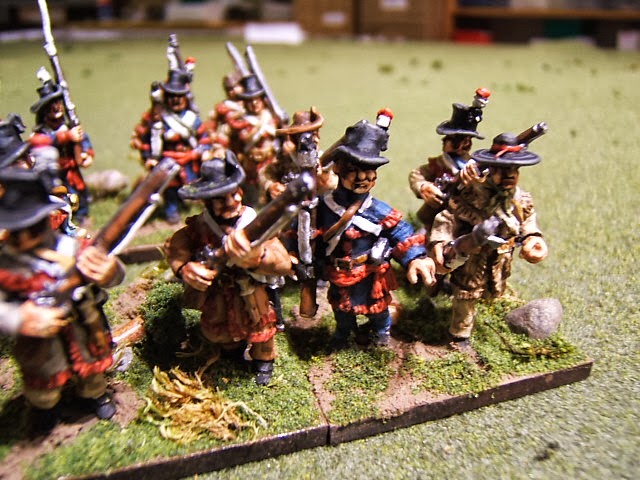
Never enough shrubbery (on my Kentucky Volunteers of the War of 1812)

While perhaps doing basing of your miniatures might only have the simple representation of grass or going very basic 'old-school' and just painting the base green and be done with; often its behooves the modeler to put a bit of work into the basing to enhance the look.  A wargaming buddy provided pictures of his new units with the commentary that he added rocks and downed tree trunks in an effort to "Doug them" up a bit.  ( Grin. )

Here are a few pictures of my 're-organized' American Militiamen of War of 1812 I did quite some time ago.
I separated the 'marching' pose from those of a more 'skirmishing' nature.  (I did not like the mix together) separating the two types and then adding the Kuckleduster command figures. 

I "Doug-ed" up base with real twigs.  I didn't go overboard with the lichen posing as shrubbery and such, as these boys might be doing some fighting in the fields.
Kuckleduster 'Frontier Militia' with command.  Some of the poses seem like their knees are ready to buckle or one leg is shorter than the other! Characterful as they say.

Wednesday, 9 December 2015

The wide bridge

One of disadvantages of large bases is the difficulties imposed upon the terrain.  This is especially true of bridges (and villages among other features) It looks rather peculiar to have a large element suspended over a narrow causeway and should combat occur, disputes can erupt over positioning.
With this in mind I created an 'expanded bridge' over my existing waterway for the large napoleonic bases we use.

The bridge is a solid piece of hardboard with short pieces of resin stone walls set slightly inside the ends so I could paint in the continuation of the latex waterway so it looks like the stream continues 'under' the walls.  Effective enough from a distance.
The rivers are from Wizard Kraft link 

Thursday, 26 November 2015

"Flintloque" type-ish Napoleonic skirmish game

A long time ago a local distributor brought in Alternative Armies 'Flintloque' fantasy Napoleonic-based figures which are very loosely scaled at about 35mm or so.
They are full of outrageous character and so I took the less fantasy (no Toads or Dogs for me) and trimmed the orc tusks and elf ears so they are now roughly human in design and organized them into recognizable historical unit - or as close as possible.
British Light Infantry 

Neapolitan 8th Line Regiment.  The standard finial is a 6mm horse!  The huge out of scale proportions are part of the charm of these big boys.....  The mules are from another undetermined source.  I considered them too large for 28mm but appropriately sized for this.  I added a plastic barrel to one and a lot of 'green stuff' to the other using soft wire to bind the bags in a very haphazard way.  

They have been stored away for some time (read: years!) but a couple of months ago I brought out the remaining few units and completed the collections, now numbering 200 or so.  Yesterday was the test of the new and very simple rules developed over some time (read: minutes!) I used as much random selection of table position, unit selection, scenario task and to keep it as even as possible because the usual Monday Night guys like to whine about everything!
Spanish infantry in late war dress being moved.

Other than a couple of minor changes, the rules I made up which are all of 2 pages long (!) were generally accepted and thought to do the trick for a fun convention game.
Later in the game, the Spanish are running...OK, then,....advancing, to gain their side of the table to complete their scenario task.
The miscellaneous figures I collected have become the guerrillas, enemy to French and British alike!

As an example of the play, playing cards selected poker style by each player dictates who has first action during a phase.  Doug's Handy Card System has the player select one of the cards dealt to him with Diamonds bettering Hearts bettering Clubs bettering Spades with ace high.  With the better card each player in turn can perform an action - shoot, reload, move etc.  The shooting is a hit with a good die and flip a card.  Face card = killed.  No wounds. Hand to hand combat is similar.  Points are given for the random scenario objective a player was given and for any kills he achieved.  That's about it actually.
The Chasseurs-Tirailleurs of the Young Guard continue to dig in the graveyard for the gold....

I am hoping for more players next time which should make the action even more wooly.....

Wednesday, 25 November 2015

Battle of Ligny play

The Battle of Ligny was a major battle of the 100 Days/Waterloo Campaign of 1815 between Napoleon's Armee d'Nord and Blucher's Prussians.  Fought at the same time as the better known Battle of Quatre Bras (trans: "four-arms" or crossroad) no doubt due to the British participation.

Having played the game five or six times now, these photos I found were archived from much earlier in the year.  I don't remember if they were 'published' yet, but I find the battle is fascinating and learned much from the re-creation on the tabletop.
The battle looking from the northwest.  The villages form the Prussian defensive line. Pirch's Prussian corps is on the left moving through the line of trees.  In the background, Milhaud's French cuirassiers are being moved up

Blucher needed to hold the left flank of the British-Allied army and understood, well, perhaps his Chief-of Staff understood.... that the crossroads would be a key to the French advance as so needed to hold at Ligny.  His dispositions reflected the defensive stance as the small but marshy Ligny stream afforded a nice line.  But that line was also convex and thus would allow the French artillery to converge fire upon the Prussian reserves.  In our games, much of the Prussian losses came from this fire.
Ziethen's Prussian Corps in the 'cauldron' formed by the Ligny stream and the line of Belgium hamlets along its length.

However the French still needed to take the towns along the stream as these afforded the only passage across.  The village of Ligny was the largest of these hamlets.
Gerard's French Corps ready to assault the village of Ligny

The eastern half of the battle, historically, had little fighting.  It became obvious during the previous playtests, that the 'Grouchy' player, commanding the French forces of mostly cavalry could not assault the eastern most villages and the Prussian player was not willing to abandon his nice defensive positions to move out to the open ground to be attacked by the French horse.  Stalemate.  In this game, I did not portray this side of the battle as it is but boring for those commanders.
Vandamme's French forces line up in support again the hamlet of S. Armand la Haye.  The artillery in our rules can fire through friendly troops.  The multiple batteries the model represents are to be considered spread among the individual units which the bases represent.  The wheel marker has it moving during this turn and so firing is compromised.  Not all the batteries are in position yet, it is assumed.

To be honest I can not remember which side won the game, but it is hard slog for both sides and, as in history, affairs can be influenced by the smallest of events. A few more good dice than the other side and enemy units collapse and victory achieved.

Saturday, 21 November 2015

Pig Sty

Without much time to do these things at home, but time to "expend" while waiting for charter trip returns, what can a hard-core wargamer to do but use the time for those fun scratch-build projects.  In this case I had some model 28mm scale swine to keep penned.  For skirmish games, the pigs could be the objective prize.  Or for the larger games, some eye-candy in the corner of the table.


I started with a scrap piece of hardboard and very haphazardly roughly cut wood stir sticks and balsa pieces not caring a bit about lengths or neatness.  A very, poor peasantry, thing.  The ramshackle  construction was certainly helped by the cramped conditions in which I worked while sitting within the school bus.  My hand would inevitably knock over the part of the fence already done and damage that part while then dislodging the newer part.  Argh.  But all part of "the look"..... if that look is to be shoddy, of course.

The shingles are individual pieces of cereal box card and roughly ordered on the roof, but the one which was very misaligned was left as is.  Again, the old and worn effect in play.


Once all dry, the next day, an hour or so of painting (lots of surface area which takes more time than one would think) with a worn-look dry brush of "old wood" and a quick stain wash to tone down the 'dusty' dry brush.   The putty muddy earth and a bit of wood shavings in the shed, finished the model.

.....as the saying goes:  'time well wasted'

Monday, 2 November 2015

my Monitor

Another of my forays into the bottom-most boxes revealed my good 'ol Monitor model of the famous ACW ironclad.  The model is some 10" long made very simply from foam core and a plastic lid for the turret; a straw for the funnel and painted black and crudely drawn iron plates using a pencil.

The intent was to make several of these size of ships for games but so far have failed to do so. While I like the naval aspect,  I really never seem to play it.


Tuesday, 20 October 2015

Medieval Irish for DBA

My new part-time job as a charter bus driver is quite the time-eater with lots of time away from the house and more importantly the painting table!
Having downtime between delivery and pickup during the day, sometimes I can get a bit of basic painting in while sitting in the cramped seats of the bus.  With only poor natural lighting and poor positioning hunched over as I am, no great detail can be done as you can imagine;  and for my version of the Irish with their rather plain dress and, well knowing that many poor brush strokes can be covered up by a heavy wash of paint, I set about doing this army of 15mm for my DBA collection.
lots of painting gaffs but really I couldn't see a lot of the details sitting on a bus.  Even with my reading glasses on.  Sigh.
These are converted Corvus Belli Numidians - which were needed for the bare Irish legs - on which I added "green stuff" cloaks
Corvus Belli Irish Kerns from their old HYW range. The first strip has been given a wash stain already.
The completed army. Yeah, well it's DBA ain't it!
Close up of the spearmen
Close up of the General as a light horse element


Wednesday, 14 October 2015

Murat during the Battle of Heilsberg, 1807

A famous incident during the Polish campaign of 1807 was the inspiration to create my own Murat figure.
Aubier of the 20th Chasseurs a Cheval relates how Murat had his horse killed by a cannonball and gave him his, with the Marechal leaving one of his red morocco boots still in the stirrup.  With this and the beautiful paintings within the Hourtoulle book "From Eylau to Friedland" I set to creating from leftover plastic bits.
I referenced this painting for my Murat who, while hatless in the event captured by the painting below , without feathers and plumage is quite unthinkable.

A great image of Murat riding off on the trooper's horse. And I just happen to have only one horse left to use! Perfect!


Like Hollywood, I combined the two paintings for a "based on the true history" along with the two beautiful paintings.  The following photos show my efforts to create the famous napoleonic cavalry leader.
note the bootless socked left foot. The other side still has the original boot of the hussar officer's leg. The details are from the first painting with the addition of his hat.
With the view as per the second painting but with the troopers horse - his now killed - he is armed with a switch rather than a sword as he is in the Girbal painting
The horse is a Perry troopers, the legs that of an officer, the torso of a trumpeter with the lace and details removed and the arms of a heavy dragoon with the sword removed. The switch will be one of those thin plastic ties used to attach price tags on clothing and glued onto the gloved hand
The front sashes and medallions still need to be added. The initial plumage to the infantry bicorne will be accentuated with more feathers later. The left leg has it's boot scraped off.  
The final version
The final version.  Murat with his flowing locks of hair.

Saturday, 3 October 2015

Gettysburg Gate


my scratch built "Gettysburg Gate" a representation of the famous cemetery gatehouse of the American Civil War battle.  General George Pickett of the CSA is shown here looking back at his destroyed division, one could assume.  (28mm Old Glory figure). 
Made of foam core and card with an old wood Monopoly playing piece as the top decoration!

Of course,  the really funny thing about all this, is that I have very few painted 28mm ACW...my collection is now only 15mm.   The gate was built for a re-creation of the historical battle with a gaming group that I no longer attend. (  I guess I should sell it )