Sunday, 17 February 2013

Terrain is just as important....

While it is getting a little better these days, what with the internet to show beautiful miniatures, and of course the glossy wargame magazines to illustrate the best examples of the sculpting and painting art; but perhaps we put in too much time into the look of the miniatures and not in the setting in which we display them on the tabletop. Consider a beautifully chair sitting in an unfinished garage. 

But many times we see, and have done ourselves no doubt, putting nicely painted, well done, realistically based figures on a plain green cloth with a few haphazard trees on felt with a brown cardboard road.  Blech.

I am trying to look less at the lead-bin bargains and trying more at the terraining aspects these days and spending the money and time to build up the tabletop terrain.

I have recently bought ready made plastic trees (I will go with the less expensive make-your-own variety in the future but wanted to know if this is the direction of the 'forest' type I wanted).
I cut out random shapes out of hardboard glued the trees upon and did my usual terrain/basing technique.  Not much undergrowth so to allow troops to move through if required and the subtle outline will allow the large stand to work as only 'decoration'.  Better than just plain felt.  Storage is more difficult but sacrifices are sometimes required!

Now back to painting minis..... ;-)

Saturday, 2 February 2013

On the Road to Paris


Nansouty's big bad 6's Guard Horse

In 1815 after his abdication and exile to the island of Elba, Napoleon returned to France, challenged the King's force meant to stop him,  which promptly returned to his command. The Bourbon King then fled .
But what if the ex-Imperial army did not come back to Napoleon, and indeed did try to stop Napoleon and his small army of Guardsmen from moving to Paris? And if Napoleon pulls his "And France is me!!" stunt, would it work or the be the death of him?    This what-if scenario pits Frenchman vs Frenchman in this Napoleonic battle. 


Not a bad what-if battle..... considering I only have French painted at this time!  Hey, if King Louis XVII had any backbone....

So I hauled the figures to, for me is a rare club GameNight and had a few of the usuals want to command.  I took some time explaining the rationalization of these rules.  For the most part they got it but it is funny how some of the 'traditional wargaming concepts' still come out. 

Bonapartists on the left, Royalist on the right.  The nice 'village' model I took some time during the week to terrain was never seriously attacked...sigh. 
For some of the players the big advantage of the Guard morale/combat effectiveness was highly discouraging.  "Look at the math, I have not chance of hurting that element.  I will lose all the time!!"  But, I say, have you even tried to wear him down? You have more units, hit him in the flank.  Hmmpf, the player shrugs, not with the pips I am getting, he says.  Well, thems the break.

However on the other flank, with the much abler Andrew handling his forces  more adroitly, the weaker Royalists, managed to wear down the Bonapartist Guard units, blocking others with well placed cavalry, and eventually making hors-de-combat two Guard infantry elements ( their only losses however. The Royalists lost 11 !)

A change in the game occurred as, Jim, the player with Napoleon, really, really, wanted to test my, only for this scenario, "And France is Me!" rule.

-->
Premise: Napoleon held great sway with the ex-imperial troops and so if an Royalist unit is in combat with a Guard unit with which Napoleon is attached may be called to return to the Emperor during the battle.
The “Napoleon” player may then call “And France is me!” He then rolls 1d6 and consults the following chart:

roll results

5 or 6 = The Royalist unit collapses in jubilation and cries of “Vive le Empereur!” throwing down their weapons to cheers. The unit is hors-de-combat for the remainder of the game.
4 = the Royalist unit is overawed by the Emperor and takes a -2 combat modifier this turn
3 = Napoleon is unhorsed and his health is unknown. The Guard unit takes a -2 modifier this turn
2 = Napoleon is wounded, the Guard unit angered by this injury to their Emperor receives a +2 combat modifier for the remainder of the close combat with this Royalist unit(s).
1 = Napoleon falls to a bullet and is killed. His dreams and the battle are done.

Thus he managed to roll for this most every turn! He actually never had old Nappy killed but one of the rolls was a 3 -- Napoleon was 'unhorsed and health unknown'. So I stated to all the players around the table that the rumor spread quickly through the army and hearts sank at the Emperor perhaps dead.  Thus I decreased all the Guard MP values by half.  The Royalists players, now seeing the odds a little more even, regained their own morale and in some instances, even went into the attack!  But like I said eventually lost 2-11.

The rules worked fairly well.  Many of the changes necessary were for the 'what you could or could not do' variety.  The MP values became very important (as they should be). Good troops will kick lesser troops butt most of the time.
Attrition seemed to be very important and the only way for lesser troops to deal with the Guard is to be a 'speed bump' after 'speed bump' until the Guard was 'slowed down'.  The players did use the General's "Rally Points" to influence some element's effectiveness but that was kinda the theory, so that worked. As they only have a small number of them, their use should be limited and have only local influence.  Again, like history, the timing will be the key.

Obviously, just in real military history, but not necessarily wargames, reserves are very important.  Fresh troops, with high MP factors, could certainly turn the tide of a battle, which is why the better commanders would keep them uncommitted for as long as possible.  Wargame players, not caring about strategic objectives or fight-another-day ideals, knowing that in 1 hour and 12 minutes the game will end because Fred needs to get up to get to work at 6am... will commit all and at once for the big victory.  For wargames defeat is only met with a small ribbing by the others and glib comments so battles are never done to their conclusions or retreats are conducted.
So unlike most wargames however I believe these rules could work into campaign games very well because of the swift and dramatic attrition in battle and will try to get some gamers to participate -- once I get enough miniatures painted that is!


Surprisingly the one issue which they did not comment upon was the use of only one move distance regardless of troop type, horse, infantry or artillery as all moved the same distance.  Good news that. No justifications required!   I made lengths of wood sticks for the purpose and for ranged fire and they were well used.
The "Royalist" array.  One can note all the bags etc on the table as we only used a 6 by 4' mat and had lots of maneuver space.  At only 6" a move, one can have a very tight battle even with the 28mm miniatures I used.      Obviously photographed early in the battle as only two eliminated Royalist elements are in the background.  The number of them did grow!
 One pleasing aspect was the compliments about the overall look of the bases and the elements.  The small number of figures on each did not seem to be an issue and many observers commented favorably on the effect.

Andrew used 'wave attacks' with one element replacing the previous to wear down the very stubborn Guard units.  One will need alot (!) of lesser troops to do the job.  One now can understand the battles of 1813 and 1814 as battles of attrition with more appreciation.


Thursday, 24 January 2013

Napoleonic Playtest

Continuing to work on our joint venture to put on the Battle of Hanau (October 30th, 1813), Seth came up last weekend to playtest the new rules I have been developing.
Because of our use of very large base sizing, the type of grand tactical game we have envisioned, and the requirement to keep the game rules as simple as possible for the convention but still be Napoleonic in style, we felt a whole new concept is required.

The lone picture (we both had technical difficulties with our cameras!) shows to good effect the look of the game.  One should ignore the uncompleted bases and rudimentary terrain as this was a private game we did much to hammer out the concepts.  Of course this was between two like minds; once played by the convention player, the rules will surely fall apart <grin>

But the game did keep us stoked about the whole project.

I now understand the popularity of the Austrians.  Very effective looking on the tabletop.  Easy to paint (white primer, a touch of flesh, browns and facing colors, a quick wash and taa daa) and the white wave of their infantry crashes upon the enemy. 

(please note that the rules will not be published and are strictly a private venture and perhaps, after the convention, thrown away!)

Tuesday, 15 January 2013

'Hanau' French completed

I have happily met my obligations to paint up the French troops for the Battle of Hanau ( October 1813) with the completion of the Imperial Guard Chasseurs a Cheval.  These are in their campaign dress - so no plumes, no pelisse, no colpack bags blowing in the wind....  Rather boring in their green uniform actually. 

My original intent was to do the 1814 Campaign for France which was fought in the winter and a wet spring; so conceptually I wanted most units in their practical campaign dress.   Not very colorful but realistic. Thus my newly painted Young Guard are thus attired with mud encrusted hems of their overcoats and loose march order showing their fatigue in fighting for Napoleon's glory.
The figures are Victrix Chasseurs of the Guard with an assortment of miscellaneous Perry heads. I did not add some backpacks and thus added the crossbelts on the back to further give a ragtag feel.  I wanted a motley look  :-)

[ For those questioning: the dice are for 'hits' and are in small divots in the terrain putty mud.  The blank sections at the rear of the stands make for easy placement of the formation's or commanding General's information card.
Yes the stands are very thick but this to to encourage the use of the stand not the handling of the figures by players.  The flocking blends the stands into the table quite well however ]

Saturday, 12 January 2013

Plastic and sun

Oh yeah, clipping plastic bits off of sprues is fun in the sun.  The sun finally makes an appearance after many weeks of hiding under clouds and rain.  So to take advantage of the light and, frankly, its morale lifting effect, I have set up a table in my south-facing office room and listened to podcasts while clipping and gluing at least a few of the many boxes of plastic Napoleonics I have acquired recently.
The largest advantage the plastics is weight; the lack thereof. However, aslo the Perrys are VERY nice sculpts.  While yes, I could get the horse in the required groups of three as sold by the Perrys, and for which I have bought many different packs already; the plastics offer modelling possiblities which are not available or would be difficult to do in metal.
 For example the 1st CaC of the Waterloo campaign were the ex-"Roi Chasseurs a Cheval" of the Restoration which did not, in the mere three months of the change back to Napoleon, manage or perhaps want to, part with their distinctive headdress.  Thus they wore, what to me looked very similar in shape to the carabineer helmet of which I had extras from the Perry Heavy horse box. The dragoon box has the upper torso for the trumpeter which I scraped off the lace - easy(ish) to do with plastic, much more problematic with metal - and used extra French hussar legs to complete the unit!  Now the unique 1st CaC will represent Pire's Light Cavalry Division of Reille's Corps of which it was one of the units. 

Anyway, sitting in the sun I can listen to podcasts and of the many various editions one had a Canadian military historian give a lecture about the logistic buildup for the Canadian attack on Vimy Ridge during WW1. (podcast) It is quite apparent that armchair generals speak of tactics (such as ourselves - luckily we wargamers do not need to feed and supply OUR troops)   Real generals speak of logistics.  One of the many aspects which lead the commander Gen. Currie to victory in spite of huge problems to overcome. 


But right now my main problem is not to get any more glue on top of this miniature's torso I am struggling to put together......

Tuesday, 8 January 2013

Again in the Russian steppes

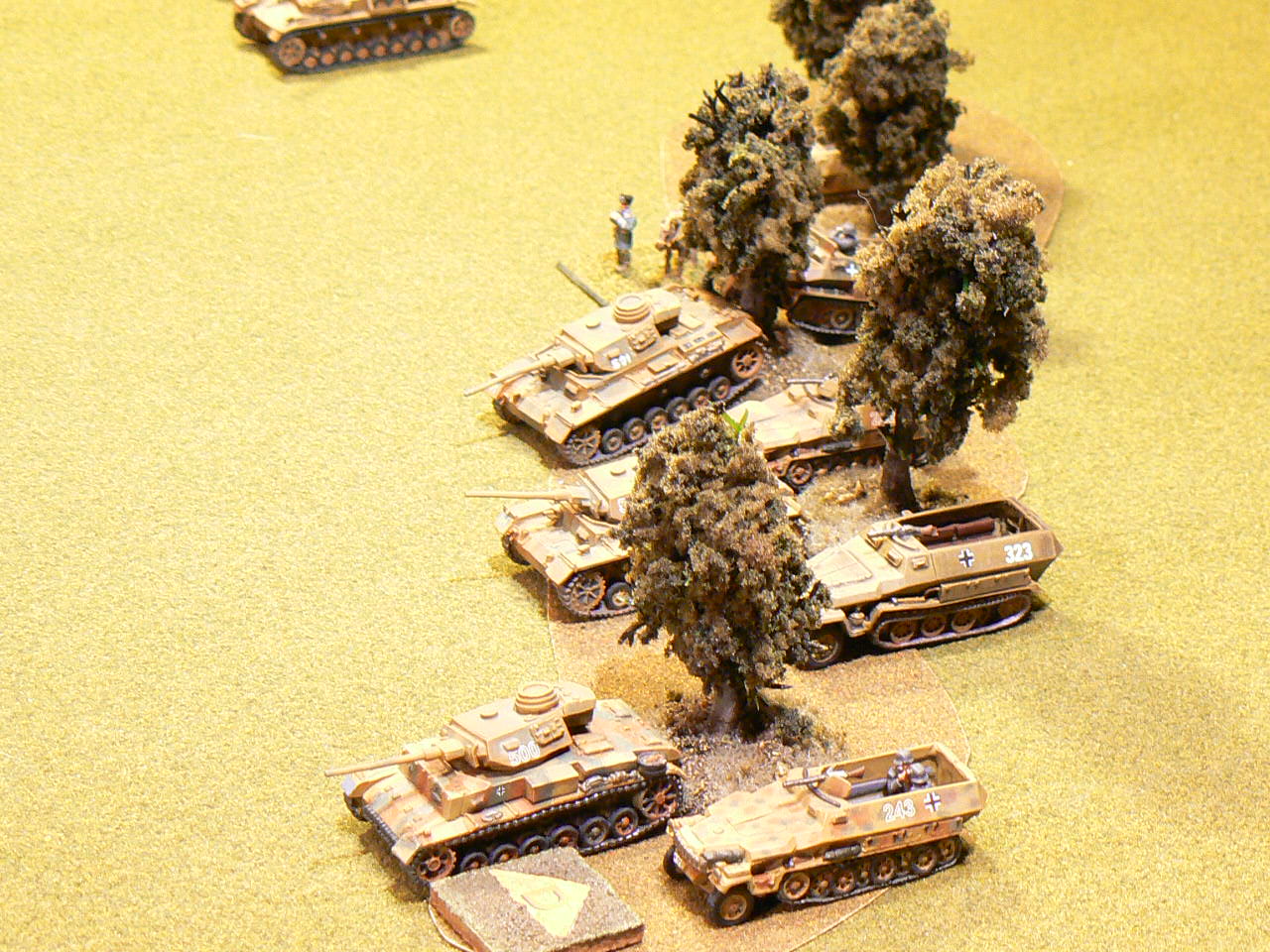
A Monday night game at Francis' which unfortunately for me is a bit of rarity these days.  While they are building planes for the latest 'Dave Craze' (1:72 scale WW1 planes for Canvas Eagles) the boys are playing a lot of WW2 15mm. Both Francis and Dave have big collections.

I joined Kev for a German attack upon a Russian strongpoint. I will not bore you will a blow by blow, but let it be said that the Russian dice were not very good and with the poor Russian 'training' and the Battlefront rules which hamper ill-trained troops, the battle was one-sided even though technically, with no time left in the night, the Germans had not penetrated the Russian defenses. (more a fault of the scenario (distance) than casualties or such)
 For a rare time, I seemed to have the best of the dice, with at least five T-34's destroyed by time end....and one plane!
The Russian defenses
my force of Germans
The results of the Russian surprise flank attack. I seemed to roll particularly well during the game!
The Russians bring up the reserves.  Dave believes we probably have a Tiger off table. I say, "No, Dave we do not have a Tiger coming on... (he now thinks "more than one?!") But no, it is but a lone Elefant!

Francis (left) hopes that this roll will not be another 1, but Dave does not seem that convinced
Part of Kev's force of elites.  SS in peadot, painted by me for Francis an few years ago.  The over sized dots on these 15mm show up better at distance so more identifiable on the table.
Oh and that plane I mentioned I had shot down, by a tank no less?  And thankful I did too as Dave forgot to bring the proper model (and it was the "special thing" of the scenario!)  so substituted this white 'object' unpainted upon the table!  Shame, shame!


Sunday, 30 December 2012

More French additions

It is horrible how the Holiday season can interrupt routines.  But nevertheless it can allow for some good quality painting time so I have created a few additions to my now completely insane Napoleonics project.  As usual it has expanded beyond my originally sizable limits to now doing the whole Hundred Days campaign, albeit at a 1 element to 2,000 infantrymen ratio.  Still nuts though.

Some of the units so far are noted below. 
Perry metal French Imperial Guard 2nd (Red) Lanciers
Some of the cavalry will be in metal, some in plastic depending upon availability for the most part.  And while the Perrys do create the required types, I will mix and match parts and do much modelling to create what I can in plastic for mainly the weight issue.
Perry French Line Horse Artillery
Most of the artillery will be, by necessity metal as only Victrix with their British Artillery box set, has created any in plastic.  The Perrys are good, well posed with each figure 'playing' its part.  For example the gun-layer of the above set of French Line Horse Artillery is so matched to the gun model that for gluing down the figure, the gun model did not require any glue to fully secure it to the base!


The infantry are again plastics and are in marching pose for the most part which is fine with me.  Most will be this way as can be seen in the above photo of the over-coated French masses.  The Perry versions are the unit to the right, while the two following units are Essex.  These I picked up from a sale very inexpensively but some of which were from the Revolutionary era; so it was off with their heads to be replaced with spare Perry heads.  They are a tad smaller than the more modern sculpts but this is not noticeable from above and so added another four elements to the French.

While most are in march pose, the Victrix Guard boxes had a couple of poses which were not 'moving' and so were destined to be in the 'firing line'.   With these I created two elements of the Young Guard Tirailleurs.
This first one I added a spare limber (Prussian) to add some space and drama to the vignette (and I was a couple guys short!).
While I would love to take credit and say I conceived of the action and glued the arms, made adjustments and sculpted them; I merely grabbed arms out of the trays and glued them on to the torso in almost random fashion.  Only after painting did I then take the time to position each according to what they appeared to be doing.  For example the figure in the middle behind the limber appears to be adjusting the firing lock on his musket (or some such).  Have no idea what the original arm positions were intended but I only made sure a right arm was on a right side of the body. Funny how the positions kinda make sense in context.


This is especially evident in the next photo of the second element as the you can almost hear the dialog of the middle two front figures.
"Mon deu, why does the musket not fire?!"
"I think your firing spring is broken.
"Where?"
"That thing there"

Trust me, while painting them I was wondering how the pointing guy was ever going to look good individually but together with that other mal-aligned pose, they seem to pull it off.
Mind you marching poses are way quicker to glue together and quicker to paint!  They better be...I have boxes of the buggers to do......


Friday, 7 December 2012

"Square" Markers

OK, here is one of those stories, dare I say typical (?) of the wargamer and his hobby.

For the new Napoleonics project,  units are on solid, one piece bases.  But Napoleonics are all about the 'square' formation, is it not?
Before this era, the SYW or AWI for example, do we have units going into square to beat off cavalry?  Nope.
After? in the Franco-Prussian War say. No again.

Even if the stand represents many individual units (the stand ratio 1 : 1,000 to 2,000 men). Tactics would suggest the square as a tactical option be available to the player. Rather than painting up an extra 100 or so miniatures for elements to be placed in pretty square shaped vignettes ( as nice as that would look!) is the need to have a marker to give the visual reminder to all the players that the unit may indeed get a modifier or some such.

Sooo, I need a marker.  And not some lame cardboard chit or colored fluff ball. Yuck.   With that in the back of my mind, I looked around the local dollar store and discovered blocks of wood.  Squares for, ahh, squares!

While quite large for the table at 5/8" or 15mm a side, I sought to minimize their obtrusive effect by painting them black and terrain the top side.  The effect can be make from the photo, whether it has been achieved.  Hopefully visible and yet not.

My French Marine Artillery formation 'in square' against Perry plastic French Cuirassiers.  (Obviously an internal dispute about the brandy rations or some such!)


Wednesday, 5 December 2012

Soldiering on

Reading the narratives of Napoleonic campaigns, one is struck by the endurance of the soldiers.  Sleeping what can only be a fitful sleep on soddened ground with only a dirty coat as warmth, with little or no food in the belly, only to woken before dawn to march another long march burdened by musket, pack and equipment.  Then to be thrown into a maelstrom of cannon and fire and slashing swords; of immediate death and panic, only to survive to see the horribly wounded and dying.  Yet to march off again wet and tired to fight the next day and go through the horror once again.
As I muse these thoughts to my wife early this Wednesday workday morning, her only comment:
"So it's like 9 to 5...."

Friday, 30 November 2012

French Line in overcoats


My latest painting are these Perry plastics.  I finding it amusing that in doing Napoleonics I choose the overcoat types over the regulation dress (the boys in the bright plumes and such).  In fact all the Perry 'Bardin' poses are still on the sprues!

Contrary to the brightly attired attraction of the Napoleonics in full dress uniforms I seem to be drawn to the covered-in-mud campaigns of 1814 France and the Hundred Days -  conducted in the rain for the most part.

Perhaps as we get older the attraction of fashionable but perhaps uncomfortable, or at least showy duds, leads to more practical clothing. Nothing more practical in the Napoleonic age than a greatcoat and waterproofed shako or forage cap. So much of my early units are thus...making the painting much easier by the way!

However one crack in this theory came as I had completed the painting and had terrained the units and viewing them on the table.  "What a dull lot" I thought.  Then I observed that I had forgotten to paint the pompoms on the shakos!  Hmm, well the orange, purple and bright blues should add a bit, what. 
Certainly did.  With that splash of color I am back on the true Napoleonics train.....


Perry metal General with accompanying Victrix infantryman


Monday, 26 November 2012

French Naval Artillery Regiments

This unique Napoleonic unit(s) fought during the 1813 and 1814 campaigns when after destroying his Grande Armee in Russia, Napoleon looked to various sources of manpower.  The naval ships, blockaded in harbors, proved to be a surprisingly good source of quality troops in this regard. While often incorrectly titled as 'Marines',  these Naval Artillery units could be considered elite, or at least, very reliable and conducted themselves well in an infantry role.

While there is some debate about the uniform and color of the belts, I went with the "classic" dark blue artillery overcoat, white belts and red shoulder fringes.  The distinctive carrot-shaped pompon of these units, I made, adding a bit of 'green stuff' to the existing round pompon on the shako.  I got them sort of the same size and my heavy coats of paint hides many imperfections.


The small d6 die is placed within a divot in the terrain and used to indicate any change in the unit's morale/hits.  The blank space in the rear will be used to easily attach the unit's commander's name for game purposes.

I'll add a photo of my Imperial Guard.  One can understand the Prussian reports from the fight for Mockern during the Battle of Leipzig (1813) mistakingly having fought with elements of the French Guard rather than these fine units.

Saturday, 24 November 2012

Lacoste AND Runchney's Colored Units

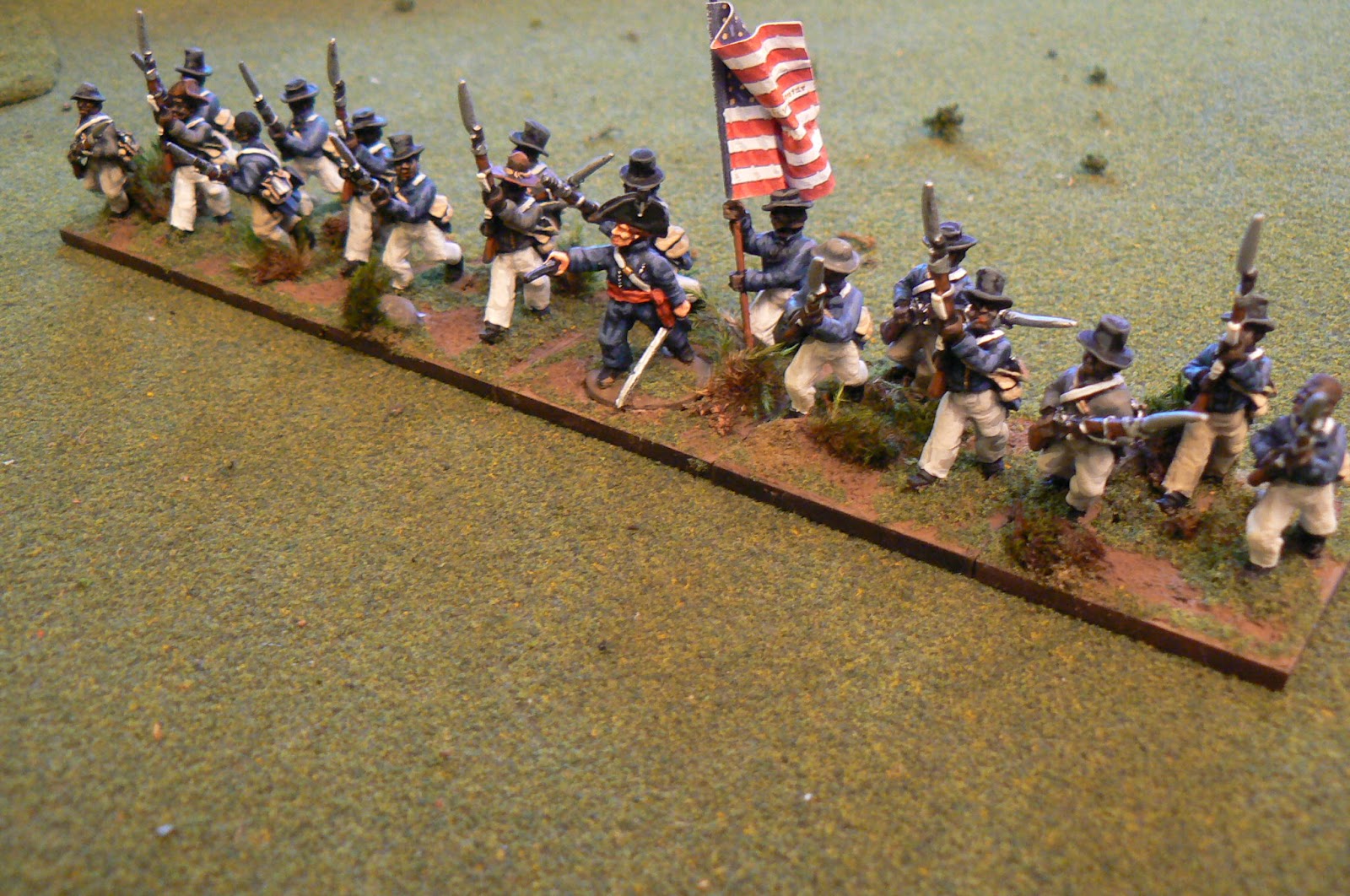
Having picked up Old Glory's pack of "Men of Color" (Why? Umm. Let's not get into the psychology of that at this time...) I obviously needed to create one of the few units of all coloreds from this war.  Lacoste's battalion fought in the New Orleans campaign (see my previous post ).  For this I used the 'better-dressed' poses from the Old Glory pack   [the others with smocks, I will use as Daquin's smaller unit of the same campaign.

Here is my finished version:


However, a lesser known unit which fought against the American invasion of Upper Canada in 1812 was 'Rauchney's Colored Corps' which contested Queenston Heights.   History: ( link)

Here is my finish version:


The astute viewer will note of course that it is indeed the same unit with a different officer which I can substitute either with the blue coated officer and placing of an American flag or a red coated officer and the Union Jack.

The officers are placed on pennies with a sabot set up:

The placing on the pennies turned out to be more elaborate than I had anticipated as the Old Glory based were so thick and when placed on the pennies put them as giants with the rank and file.  Thus I removed the bases and placed them in 'green stuff' to create the ground work.  However much faster than painting up another unit, eh.


Tuesday, 20 November 2012

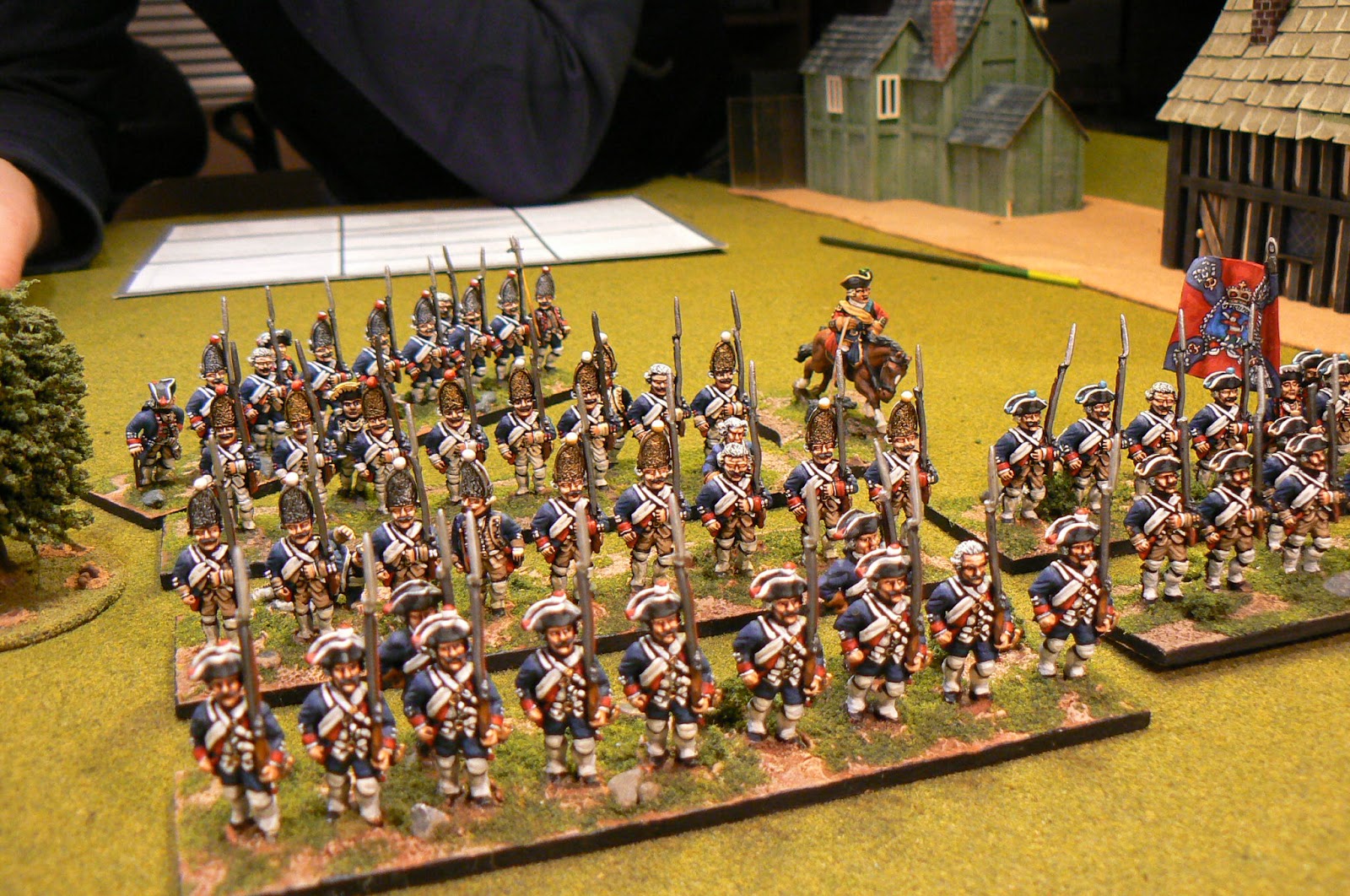
an SYW "Battle of Bunker Hill"

Another Monday Night game at Francis'.   He wanted another Shako game so I said I would come up with the scenario.  The usual for those boys is 15mm Napoleonics but I wanted to see if Shako would handle my SYW basing and a tough scenario of Bunker Hill!
This battle of the American War of Independence/ Revolutionary War (take your choice), has been on my 'bucket list' of scenarios to play.  SYW troops?  Yeah, close enough.....

The Brunswickers (i.e. the Americans)  were given 10 units in total, 4 as a division in the redoubt on the hill along with a stationary artillery piece (facing the wrong way it turned out), three units forming a division along the fence with one of its units in reserve off table. The reserve was to only come on if a double is thrown with 2d6.  This was to portray the reluctance of many of the militia men to join the defenders through the artillery rounds tossed by the British ships in the harbor.  Of course, Francis "Mr. Dice King" (that is the polite version - he was called other rather more impolite names at the table) rolled the necessary double on his first try and on they came.

To portray the snipers in Charles Town, I gave the Brunswickers/Americans a skirmish unit within the town.  The British historically fired upon the town, starting blazes which forced them out.  I gave the Hessians and Hanoverians which comprised the historical British forces 6 rounds of off-board artillery which was used could have used thus, or to damage the Brunswick/American off-table reserves, but they choose to cannonade the redoubt and roll a darn 6 EACH time for three consecutive turns!  Lost a unit with that.
The Brunswicker officers happy with the troops deployment the moments before the cannonballs start raining down on them.

Kev's Hessians, which made up the first wave of the "British" landings with half of the 12 regular and elite units , massed to move around the backside of the hill/redoubt.  His lone skirmish unit fired upon Francis' skirmish unit and rolled a 6 destroying its target. At the same time Francis (pulling another 6 out of his arse) did likewise!
  Well, we don't have to go through that phase of the turn chart anymore.

Francis moved his units from the fence line, got a few turns moves toward Dave's side of the board when Dave finally rolled the required double and 'landed', moving his 6 units of red-coated Hanoverians (also playing as British) in a great line.  Francis stated: "I wouldn't have moved up if I thought he would have THAT much".  Personally, I was happy as a scenario designer.  Players shouldn't know all.  I didn't tell him what would oppose us (and he actually didn't ask either).

Well, as Kev moved around the hill and my musket fire into his units as they filed past proved totally ineffective  ( lots of sixes were being rolled by every one...except me of course!) Dave directly assaulted the redoubt. One of my militia quality units gainly threw back a couple of assaults but could not hold forever and with divisional morale now demoralized, no reserves, and Kev directly in the rear, the units were lost (surrendered). 

My Brunswick troops happy to be in the redoubt
a look at my Brunswickers under Francis' control (standing in as Stark's command in the actual Bunker Hill battle)
The Hessians advance


Dave's Red-coats (Hanoverians) in the great line. One of Francis' Brunswick units already moving back!
German artillery.  'Beer. Never fire without it.' (yes, yes, the model is not correct for the era)
The assault up the hill. The redoubt was taken after a few more turns.


Wednesday, 14 November 2012

a Monday Night Game - 'Shako' 15mm

Went to Francis' Monday Night gaming session for a 'Shako' affair as he readies himself with practice on the rules.  The White Rock boys are having the big Borodino game in a week or so and they think he is a dice god (he does seem to roll extremely well at times!) so he has a lot of pressure to do well.  It would seem he is tasked with commanding the Grand Armee heavy cavalry - the ones who historically assaulted and took the redoubts - and so is expected to recreate this feat.
Personally I think it is good tactics and knowing how the rules work and his intelligence that is the true key to his tabletop success.  But perhaps when he can actually verbally dictate which dice numbers he or his opponent should get (!) or his ability to get 6s at the best times earns him comments like "Francis, you are a f***ing c**t!"  ,that he is best known.

I haven't played 'Shako' for quite some time, but I seemed to remember most of the key points during the game.  While Francis would play GM and set up the simple scenario;   "Doug, see this chit? Yes, this one on the far side of the table and behind all this large Russian army?  That is your objective and victory condition."
  I commanded my Polish army while Dave set up the Russians; the almost as large as my army, Russians. Well, who said war was fair.  Dave as defender set up first and with very good scouting (apparently!) I knew his exact deployment (other than where his Cossacks would appear and when).  He stretched out his army thinly along the whole line of the table so I ignored one flank, used one command to go up the middle and the other infantry force with my light horse lancers to overwhelm his left flank and so hoping to collapse his line.  It would have worked but time ran out and with one less unit eliminated and still holding the 'chit', Dave claimed victory.

my 15mm Poles advance
the middle units are in white uniforms as the Polish 13th Infantry Regt.  Ex- Austrian attire apparently.
"The General's eye view"


Thursday, 8 November 2012

Battle of Sans Ile (fictional solo game) War of 1812

Battle of Sans Ile  (fictional solo game) War of 1812.  November 7, 1812

"God-d*mnit General, I want a diversion for the main landing across the St. Lawrence and I want it here!!", screamed the  Commander, his finger pointing at a small dot named "Landing de Merde" . 
"But sir..." , the General managed to get out before the Commander cut him off.
"But nothing, General!" , the commander's red face from anger and drink irrupted.
"Yes, sir" the General stated while saluting and then walked out into the miserable weather.  Too few boats, he thought and pilots and experienced crews.  I could never hope to get enough regiments across before the British hit us. Perhaps they will be caught off guard. But not likely. Lots of bluster and dreams but little preparation by this commander. 


Thus, the scenario has the Americans coming piecemeal on a small landing on the north bank of the St. Lawrence.  I began the battle with the advance guard of US Riflemen already landed.
The US Rifles and my dismounted General telling them not to go "that way!" The General is a conversion I made.  See: post

 Each subsequent regiment would land on the turn when 2d6 turned up doubles. (this was the case for the British reinforcements also).  Originally facing the Americans were pickets of the Voltigeurs, a French-Canadien light infantry unit,  guarding the east road and two small units of Lower Canadian Sedentary Militia coming across the west bridge.
my Lower Canadian Sedentary Militia, by employing French and Indian War Quebec militia in capots.  Very similar.  I placed in British officers to make them more "1812-ish"
The officers of these units, unused to command in the field, fretted about.
(I rolled a 1 for 'Orders' and for disruption. If a 1 was rolled for the random movement, this added to the disruption. Going THAT slow must be for SOME disrupting reason!  This poor rolling was to affect many units in this battle. Veteran units will be less affected, poor units more unlikely to recover.)

The American Rifles continued their probe up the west road when finally arriving at the fence line to face the militia while under ineffective artillery battery deployed in a rare opening through the heavy vegetation of the slough.  The militiamen's will then collapsed, in part it was said because one of the officers were leading them to the cemetery(!) (and my dice rolls!) and both routed back across the bridge.  But as they crossed the first of the British regiments, the 89th Foot, arrived pushing the militia out of the way. Right behind, was the de Meuron Foot (a 'Swiss' unit of the British army) coming with veteran efficiency and they quickly formed to right and left of the bridge putting the Rifles in crossfire.
The British 'de Meuron' Regiment of Foot on the bridge. Did the unit just for the colorful flag! This formation was involved in the 1814 Plattsburg campaign.

The US 16th Infantry.  It wore black tunics for much of the war.  I wanted to paint it in lieu of doing Napoleonic era Brunswickers!
Meanwhile the 16th US managed to land and move tentatively up the road to support the Rifles.   The regimental records have the colonel ordering the advance. However the officers and sergeants with proper intent to redress instead, caused some confusion and the unit retired slightly to the rear.  [ I 'ordered' the unit to advance but then noticed the forgotten 2 disorder points  which had the effect, with a poor roll {again!}, to have the unit back up according to my "Order Chart".  It would have been better in the circumstances to have the unit redress the ranks and eliminate some of the disorder points. While this 'history' is contrived, it does give the solo game fun to justify the dice!]

British artillery

By this time, the US 28th Regiment had landed but was quite disorganized by its move toward the action and taking hits from effective long range artillery fire and thus finally routing back to the landing. 

While the US 16th together with the Rifles were making a valiant stand, more British reinforcements made their way to the battlefield, as the 104th Foot arrived (this veteran unit never made a shot in anger as it continued to try to force the American flank, advancing all the while in march column without the opportunity to come to grips!) 

Behind the US 16th, the panic stricken mass of the US 28th finally reached the landing area only to come under fire from the Voltigeurs skirmishers.   Into this, the US 17th Regiment arrived on shore, moving passed those soldiers looking for a way on board the boats.  Frightened soldiers grabbed at oars and waded into the deep strong water of the river to gain space in the returning boats. Confusion reigned and the US 17th, a newly-trained unit was much disorganized by all this.  However disorganized they gainfully charged the skirmishers who retired in haste losing half their number back to the north bridge and were done as an effective unit this day.
The US 17th advance upon the Voltigeurs in the background as the US 28th mill about in confusion.  The 'cannonballs' marker show the disorder points
The 17th did not pursue the Voltigeurs but moved west to support the main force.  But this main force was already in trouble. With three full British veteran regiments in the field, the Americans were outgunned and the line started to collapse with the US 16th and Rifles falling back under steady musket fire. (the British artillery, now masked, was slowly repositioning)

The 89th perhaps angered or wanting to be gone from the cemetery, then made a large sweep forward overwhelming the 16th in close combat and having that unit, together with the General accompanying it, surrender en mass.  Continuing the charge, the 89th Foot then collided with the line of Riflemen who had just briefly rallied but who also joined the mad rush of Americans to the dubious safety of the landing. 


The 89th Foot in the cemetery I built for the historic Lundy's Lane battle
The aggressive 89th Foot, as a veteran unit, shrugged off any disorder and continued its advance smashing into the US 17th which also fell apart.  Thus all the American units had collapsed.   And with all hope of meaningful reinforcements or a way home abandoned, the wholesale surrender began.  

Against only under 100 casualties, the Americans suffered some 200 casualties with over 1000 captured including the American General.
As the General was graciously given a horse and led away, he remembered the tirade by the commander who interrupted him off before he could say. "But sir,... .....that is an island.  If the British block the bridges, as surely they will, we will have no where to go, no way to retreat.  Our force can only come piecemeal, and only by luck cross the river, as you have all the boats.  Yes, sir, we must win to get off the island, but if the British outnumber us in strength, what then?"
But he knew, the commander would not have tolerated such talk anyway. With different luck, different throws of the disorder, the whole affair would be much affected.  That is the fog of war and the story of the wargame.