Thursday, 17 March 2016

Russian church, painted

Guilt hit me like a fist as I took a step back from the architectural nightmare I just painted.  All wrong. In my defence, it did not spend much detailed effort on the affair, knowing it ain't going to be true in any event. Serves me right starting by using a toilet roll tube as a support, eh?  However I guess I have seen worse on the tabletop without much discourse.   However, for me the "good scale" of it to the miniatures is actually a bit large for the ground scale.  If I have time I might do the actual Borodino Church.
my newly painted Russian Life Guard Jagers march past

Wednesday, 16 March 2016

WW1 air game...shot down again...

I like airgames but my piloting skill, frankly, is poor.   My luck also is in short supply.

Case in point.  I am flying around in my new SPAD which I bought.  There were two of us Frenchies vs three Boche.  Should be enough, oui?  No one was getting much success and most of the game was just flying around.  Yeah OK I did get early hits putting "DaveCoke"'s plane on fire - but he put it out.  Everyone was still in the fight. But later, DaveMc, my wing man, decided his damage was too much and scarpered.  The very next turn I ended up in the sights of ALL three German planes!

I was shot down.
Again.
Like always.
Sigh.


Tuesday, 8 March 2016

Not quite the Borodino Church...

Along with all the painting, I decided on making models of the villages in the battlefield of Borodino ( Bo-rrrrod-knee-o) rather than again constructing paper models. Almost as light, and I could not find any paper buildings I really liked and.... I had this dome...

Let me explain.  About 30 years ago, the vodka maker Smirnoff added for promotion a large plastic Christmas ornament to the top of their bottles in a shape of a onion shaped Orthodox church roof top.  Very cool.  I have kept the thing throughout all my moves, knowing one day I would make a church for it.  Romantic, no?  ( hey, who ever said "wargamer crazy" please refrain from further comments please!)

 I am so far enjoying the building.  My wife says, "Why not a real fence, then if you like building out of wood so much? ".   But she obviously does not know how I go about making these models.  No plans or even thought to it.  Just a few pictures for inspiration and a whole lot of improvisation along the way.  I use many thoughts like: "hmm, if I just fit in another half piece" or "Oops, I guess I'll need to cover that gap by gluing in a extra length" using whatever pieces and foam core sheets and bits I have.

a picture of the early work:
Obviously no architectural engineers were employed. With foam core walls, tongue depressor roof, and an empty toilet paper roll holding up the dome you understand why......

The famous church at Borodino is a fine example of Russian Orthodox Church architecture.  But this ain't it.... but I plan to use it to represent the village of Borodino in our upcoming game when though it is vastly oversized for the battlefield/gametable scale.

Again I must insist that all architects, structural engineers, construction contractors, historical designers and all real builders among you, do not comment or even breath heavily through your nose about the rather dubious style of the model please.  ( that includes you in the back row looking mournfully at the blueprints )

stage two of construction:
Overhang roof and some siding still to be added. 

stage three of the construction:
These few railing columns I have had for over thirty years!   I just knew I would have the perfect use for them someday.....


final primer before painting:


Sunday, 28 February 2016

The Russian army is assembling....

( I wonder if the CIA spy-detection super computer picked up the title and flagged it ? .... )

Anyway,  I finally completed the first two of my infantry corps for the upcoming Borodino battle.  With a ~2000/base ratio, a corps does not amount to that many figures but does look fine on the tabletop.

I painted all the figures in rather large groups according to same pose then mixed them per base. Thus glued, then I painted on the appropriate shoulder board color and attached the correct flag for each regiment representing some which were in each corps' divisional OOB.  The proportions of grenadiers to line to jagers are as close as possible given the large ratio.

One might note that I decided to have my jagers in march order than indeed skirmishing.  If I expand my Russian army ( yeah, it might NOT happen...)  then I have some modified OG models (running at full sprint!) to fulfill those lights elements; but the plastics are lighter in weight.

The 8th Corps under Borozdin:
4 grenadiers, 2 line, 1 jager, 1 artillery and the commander
I found flags for enough regiments to have all with standard bearers (except the jagers which did not carry)


The 4th Corps under Tolstoi:
1 grenadier, 3 line, 1 jager, 1 artillery and the commander
In this case, I had but one standard bearer left and so added the colonel's colour. The other 'command figures' (drummers, officers ) were spread out among the remaining units.  If not enough, they did not get one at all.  A quick view of the mass does not make this evident lack obvious and I think it not worth it to buy the extra sprue or command pack to make it so.

Speaking of the Russian jagers, they can be represented by the usual line troops as they were identical but for their black belts and green facings. (among other minor details)

Only two of the seven infantry corps for the game.  I have one more infantry corps to do: Lavrov's 5th Corps -- and a few cavalry corps --- but the remaining will be completed by other players for the battle and thus they will have the exciting task of commanding their own figures in the game.


Thursday, 25 February 2016

A rare military force - Swedes in the late Napoleonic wars

Sweden had an interesting place among the Allies fighting Napoleon in 1813.  It's king and army commander Bernadotte (ex-French General under Napoleon...long story that) was very keen, it would appear, to keep the Swedes near the action but not in the action.  Thus, outside of very minor engagements,  the only Swedish units to gain action in a major engagement was the Mornerska Hussars and a small horse battery at the Battle of Dennewitz. (and please correct me if I am wrong)
Leipzig might (?) be the only other battle but I think more only of a support role.


I had still a few bits and pieces from all the boxes of Perry plastics (every nation luckily has a hussar unit or two).  While I had one horse with the pointed saddle cloth on which the distinctive 'wolfs-tooth' design could be painted, the other horses were modified to a more campaign look. The one thing I was missing was sword arms.  I simply had ran out of them.  But I thought, were not the Swedes the 'neutrals' of the world?  Going into combat without a sword in the hand would be appropriate, no?  So arms were found from other sources and scabbarded swords were collected(ex for trumpeters and at one per box I am 'lucky' to have bought three boxes! )The Swedes were a bit behind in the military sartorial department so were still wearing the old mirliton headdress, colourful as that is.


......and how is NASA's lunar program like my wargaming hobby?  Spend loads of money, countless years of research, spend lots of effort to get to the moon/ collect a unit , then never to go back/ put in a box!

Monday, 15 February 2016

Sneak Preview

I am currently painting Russians for the Battle of Borodino game.  Awaiting to complete the Jager units but looking to get the line units all "terrained" up.   Yesterday glued on the line units onto the bases when I had a few minutes.  I show a couple pictures to demonstrate how I do the terrain work.
close up of one of the completed bases with die frame and blank space for a label. For these I don't do a lot of 'shrubbery' as the mats are plain and I want the stands to blend in.


and under the nice lighting of the game hall showing, hopefully, the bases blend into the mat 'ground' in spite of the practical thick bases (to pick up and move the fragile plastics rather than by the miniatures)
A tutorial is at  link   .  The technique is quite simple but I hope effective to give a pleasing image of pastoral field cover and to blend in with the mats I use.

The initial start of the putty cover.   Note the painters tape to cover the label area.  Also the edge of the flag needs to be painted so it doesn't look so paper-y.


Saturday, 13 February 2016

Napoleonic era Neapolitans

In my continuing mania to do every d*mned unit of the Napoleonic wars... or it would seem... I had some miscellaneous Victrix leftovers in the pre-1812 uniform but only a few. These are perhaps not appropriate for the French units for the late war 1813-15 campaigns, which are my focus,  but which were still worn by some French allies, including Neapolitans.  Thus I could create the skirmishing infantry of the 4th Light Regiment which did service during the 1813 campaign.

Of interest is the flag which I hand-painted some 20+ years ago (!) which I kept, having sold the army but still liking the design ( yeah yeah wrong inscription but still ...)

  The all-light blue uniform is attractive way to fight the hordes of Allies during the autumn campaign of 1813.

Saturday, 6 February 2016

Battle of Dennewitz 1813 game

I carried in two hockey equipment bags, fairly light-weight, the terrain and figures (thankfully mostly plastic!) to the club's monthly meet to set up the historical Napoleonic battle of Dennewitz.  The scenario has the French (with Napoleon away to the south) moving toward Berlin with the Prussians counterattacking.

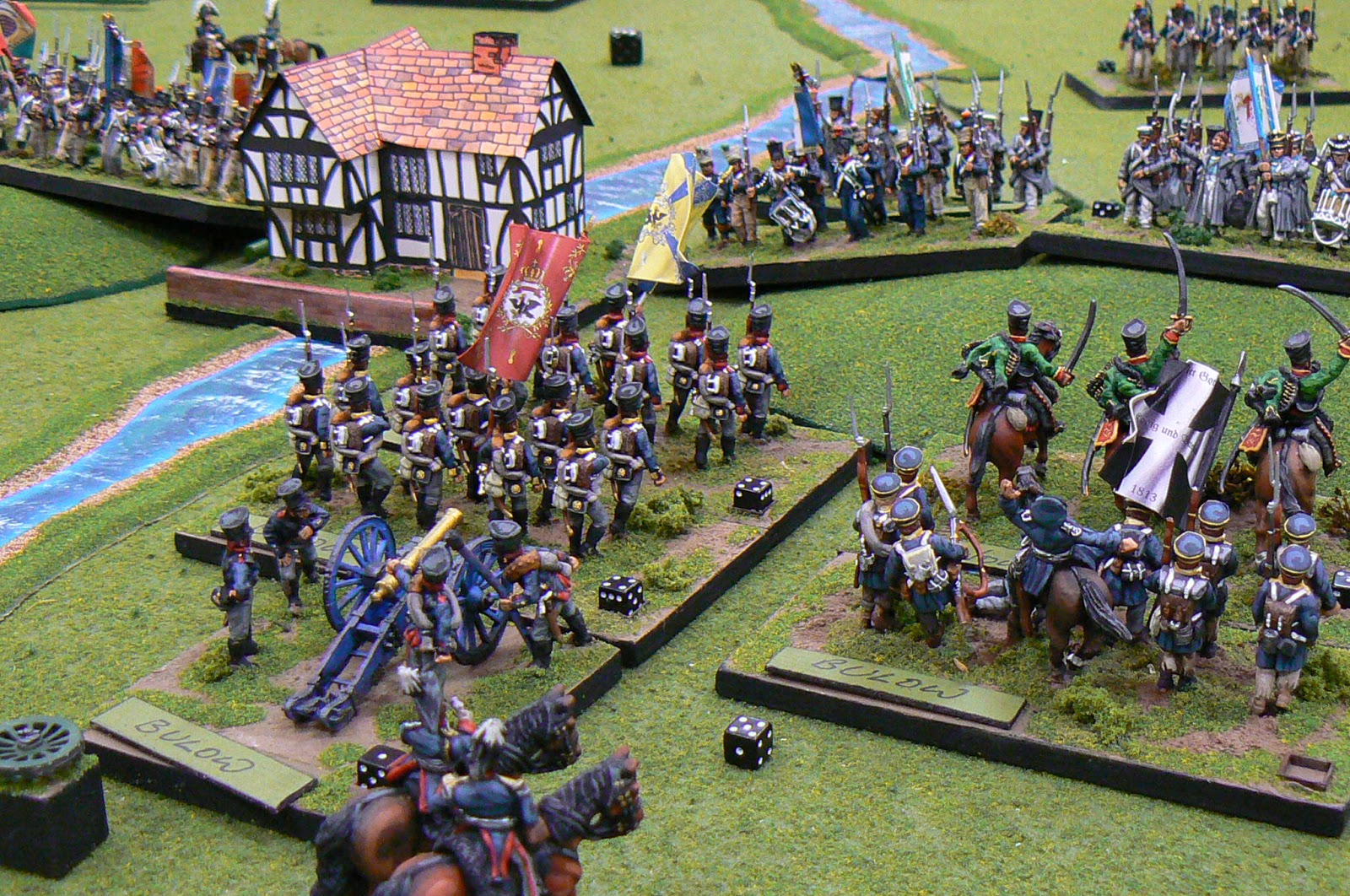
Bertrand's corps was caught across the muddy Ahebach stream with the rest of the French strung out behind him.  I decided on placing the commands in roughly mid-battle positions with the players allowed to place their elements anywhere within the rather large command radius;  even allowing contact within the first turn should they wish. Game on.  (but the players generally followed the rather more discrete course)
'Crunch time' approaches

Even on a small 8 by 6 foot table, lots of space is still available to keep reserves out of harm's way until needed (hint, hint)

JimF's French Bertrand's Corps plunked itself on the hill north of Dennewitz and followed a cautious defensive stance while DennisC's Tauentzien's and Thumen's forces moved slowly to confront them.
The Prussian artillery concentration. A careful observation will note a Russian gun as some Prussian forces historically were aided with Russian artillery batteries.

To the south, the smaller commands of Oppen, Bulow (as Homburg-Hesse) and Krafft all under MikeB's guidance, went full tilt into the French (and their guns!)  As Dennis did in the north, the French commands of PeterM's Reynier Corps and KevinA's Oudinot's combined artillery to concentrate their fire - rather effectively from early large number of high dice rolls ! - to much weaken the Prussian assaults.   Eventually Oppen's command collapsed which allowed Oudinot to swing against the flank of Borstell.
Borstell's forces included a Swedish cavalry continent of hussars.
The battlefield looking to the north.  Dennewitz is the tudor styled house above the hand.  Bertrand's Corps in on the north side of the stream, Reynier's are being pointed to by the hand while Arrighi's small cavalry corps are in reserve behind. Gohlsdorf village is represented by the house on the left.  Oudinot is off camera to the south (left).
Poles and Wuerttembergers are among the nations which formed a large part of Napoleon's forces in 1813 
1813 Wuerttemburgers made from modified Perry Austrians and heavily altered shakos, lead Bertrand's defensive stance.
Saxons of Bertrand's Corps.  Modified French style plastics most with trimmed Prussian shakos but some with Russian forage caps or 1809 shakos which are close to the Saxon uniform at the time.

With the Prussians forces strength waining and the French still holding the strong hill positions north and south of Dennewitz; and the player's seeing that the Command Morale Chart was not to be toyed with ( grin ) the Prussians ordered their withdrawal.

Not a historical outcome of course.  It is harder for the attacker to use their artillery effectively as it takes a patient command process to allow the artillery to set up, time to soften up the enemy and finally to organize the infantry and cavalry attacks.  The players, while all experienced wargamers and all having played at least one of my games and rules, still fall to the excitement and tend to charge forthwith.

The post-game analysis had some discussion about tactics and while related to the rules of course, (taken advantage of?) these were more tactical for historical play rather than holes in the rules.

 The players seemed to like the scenario saying they still had maneuver space even if the forces were close to each other.   Not bad to have a large Napoleonic battle of 28mm on a 8 x 6' table.  I will downgrade the French forces a bit for playability.   At this point of the war, their units were understrength and tired and but find themselves in good defensive positions.

I will put on the game again at the big Salute convention mainly as I have put some effort in the organization and labelling and, more importantly,  have everything already packed!


French hussars in late war uniform

Wednesday, 3 February 2016

Uvanov's Cavalry "Corps"

Painting for a good time, not a long time.
With this in mind, the large ratio for our Napoleonic games has one to paint a mere three horsemen to represent a whole brigade of cavalry.  Surprisingly it looks good on the tabletop and allows us to play most of the larger of the Napoleonic battles in 28mm on the usual convention sized table (usually 9' by 6'or less) .

Many of the guys who have played these games in the past are excited enough to now collect a "corps" or two for the cause, as we are preparing to do the large Battle of Borodino in May.  One of the Russian formations which I volunteered to complete is Uvanov's Cavalry Corps, positioned on the right flank of the Russian army and were sent along with Platov's Cossacks to rampage against the French left.  I represent this formation with two elements of hussars: the Russian LifeGuard Hussars and the Elizabetgrad Hussar Regiment picked among the several regiments within.

The figures use plastic Fireforge medieval horses with added saddle rolls to give the troopers the campaign look and, frankly, to coverup the slight gap between the horse and the plastic Perry riders who themselves are a conglomerate of miscellaneous bits and pieces of French and British hussars with Russian heads. Some of the Russian hussars historically may have carried lances for which I used French standards with the eagle cut off and pennons added. I used these as I ran out of sword arms!


Sunday, 31 January 2016

A rare wargame...

Over the holidays, bored during winter power outages and on those rainy grey weekends, my wife liked to enjoy a nice game of Scrabble.  I am to her as the opponents of the Harlem Globetrotters.  You know, the guys they maneuver around without mercy.  I am not particularly good at the game and so am thrilled to play a 12 point word while she routinely places the 'z' on the triple letter.

She surprised me today by saying "You want to play a wargame, instead?"
I hardly needed to fake a heart attack.

I chose my French and Indian Wars game as she might relate to it as she enjoys the "Last of the Mohicans" movie.  She picked the French as she said, "then I can affect a silly French accent!"

The quick scenario was for the New Jersey Regiment of Provincials to escort a wagon of whiskey (yes, my scenarios always seem to involve the wagon of booze...) to the fort defended by a few New York Independent companies while the French allied natives and a few French-Canadien militia try to prevent the delivery and capture the wagon.

The terrain of all forest favoured the Natives as the Provincials feared the deep woods.  While the French commander had little idea of deployment in the forest (her military background that only being married to the General du Maison)  but slowly understood the situation and had her forces finally defeat the provincials and abscond with their prize.


The natives halt the Provincials advance.  The length of stick is a set measure of 6".  All troops types move at either 4, 6 or 9" depending on their location.  Part of the simplicity of the rules, based roughly on the DBA model.
This element of Provincials and Quebec militia continued an uneven shooting duel across the creek for the entire battle.

'Conquest' figures (now 'Warlord') 
the capture of the unguarded wagon.

Saturday, 16 January 2016

ACW - the fight of Forney's Field

Free to play at the club's game night at Bonsor,  I joined in Dennis' 20mm ACW scenario which  replicates part of the first day fighting of the Battle of Gettysburg.

My painted boys with the Irish flag added by Dennis.  Of course they continued to hold the wall throughout this game....


map link

Note the yellow stars which indicate "battle objectives"  Now I understand the trademark of Dennis's games -- lightbulb moment!  

He play-tested the scenario and Cutler's brigade quickly collapsed.  Indicating I don't mind if he gave me the "disaster command" I was given these regiments.  In this game however while I did get pushed back,  the Confederate forces could not recover from the combat along the woods so gave me a couple turns to make the right die rolls to get rid of my shaken status.
The yellow star corresponds to the star in the middle of Baxter's command.  Carter's Confederates line the wall.

Meanwhile, the two other Reb commands were making trouble for my counterpart on the other side of the Union's chevron shaped defensive position.  Eventually we were to have limited success holding off the steady deliberate Southern attacks.  The Union reinforcements were scheduled to come on shortly which probably would stabilize the situation for us Northerners.
"Rebs to the left, Rebs to the right...."

the scene of O'Neal's Reb command (see map) advancing.  

For the second time in a many games in which others hosted, I got to play with figures I painted;  in this case the 20mm ACW of Dennis's collection.  Nice to see the boys put to good use!

Thursday, 14 January 2016

Inspiration many years ago.....

  I wish I had realized many years ago that my collecting had much do with my very youthful early inspirations.  Movies such as Zulu for my continued interest in colonial South Africa; Cromwell for my inevitable collecting of English Civil War material; and Waterloo for Napoleonics.

Also the Grant book “The War Game” for which I have for 40 years now and one of my first war game references. I show you the book version of the Austerlitz battle and my own.  I did not intentionally draw this comparison but rather came to it in a flashbulb moment looking at the table of a game I recently played.  recent post


Tuesday, 12 January 2016

Napoleonic Poles vs British?? 15mm fictional battle

Can't resist playing in any Napoleonics game... actually, any miniatures game.  Monday's affair was set up with a nice map for each side and even off-table troops!  Francis brought out the Poles - all of whom I painted and subsequently sold to him last year and his British - some of which I also painted - to defend a hill position.
My old Old Glory 15mm Polish.  The white clad units are the Polish 13th Infantry Regiment who were distinctive from the dark blue uniformed units of the rest of the infantry.  Staring at this photo I realized perhaps why I sold these as the poses are rather strange, looking as they are of running into hurricane strength winds?  

With Kev holding the right flank, our plan was simple as we had the defend orders. I plunked down on the hill and awaited the inevitable charge up the gut by DaveMc., while Kev had to deal with Francis' onslaught.
Francis lining up artillery fire on Kev's British.  My position is in the foreground with the red coat Marines on the hill.

With woods covering my left and centre, with a skirmish unit within to act as a tripwire, I deployed my artillery in front of the hill knowing DaveMc will aim right at them and so soften him up.  Kev had the same idea and so we lobbed shot after shot/dice into the mass of Dave's Poles and rolled very poorly.  Not one shot hit!   Not one.

The loyal allies of Napoleon then overran my artillery - not that I cared at that point as they could not hit anything anyway so no big loss! ~grin~.  However my steady British Marines stopped their advance with a volley and counter-attack throwing them off the hill.  The units of my left then formed columns to quickly swing inward to complete the disintegration of DaveMc's division.
The Poles charging to be repulsed by the steady (from the dice anyway) Marines.  All these 15mm were painted by me and in Francis' collection.

Meanwhile, Kev had to defend against Francis who is a very experienced Shako2 rules player and who gained the reinforcement of the Polish light horse brigade from off-table.  With Kev rolling rather poorly overall, outnumbered and hit in front and flank, his division collapsed.  However as I would have time to establish a defensive posture in time to meet Francis's forces, the British were given the victory.
The right flank action

Shako2 is very much a tactical game with only an overlay of grand-tactical effect (a simple divisional "arrows" indicating direction of attack).  However it does this rather well with easy to remember modifiers.

Good to see my old 15mm boys in action
A"stagger" marker.  Each nation has their own in a "national" regimental flag

Friday, 8 January 2016

Command in my GdC rules


In a previous post showing the play-test of the Austerlitz scenario,  I made references to my command morale and command control rules.  As I like everything to be indicated on the table and so I prefer markers and numbers directly on the element; avoiding written rosters and the like.

  In the following photo, I have one of the commanders - the name label can be changed for each historical battle - showing,  he has 1d6 roll for the number of command points he can employ to  maneuver each element. (this can change at random obviously and can be rationalized as due to orders being well written or not, couriers being shot or not, etc.).  The larger the command, the more pips the player will be given.

The green flag indicates he has one more step-down until a loss will lessen his command morale total indicated by the small black die which is added to his Command Morale Chart roll.  This allows large commands to be decreased at a similar rate to small ones and allows me to allocate historical numbers to each player without problems of equality for differing quantity, within the rules.

Finally, the white flag indicates his command has previously suffered a loss last turn to which the player must roll upon the dreaded Command Morale Chart.  Early losses should not affect most commands but as the losses accumulate it becomes harder not to have the formations fail to advance or to indeed forced to withdraw. Thus the petering out of the battle in a more realistic way.


The flags markers are simply green plastic toothpicks cut in half and hot glued onto plastic bases (insuring a strong bond) The flags are paper folded over and glued on. ta da.

Too many games are marred by ugly coloured markers or dice and I try to prevent that while giving a 'clean' but effective and efficient look.  At least I try.